
The 2026 state of AI in radio broadcasting: what's mature enough to put on the air today, what's still demoware, the named tools radio is actually using (Futuri's RadioGPT and TopicPulse, Radio Content Pro, ElevenLabs, Descript, Veritone, AdsWizz), and the human-vs-AI line that separates the stations gaining ground from the ones losing it.
Forget "will AI change radio." That argument is settled. The question that matters in 2026 is which AI tools are mature enough to put on the air today, which ones are still demoware, and where the line between AI assist and human judgment actually lives. Stations tell us the same thing over and over: they're not looking for moonshots, they're looking for the parts of the workflow that AI does reliably enough to free a human to do the parts AI still can't.
This is that map.
What "AI in radio" actually means (the terminology cleanup)
The trade press uses "AI" as a single word, but inside a station it lands in five very different lanes. Treating them as one category is why so many AI conversations stall out in the GM's office.
- Content generation — written prep, scripted talk breaks, social copy, web articles, newsletter copy. This is the most mature lane in 2026.
- Audio synthesis — voice cloning, voice tracking, multilingual dubbing, AI-anchored newscasts, full AI personalities. Maturity varies wildly here, and so does listener tolerance.
- Show prep and discovery — surfacing what's trending in your market, what your audience cares about right now, what's about to break. The category that quietly delivers the most leverage per dollar.
- Analytics and audience intelligence — listener behavior modeling, churn signals, sales targeting, content-performance attribution.
- Operations and ad tech — programmatic insertion, dynamic creative, ad-tag cleanup, broadcast monitoring and indexing.
When someone tells you "AI is taking over radio," ask which lane. The conversation gets useful fast. For a deeper breakdown of the two lanes that confuse stations the most, see our piece on AI radio host vs. AI show prep — knowing the difference.
What's actually mature in 2026 (the named tools, what they do, who's using them)
Here's where 2026 has earned the word "mature" — vendors with real install bases, not stage-demo screenshots.
Futuri's RadioGPT and TopicPulse
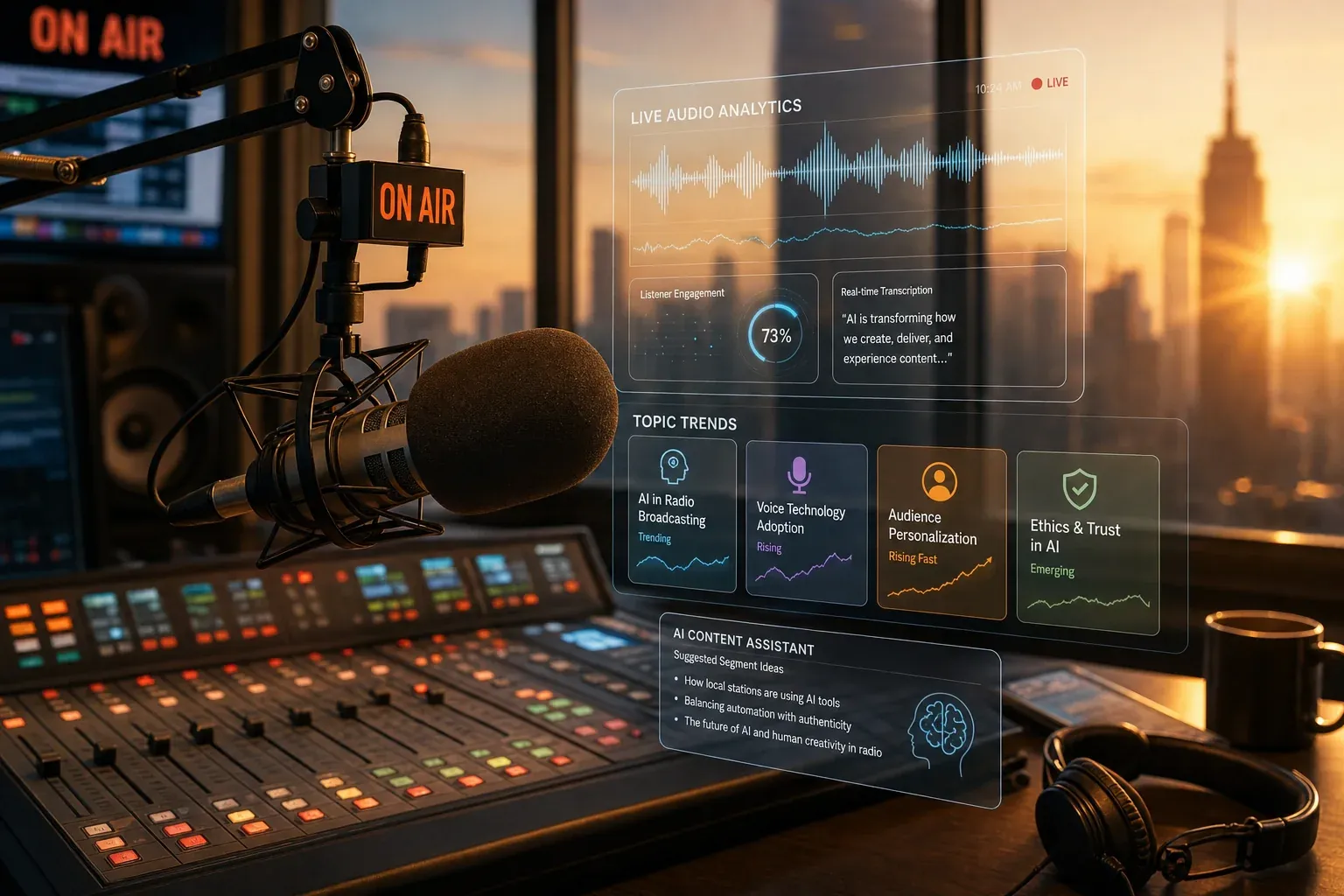
Futuri Media's RadioGPT is the flagship "AI on-air" product the trades keep writing about. Two things are true about it at once: it's the most visible AI personality system in radio, and most of the stations using it use it for parts of the day, not the whole clock. TopicPulse, Futuri's older companion product, is arguably the more important tool — it surfaces emerging topics by market in near real time and is what's actually feeding prep across hundreds of stations. If you only adopt one Futuri product in 2026, TopicPulse is doing the heavier lift.
Radio Content Pro
Radio Content Pro is the format-specific show-prep stack — daily teases, social posts, web articles, and newsletter copy, written for your specific format and your specific demo, delivered as a feed your team uses verbatim or edits in seconds. The premise is the 90/10 rule: RCP does 90% of the work, your personality adds the final 10% that makes it yours. PDs use it to give a solo morning host the prep budget of a four-person team. (See Ava Hart — RCP's AI radio personality — for what AI-assisted on-air content looks like in practice.)
ElevenLabs
ElevenLabs is the voice-synthesis layer most quietly being adopted across radio in 2026. Multilingual dubbing of long-form content, accent-true voice cloning for talent who want a backup voice on commute traffic, and one of the better text-to-speech engines for sweepers and stagers. Stations using ElevenLabs for voiceover work tend to be in two camps: small-market clusters that can't afford full-time imaging, and large-group clusters using it for Spanish-language simulcast.
Descript
Descript is post-production's quiet workhorse. Transcription, multitrack editing as a text document, filler-word removal, and "overdub" voice fixes on existing recordings. Not a real-time broadcast tool — a podcast and on-demand prep tool — but radio shops with a podcast arm are using it daily. If your morning show ships a podcast version of the show every day, Descript probably touches it.
Veritone and AdsWizz
Two operational tools that fly under the radar but matter. Veritone indexes and timestamps your broadcast — useful for sales attribution, compliance, and resurfacing on-air mentions for digital reuse. AdsWizz handles programmatic audio insertion — the dynamic ad-tech layer that makes streaming ad-revenue work at scale. These aren't sexy demos. They're the plumbing.
What this list does NOT include
You will not find an AI "tool" in 2026 that handles a hot call from a listener whose week just fell apart, that breaks news from a tornado warning with the right cadence, or that reads a room of advertisers in a sales meeting. Those are still — and for the foreseeable future — human jobs. Anyone selling you otherwise is selling 2027 promises with a 2026 invoice.
How stations are actually using AI day-to-day in 2026
The marketing decks are full of grand ideas. The Tuesday-morning reality is narrower and more practical. Five use cases have moved from "promising" to "running on the air this week" across the stations and consultants we track.
AI-drafted promo copy. The most common production-line use of AI in 2026 isn't an on-air personality — it's promo copy. Stations feed a structured prompt (format, daypart, station voice cues, a goal, a tone) and get back three to five usable scripts in under a minute. Imaging directors then edit, voice, and produce. The win isn't the writing — it's that the imaging desk gets to pick from options instead of starting at a blank page at 4:30 on a Friday afternoon.
AI-generated testimonial reads. Industry voices keep flagging this as the underrated use case: scripting the feeling of a listener talking about the station, in believable cadence, without needing the listener present. AI handles the script. A real voice (often a freelancer, sometimes a staffer) reads it. Sales teams now have testimonial-style sweepers without waiting on a fan to call back. Listeners tell stations they don't notice; the audio passes because the script was good, not because the AI was on-air.
AI-built listener personas. PDs and digital sellers are using AI to formalize the two or three listener personas a station programs to. Inputs: PPM data, social listening, sales archetypes. Output: a one-page persona document that the morning show, the digital team, and the sales floor all reference. The exercise itself — naming the personas, agreeing on them — moves the needle as much as the document does.
AI-assisted station voice development. A growing pattern in 2026: programmers using AI to formalize a Station Character Profile and a Brand Voice Bible. The model isn't writing the station's voice — it's interviewing the programmer, organizing answers, and producing a reference document the imaging team and the on-air talent can both work from. The output is the alignment, not the prose.
AI for audience growth and revenue. This is the lane where broadcasters who have not yet found ways to leverage AI are falling behind those who have. Stations using AI for newsletter copy, social engagement, contest content, and digital ad creative are reporting measurable lifts — not because AI is magic, but because their teams can finally ship enough material to test what works. The 2026 advantage isn't speed of each piece. It's volume of attempts per month.
If you read those five and think "none of those are scary," that's the point. The mature use of AI in 2026 radio is unglamorous, repeatable, and operationally boring. Boring is what gets renewed at budget time.
The hype line — what AI in radio still isn't good at
A clear-eyed view of where the tools fall short matters more than the optimistic version, because the hype version is what gets stations to make purchases they regret.
Live judgment. AI can't decide in real time whether a caller's story is too raw to air, whether a guest is about to say something that needs to be cut, or whether a sponsor's spot should be pulled because of breaking news. Those are split-second calls a human makes constantly across a four-hour show.
Audience-room reading. AI can model what an audience clicks on. It can't read the energy in a remote broadcast, sense when a sales prospect is about to close, or feel when a contest line has gone from fun to uncomfortable.
Trust-on-mic. Listeners in 2026 are getting better at hearing AI audio, not worse. Stations report that "is this a real person?" is now a regular text-line question. A station that builds its identity on an AI personality is making a bet about whether audience tolerance grows or shrinks over the next five years. The honest answer is: nobody knows yet.
Sales relationships. A local advertiser writing a $40,000 annual buy is buying a relationship as much as a schedule. AI helps the seller prep faster, surface better data, write better proposals. It does not replace the part where two humans sit in a conference room and decide if they trust each other.
The human-vs-AI line that matters
Here's the framework worth memorizing in 2026: AI handles the work that's predictable. Humans handle the work that's contextual.
- Predictable work — content that follows a known template: daily teases, social posts in a known voice, format-specific web articles, sweepers in your station voice, transcription, ad insertion logic.
- Contextual work — the live decision that hasn't happened yet: the breaking-news call, the live caller, the room read, the relationship, the editorial judgment about what not to play.
The stations gaining ground in 2026 use AI to free their humans for the contextual work. The stations losing ground use AI to replace the contextual work — and lose the part of the product their listeners actually pay attention to. For more on this for resource-constrained markets, see our piece on AI for small-market radio.
What this means for PDs and GMs right now
If you're staring at a station P&L in 2026 and trying to decide where AI helps you most, here's how the operators we work with sequence it.
Start with show prep, not on-air voices. The highest ROI move in 2026 is AI-assisted show prep — daily teases, social copy, web articles. Lowest disruption to the on-air product, highest hours-saved per week. Our AI show prep comparison walks through the leading options side by side.
Add discovery second. TopicPulse-style trend surfacing turns into better breaks within the first week. Your morning show knows what your market is talking about before the audience does.
Treat voice synthesis as a precision tool. Use it for sweepers, sponsor reads, multilingual dubs, and overnight imaging — not for replacing live personality. The economics make sense; the on-air gamble usually doesn't.
Use analytics for sales, not for replacing programmers. AI-driven listener intelligence is a powerful sales asset. It is not a programming director.
Build the human-AI ratio into your job descriptions. If you're hiring a morning host in 2026, the job description should explicitly say what AI is handling and what the host owns. Ambiguity here is why so many stations have unhappy hires within six months. Our solo-host AI tool stack is a good starting point for that conversation.
The 2026 industry context
Three external signals matter for the year ahead.
- Edison Research's Infinite Dial 2026 continues to show AM/FM radio reaching the broadest weekly audience in American audio — over 200 million Americans weekly. The "radio is dead" framing has been wrong for a decade, and the 2026 data is the latest reminder.
- The NAB Show 2026 programmed AI across two full conference tracks for the first time, and the floor felt visibly different from 2024 — fewer "AI vendors with demos" and more "AI vendors with case studies and customer lists." Read our recap in AI radio at NAB 2026.
- The largest radio groups are now publishing AI use policies, treating it the way they treated social-media policy in 2014. If you don't have one yet, you're behind your peer set — and the timing matters before your next compliance review.
For the full picture of how AI is reshaping content workflows specifically, our piece on how AI is transforming radio content creation goes deeper into the prep-and-publish side of the stack.
How to evaluate an AI vendor in 2026
The vendor landscape is noisier than it has ever been. Five questions separate signal from pitch deck.
Who is actually using this in production? Ask for a current customer list with stations you can call. Mature vendors share them. Pre-product vendors deflect.
What's the human-loop look like? Every viable AI product in radio has a human-in-the-loop somewhere. If a vendor can't draw you the workflow — including who edits, who approves, and who owns the final output — that's a tell.
What's the format and demo fit? Country, CHR, News/Talk, Spanish-language, Christian, and Urban each have different content rhythms. Tools that work in one format don't automatically work in another. Generic AI output is the single most common reason a station rips out an AI tool inside 90 days.
What's the failure mode? Ask what happens when the tool gets it wrong. A vendor that hasn't thought hard about failure modes is a vendor whose product hasn't been stress-tested. The first AI-on-air incident your station has should not be a learning moment for the vendor.
Does the price scale with usage or with value? Per-minute pricing on voice synthesis can look cheap until you actually run it across a cluster. Per-station pricing on prep tools can look expensive until you compare it to the hours-saved math. Both models are fine. The mistake is not running the math.
The PDs we work with who picked well in 2025 share a pattern: they ran a 30-day pilot with measurable success criteria written down before signing anything. The PDs who picked poorly skipped the pilot.
How RCP fits
Radio Content Pro is the show-prep slice of this stack — format-specific daily content, written for your demo, delivered at the cadence a working morning show actually uses. Daily teases your hosts can read straight off the page. Social posts your digital person doesn't have to write. Web articles your news director doesn't have to rewrite. All of it tuned to your format and your market.
We don't replace your talent. We get your talent the prep budget of a four-person team for the cost of a quarter-time intern. The 10% your personality adds is what makes the station yours — RCP just makes sure your team has time to add it.
Ready to simplify your show prep?
Try RCP free for 7 days. $0 until day 8
Frequently asked questions
What is the best AI tool for radio stations in 2026?
There isn't one tool. The stations getting real value in 2026 combine a show-prep system (Radio Content Pro or Futuri), a discovery system (TopicPulse or equivalent), a voice-synthesis layer (ElevenLabs for imaging), and an operations layer (Veritone for indexing, AdsWizz for programmatic). The common mistake is buying one product and expecting it to cover all five lanes of the workflow.
Is AI going to replace radio hosts?
In 2026, no — and the stations that have tried to replace hosts wholesale are reporting audience pushback, not gains. AI is excellent at the predictable parts of a host's workflow (prep, social copy, web articles, sweepers). It is not yet ready for the contextual parts (live calls, breaking news, room reads, sales relationships). The realistic 2026 model is human-fronted, AI-supported.
What does Futuri's RadioGPT actually do?
RadioGPT is Futuri's AI-anchored content and on-air system. In 2026 it's most commonly used for parts of dayparts — overnights, voice-tracked shifts, multi-market clusters — rather than full-time live programming. Its older companion product, TopicPulse, is the trend-discovery layer that most stations get more daily value from.
How is Radio Content Pro different from RadioGPT?
Radio Content Pro is format-specific show prep — daily teases, social copy, web articles, newsletter copy — delivered to your team for human personalities to use on-air. RadioGPT is an AI-anchor product where the AI itself runs the on-air content. They solve different problems, and the smartest stations using both keep RadioGPT for off-peak content while using RCP to give their live morning show more reps per hour.
What's the safest place for a station to start with AI?
Show prep. Lowest risk, highest hours saved per week, no on-air audibility change. From there, add a discovery layer (TopicPulse), then a voice-synthesis layer for imaging and sweepers, then operational tooling like Veritone and AdsWizz. The stations that try to start at audio synthesis or full-time AI on-air tend to spend the first year fixing what they broke.
What AI tools are radio stations actually using in 2026?
The most common stack we see in 2026 mixes Radio Content Pro for format-specific show prep, Futuri's TopicPulse for market-level topic discovery, ElevenLabs for sweepers and multilingual imaging, Descript for podcast and on-demand post-production, and Veritone or AdsWizz for the broadcast-and-ad-tech operational layer. Almost no station runs all of them. Most run two or three, picked deliberately, and treat the others as future state.