
When the National Association of Broadcasters puts AI front and center at its biggest annual event, it's not a signal that the future is coming. It's a signal that the future showed up, found a seat, and is now asking about the Wi-Fi password.
NAB Show 2026 — running April 18-22 in Las Vegas — has done something that should get every radio professional's attention: it moved AI out of the "emerging trends" track and into the operations track. The Small and Medium Market Radio Forum is opening with an AI panel. The Broadcast Management and Monetization Conference has an AI-centric session. And the overall show theme spotlights AI alongside streaming, sports innovation, and cloud-based workflows.
This isn't theoretical anymore. The industry's most important conference is treating AI as operational infrastructure — something you manage and optimize, not something you debate adopting.
Here's what that shift means for your station, your content workflow, and the future of show prep.
What NAB Show 2026 Is Putting on the Table
The most telling detail about NAB's 2026 programming isn't that AI is on the agenda. It's where AI is on the agenda.
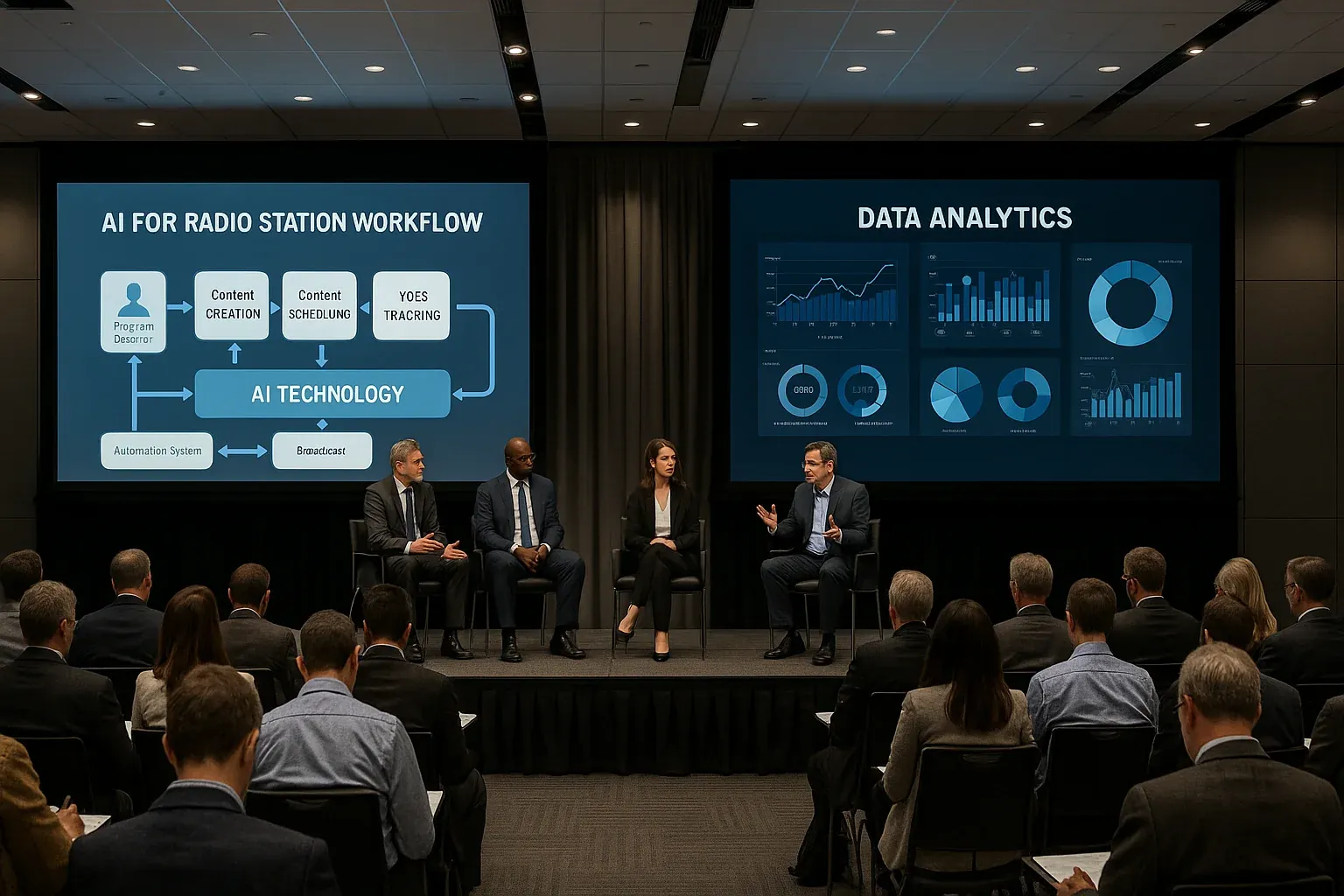
The Small and Medium Market Radio Forum — set for Sunday, April 19, from 2-6pm in North Hall — is opening with a dedicated AI panel. Not tucked into a breakout session. Not sandwiched between sales presentations. It's the lead. The conversation starter. The thing NAB thinks matters most for markets 51 and beyond.
The panel is moderated by Julie Koehn and features Townsquare Media SVP of Digital Products Sun Sachs alongside communications attorney David Oxenford of Wilkinson Barker Knauer LLP. That pairing tells you everything about where AI in radio stands right now: a digital product leader explaining what's possible, and a media attorney explaining what's permissible. The industry is building tools and guardrails at the same time.
The focus areas — programming, station workflows, and revenue generation — aren't futuristic. They're Tuesday. These are the operational problems every station faces, and NAB is saying AI belongs in that conversation now, not in five years.
After the panel, the forum shifts into peer-driven roundtables covering programming development, digital sales, audience growth, and operational strategy. And over in the Broadcast Management and Monetization Conference, WTOP's John Wordock leads a session on the evolving roles of video, podcasting, and artificial intelligence in broadcast operations.
The Three AI Shifts NAB Is Signaling
Read between the lines of NAB's session lineup, and three clear signals emerge about where AI in radio is headed.
Shift 1: From Experiment to Infrastructure
Two years ago, NAB sessions about AI were in the "what if" category — speculative panels about a distant future. This year, they're in the "how to" category. That's not a subtle difference. It means the industry has crossed the adoption threshold.
The World Radio Day 2026 theme confirmed this trajectory: "Radio and Artificial Intelligence" — with the explicit emphasis that AI is a tool to support broadcasters, not replace the human connection that makes radio matter. The ITU framed it as "AI-ready radio moves from channels to conversations."
When both the global regulatory body and the national trade organization treat AI as a current operational reality rather than a future possibility, the debate about whether to adopt is over. The only question is how.
Shift 2: Small Market Access Is Here
Here's what should excite — or concern — you, depending on your perspective: NAB didn't put the AI session in the main conference hall aimed at iHeart and Cumulus executives. They put it in the Small and Medium Market Radio Forum for markets 51 and beyond.
That's significant. It means AI tools have reached the price point, the simplicity, and the practical value where a station in market 142 can use them just as effectively as a station in market 3. The technology gap that used to separate major market stations from everyone else is closing fast.
Enterprise solutions like Futuri's TopicPulse still exist for stations that want to scan 250,000 news sources. But tools built for real radio workflows — accessible, format-specific, and ready out of the box — are now available at every market size. If you haven't explored what's out there yet, our guide to how AI is transforming radio content creation covers the landscape.
Shift 3: Legal Frameworks Are Catching Up
Having an attorney on the opening AI panel isn't an afterthought. It's a signal that the industry is moving past "can we do this?" and into "how do we do this responsibly?"
Questions about copyright, voice likeness, content attribution, and FCC compliance are no longer hypothetical. Stations are actively using AI tools, and the legal frameworks need to match. David Oxenford's presence on the panel suggests NAB recognizes that smart adoption requires understanding the boundaries — not just the possibilities.
This is actually good news. Clear legal guidance accelerates adoption because it removes uncertainty. When stations know what they can and can't do with AI, they move faster.
What's Real vs. What's Still Hype
Every new technology goes through a hype cycle, and AI in radio is no exception. Here's the honest breakdown of what's working today versus what's still more promise than product.
What's real and delivering value right now:
- Content curation and show prep automation. AI that scans news sources, filters for format relevance, and delivers curated content daily. This is the biggest time-saver for most stations — turning hours of prep into minutes of review. See our radio show prep guide for how this fits into a daily workflow.
- Social content generation. First-draft social posts, listener engagement prompts, and cross-platform content adapted from on-air material.
- "This Day in History" and music milestone curation. Automated surfacing of music history, anniversaries, and trending nostalgia stories — essential for formats like Classic Hits, Country, and AC.
- Scheduling and workflow optimization. AI-assisted scheduling tools that reduce administrative overhead and improve consistency.
What's still in the hype zone:
- Fully autonomous AI radio stations. A few experiments exist, but the stations generating real results in 2026 use AI to support human talent, not replace it.
- AI voices replacing on-air personality. Synthetic voices work for utility tasks like weather and traffic. But the reason people choose radio over Spotify is the human between the songs. That's not changing.
- "Set it and forget it" automation. Even the best AI tools require human oversight, customization, and local context that no algorithm can provide.
The sweet spot — and what NAB's session lineup reflects — is somewhere in the middle. At Radio Content Pro, we call it the 90/10 model: AI handles 90% of the heavy lifting (aggregation, curation, formatting), and you add the final 10% (personality, local context, emotional connection). That 10% is what makes radio irreplaceable — and it's what AI frees you up to focus on.
What This Means for Your Station Right Now
You don't need to wait for NAB to start getting value from AI. The tools are available today, and the stations that arrive in Las Vegas in April having already tested AI workflows will get far more out of the sessions than those starting from scratch.
Here's a practical checklist:
Audit your workflows. Walk through your daily content process from first alarm to sign-off. Where does the most time go? For most stations, it's content aggregation and show prep — exactly where AI delivers the fastest ROI. Our show prep checklist can help you identify the specific bottlenecks.
Start with one workflow. Don't try to automate everything at once. Pick the single most time-consuming task and test an AI solution against it. Content curation is the easiest win for most stations because the value is immediate and measurable.
Prioritize format-specific tools. A generic AI chatbot doesn't understand the difference between what works for Country morning drive and what works for News/Talk afternoon. Format-specific solutions like RCP's content kits deliver material that's ready to localize — not raw data that requires another hour of processing. Compare your options with our best show prep services guide.
Think about the 2026 radio industry trends that compound. AI isn't happening in isolation. It intersects with the local content renaissance, digital revenue growth, and the small market innovation wave. Stations that connect these trends will compound their advantages.
Talk to your team. The biggest barrier to AI adoption isn't technology — it's fear. When your morning host hears "AI," they hear "replacement." Reframe the conversation: AI eliminates the drudge work so talent can focus on the creative work that actually makes the show good.
What to Watch for at NAB
If you're heading to Las Vegas in April, here's how to get the most out of NAB's AI programming.
At the Small and Medium Market Forum: Come with specific questions about your station's workflows. The peer roundtables after the opening panel are where real, tactical conversations happen. "How are you using AI for morning show prep?" beats "What do you think about AI?" every time. Qualifying radio professionals in markets 51+ can use code SMMRF26 for a $200 discount on the Premium Conference Pass.
On the show floor: Look beyond the flashy demos. Ask vendors about integration with your existing tools, format-specific training data, and what happens when the AI gets it wrong. The best AI tools have robust editing and customization workflows — not just impressive auto-generated outputs.
In the hallways: The most valuable NAB conversations happen between sessions. Find stations your size that are already using AI tools and ask what surprised them. The gap between expectations and reality is where the best learning happens.
FAQ
What AI sessions are at NAB Show 2026? NAB Show 2026 features AI-focused sessions across multiple tracks. The Small and Medium Market Radio Forum (April 19) opens with a dedicated AI panel featuring Townsquare Media's Sun Sachs and attorney David Oxenford. The Broadcast Management and Monetization Conference includes an AI session led by WTOP's John Wordock. The overall show theme spotlights AI as a key transformative trend.
How are radio stations using AI in 2026? Most stations in 2026 use AI for content curation and show prep — scanning news sources, filtering for format relevance, and delivering curated content daily. Other common applications include social content generation, music history curation, scheduling optimization, and cross-platform content adaptation. AI is handling operational tasks so talent can focus on creativity and audience connection.
Will AI replace radio hosts? No. The industry consensus — reinforced by NAB 2026's session focus and the World Radio Day 2026 theme — is that AI enhances rather than replaces human talent. Synthetic voices work for utility tasks like weather and traffic, but listeners choose radio for the human connection between the songs. AI handles the 90% that's operational; the 10% that's personality is irreplaceable.
What AI tools do small market radio stations use? Small market stations are increasingly using format-specific AI content tools like Radio Content Pro, which delivers curated show prep material without enterprise complexity. Other options include AI ShowPrep and RadioPrep.ai for content automation. The key for small markets is accessibility — tools that work out of the box without dedicated technical staff.
When is the NAB Show 2026? NAB Show 2026 runs April 18-22 at the Las Vegas Convention Center, with exhibits open April 19-22. The Small and Medium Market Radio Forum is Sunday, April 19, from 2-6pm in North Hall.

The Bottom Line
NAB Show 2026 isn't asking whether AI belongs in radio. It's teaching stations how to use it. That shift — from debate to deployment — is the story.
The stations that will get the most from this moment aren't the ones with the biggest budgets or the most sophisticated tech teams. They're the ones willing to start now, learn fast, and treat AI as what it actually is: the best production assistant you've ever had. One that never calls in sick, never misses a trending story, and never forgets that your audience in market 87 cares about different things than the audience in market 3.
The technology is ready. The legal frameworks are forming. The industry's biggest conference is making AI the opening act. The only variable left is whether your station shows up to the conversation — or watches from the parking lot.
Want a personalized walkthrough?
Schedule a 15-minute demo with our team.