
You know the drill. Alarm goes off, you stumble to the desk, and the next two hours disappear into a black hole of scrolling, scanning, and second-guessing. Industry surveys suggest most radio personalities spend 15 or more hours per week on show prep — and that's before social media demands, blog posts, podcast clips, and the actual show get stacked on top. Prep time is the first thing that gets squeezed. By the time you're done, you're exhausted. And the show hasn't even started.
Here's the thing: the best radio hosts we work with don't spend hours on prep. They spend 15 minutes. Not because they're lazy. Because they have a system.
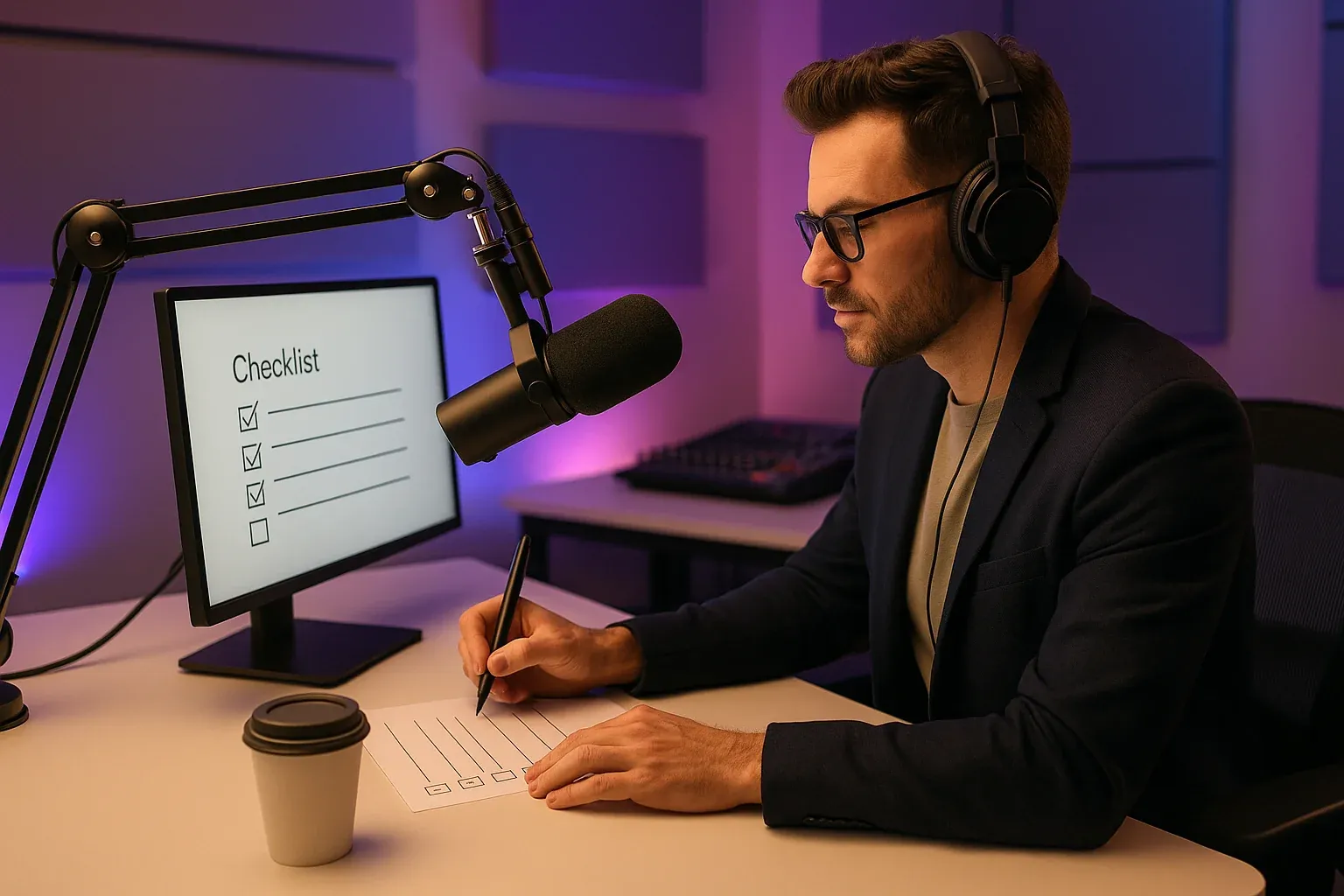
This is that system. A step-by-step checklist you can run every single day, regardless of format, market size, or shift. Print it. Bookmark it. Tape it to your studio wall. Fifteen minutes from now, you'll be ready to go.
If you want the deep dive on show prep strategy, start with our complete radio show prep guide. This checklist is the tactical companion — the daily routine that makes the strategy work.
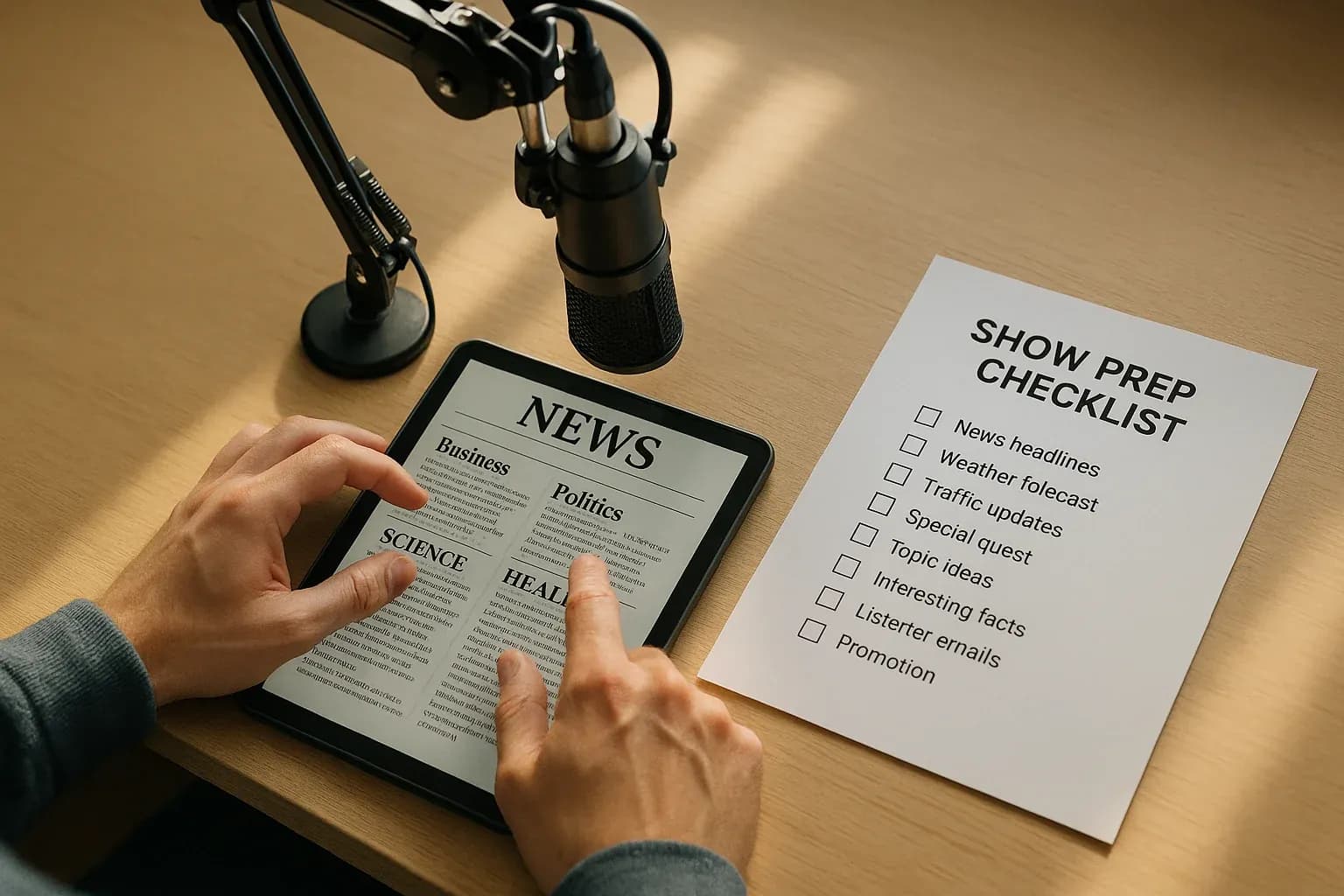
Why a Checklist Beats "I'll Figure It Out"
Airline pilots don't wing pre-flight. Surgeons don't skip the safety check — Atul Gawande's landmark research showed that implementing a simple surgical checklist dropped complications from 11% to 7% and mortality from 1.5% to 0.8%. And the best radio hosts don't walk into the studio hoping something good will come to them.
Most shows fall into one of two traps. Over-prepared: every word sounds rehearsed until the show comes out stiff and scripted. Under-prepared: you scribble a few topics on a sticky note and pray you'll "feel it and wing it." A checklist lands in the sweet spot — structured enough to keep you sharp, loose enough to leave room for the moment.
Here's the real secret: fix the prep process and most other on-air mistakes take care of themselves. A checklist eliminates decision fatigue — and that's not just a feeling. Research suggests that about 60% of executives report decision fatigue as a major factor in poor choices by end of day. You stop asking "what should I look at?" and start asking "what angle am I taking?" That's the shift. Less hunting, more thinking.
Here's what a daily checklist actually does for you:
- Kills prep anxiety. You know exactly what to do and when you're done.
- Makes you consistent. Your worst show gets better because you never skip the basics.
- Frees up creative energy. When you're not scrambling for content, you're thinking about delivery, timing, and audience connection.
- Saves time. Fifteen minutes, every day. Not ninety. Not "however long it takes." Fifteen.
The mistakes that kill ratings almost always come from skipping the fundamentals. A checklist makes that impossible.
The 15-Minute Show Prep Checklist
Here's the routine, minute by minute. Set a timer if you need to. The constraint is the point — it forces you to be decisive instead of drifting.
Minutes 0–3: Scan the Headlines
Open three sources. Not twelve. Three.
- One national news source — AP, CNN, or whatever your format trusts. You're scanning headlines only. Don't read full articles.
- One entertainment/pop culture source — TMZ, People, or your go-to. Grab the two stories everyone will be talking about.
- One local source — Your city's newspaper or local news site. This is your differentiator. Over 70% of stations run some form of local news programming, and it's consistently the highest-engagement content in radio. Streaming can't do local. You can.
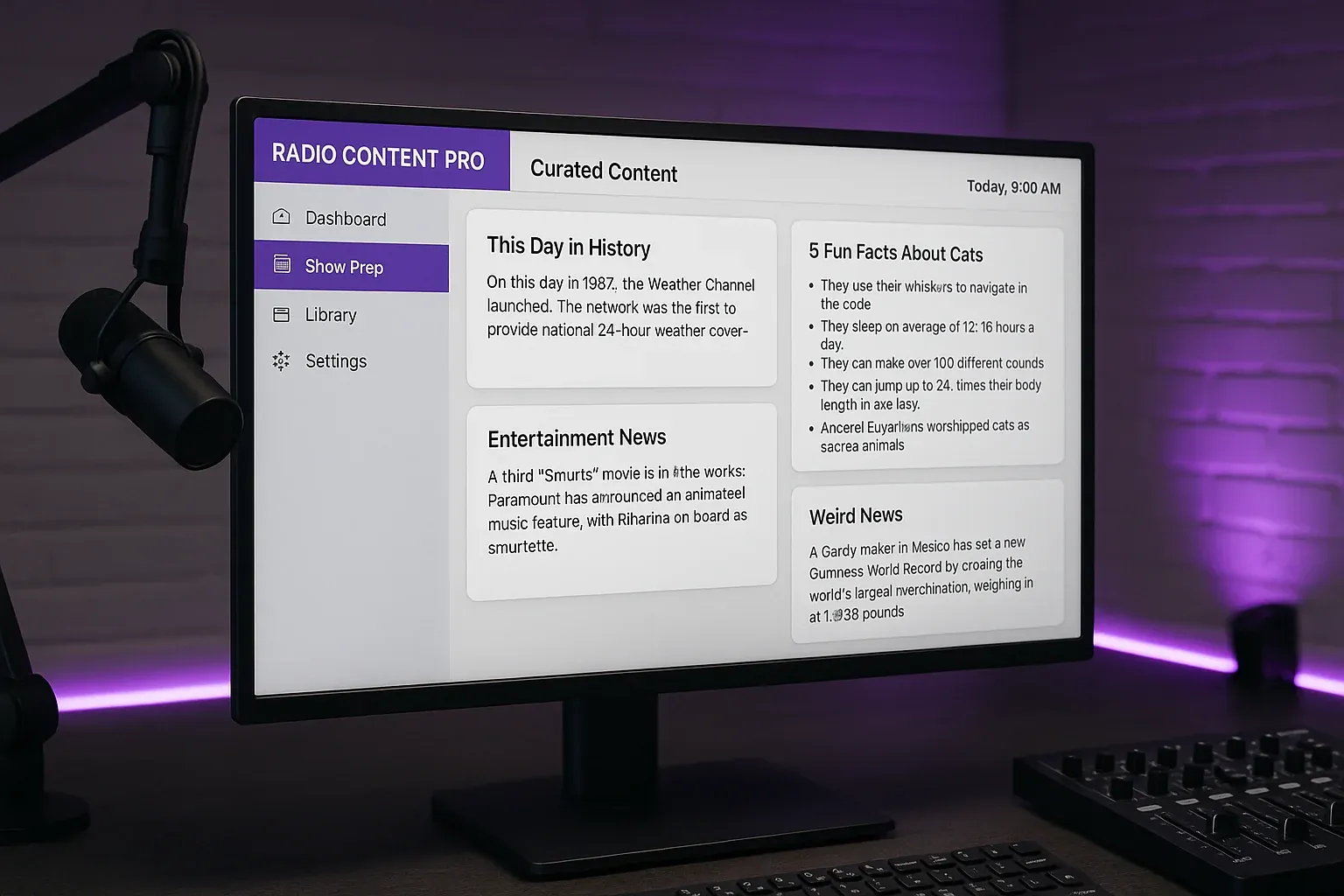
If you're using Radio Content Pro, this step takes 60 seconds. Your Info Kit has already curated headlines by format and market. Scan what Ava pulled for you and move on.
Minutes 3–5: Pick Your 3 Stories
Three stories. That's it. Not seven "just in case" stories — three that you're actually going to talk about.
Think about the math. If you're doing four breaks an hour across a four-hour show, that's 80 breaks every week. Nobody — not late night hosts, not SNL writers — creates that much A-material. You don't need more content. You need the right content, prepped well enough to stretch across multiple breaks.
Use this filter: Will my listener mention this to a coworker today? If the answer is yes, it's a story. If it's only interesting to you, it's not.
Rank them:
- Story 1: Your A-block. The one you open with.
- Story 2: Your mid-show pivot. Different energy, different topic.
- Story 3: Your phone-driver or closer. The one with the strongest opinion angle.
Minutes 5–8: Build Your Angles
For each of your three stories, answer two questions:
- What's my take? Not "here's what happened." Your listener already knows what happened. What do you think about it? Pick a side. Have a position.
- What's the caller bait? What question or statement will make someone pick up the phone? "Am I crazy, or..." is a great format. So is "here's why everyone's wrong about..."
This is where great morning show prep separates from average prep. The stories are the same for everyone. The angles are yours.
Minutes 8–11: Pull Your Supporting Material
You've got your stories and your angles. Now grab 1–2 supporting pieces for each:
- A stat or fact that backs up your take. "According to..." makes you sound prepared, not opinionated.
- A social post or clip that captures the conversation. About 44% of adults now get news from social media, and 25% of younger listeners get it from TikTok first. Screenshot a trending post. Pull a 15-second audio clip. Reference a viral TikTok. If your listeners are seeing it there, you should be talking about it here.
- A local connection if the story is national. How does this affect your market? Your listeners' daily lives?
Don't go deep here. You need ammunition, not a research paper. Two data points per story is plenty.
Minutes 11–13: Write Your Teases
Teases keep listeners through the break. Write one for each of your three stories. Keep them under 15 words.
Good teases create curiosity without giving away the answer:
- "The one thing every [city] parent needs to know about this weekend..."
- "A baseball trade that has nothing to do with baseball. I'll explain after this."
- "I got three texts about this before 6 AM. You probably did too."
Bad teases are vague: "Coming up — stuff you need to hear." That's not a tease. That's nothing.
Minutes 13–15: Local Angle Check + Final Scan
Last two minutes. Quick gut check:
- Does at least one story have a local angle? If not, force one. Mention a neighborhood, a local business, a street name. Localism is your superpower — streaming can't touch it.
- Quick social scan. Thirty seconds on X or your local Facebook groups. Did anything break in the last hour that changes your plan? If yes, swap. If no, you're done.
- Review your rundown. Three stories, three angles, three teases, supporting material. Remember: the number one cause of listener tune-out is confusion. If a listener tunes in mid-break and can't figure out what's happening, they punch a button. Your rundown keeps you from rambling into that danger zone.
That's it. Fifteen minutes. Timer off. Go do your show.
Customize the Checklist for Your Format
The 15-minute structure works across formats, but the sources you scan and the angles you build shift depending on who's listening.
AC/Hot AC: Lean into pop culture, relationships, and family-relatable content. Your audience wants to feel connected, not lectured. Entertainment stories land harder than political takes.
Country: Community stories and lifestyle content win. Concerts, local events, outdoor activities, and small-town news. If a story involves family, faith, or Friday nights — it's probably your A-block.
News/Talk: You need more depth per story, fewer total stories. Consider spending 5 of your 15 minutes on a single topic with multiple angles. Caller bait is everything.
CHR/Top 40: Speed matters. Your audience skews younger and shorter attention spans. Lead with viral moments, celebrity drama, and "did you see this?" content. Social media is your source.
Sports: Your prep looks different entirely — check our dedicated sports radio show prep guide for the full routine.
From Checklist to Autopilot
Fifteen minutes is good. But what if most of those minutes were already done for you?
Here's the reality many personalities face: between blog posts, social media content, podcast episodes, and video clips, the time available for actual show prep keeps shrinking. When producing digital content starts eating your radio show, something has to give. The answer isn't working harder — it's letting the scanning and sorting happen before you sit down.
That's what AI-powered show prep looks like in 2026. About 76% of media organizations now use AI tools in some part of their workflow, and 65% of content professionals say AI-assisted content performs equally or better than fully manual work. Tools like Radio Content Pro scan the headlines, curate format-specific content, surface trending topics, and build talk-break material — all before you arrive.
Your job becomes the last 5 minutes of the checklist: pick your stories, build your angles, write your teases. The hunting-and-gathering phase? Handled.
RCP subscribers tell us the 15-minute checklist becomes a 5-minute checklist. Same quality. Same consistency. A third of the time.
Key Takeaways
- Set a 15-minute timer. Parkinson's Law says work expands to fill the time available. A tight timer forces decisiveness and kills prep drift.
- Three stories, three angles, three teases. That's your daily prep output. No more, no less.
- Scan three sources, not twelve. One national, one entertainment, one local.
- Build angles, not summaries. Your audience already knows the news. Give them your take.
- Localism wins. Radio reaches roughly 85% of adults 25-64 every week — and local content is consistently what keeps them tuned in. At least one story needs a local connection every single day.
- AI tools cut the time further. Let the scanning and curating happen automatically so you can focus on what matters — your voice.
Frequently Asked Questions
What should a radio show prep checklist include?
A complete daily prep checklist covers: three specific stories (not seven "just in case"), a personal angle and caller-bait question for each story, one or two supporting facts or social media references per story, a tease under 15 words for each break, and a final local angle check to ensure at least one story connects to your market. The structure stays consistent every day — only the content changes.
How do you organize radio show prep efficiently?
The most efficient approach is a timed, step-by-step routine: scan three sources (not twelve) in the first three minutes, pick your three stories in the next two, build your angles and caller bait in the following three, pull supporting stats and social references after that, write your teases, and do a final local check. Setting a hard 15-minute timer forces decisiveness and eliminates the prep drift that turns an hour-long session into two hours of open tabs.
How early should you start show prep before going on air?
For most formats, 15–30 minutes before airtime is sufficient when you have a system. The common mistake is starting hours early and using the extra time to scan more sources rather than sharpen angles. With AI-powered content curation already handling the scanning, Radio Content Pro subscribers report completing a full prep in under 5 minutes because the discovery phase is done before they sit down.
What's a good daily show prep routine for radio hosts?
A good routine has three parts: a consistent structure you repeat every day (so you never wonder what to do next), a constraint that forces you to commit to a small number of stories rather than hedge with ten, and a local angle built into every show. The 15-minute checklist in this post — scan, select, angle, support, tease, local check — works across formats because it targets the decisions that matter, not the volume of content consumed.
Ready to simplify your show prep?
Try RCP free for 7 days. $0 until day 8