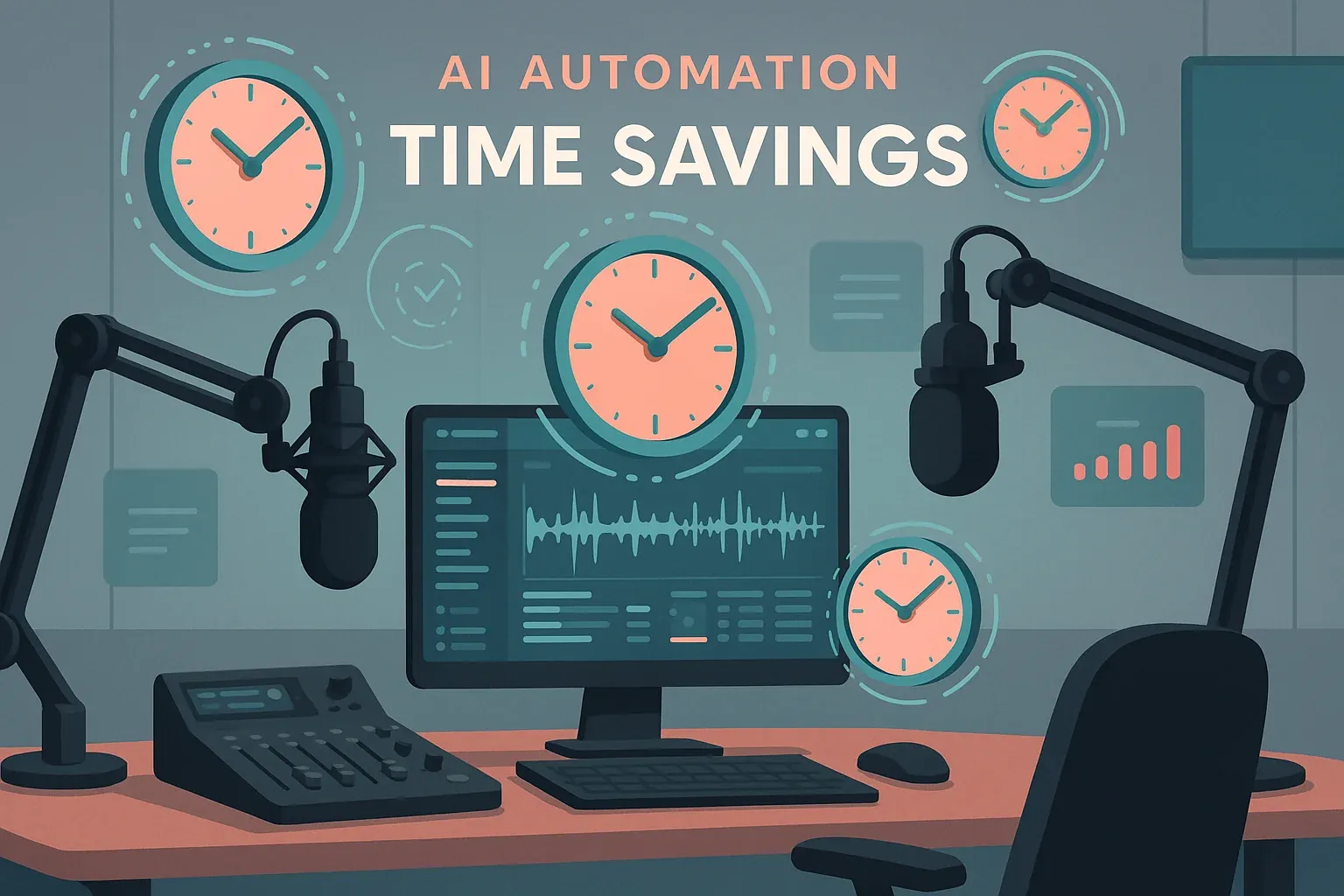

Fifteen hours. That's how long radio professionals spend on show prep every single week.
We hear this constantly from stations across the country. The 4 AM alarms. The endless browser tabs. The ritual of scanning a dozen websites before sunrise, hoping to find something—anything—that'll make listeners care. And after all that time? There's barely any left for the creative work that actually makes great radio.
Here's the thing: automated show prep using AI isn't about replacing what you do. It's about reclaiming those hours so you can do it better. This guide breaks down exactly where the time savings come from—task by task—and how to implement AI-powered prep without losing your voice.
 The traditional show prep grind: effective, but exhausting.
The Traditional Show Prep Time Sink
Let's be honest about what traditional show prep actually looks like. Industry research puts the number at 15+ hours per week for most radio personalities. That's not an exaggeration—it's the reality for anyone doing morning drive, afternoon shows, or any shift where content matters.
Here's where those hours typically go:
Content research: 3-4 hours scouring news sites, entertainment blogs, social feeds, and aggregators for anything relevant. Most of that time isn't spent reading—it's spent searching.
News aggregation: 2-3 hours compiling and organizing what you've found. Copy this link, paste that quote, format the talking points. Rinse and repeat.
Entertainment updates: 2 hours staying current on celebrity news, pop culture moments, music charts, and whatever's trending. This varies by format, but Hot AC and CHR shows feel this one hard.
Writing talking points: 3-4 hours turning raw material into something you can actually use on air. The angles, the setups, the payoffs—this is where skill matters.
Organization and formatting: 1-2 hours getting everything into your prep system, whether that's a document, a database, or sticky notes on your monitor.
That adds up to roughly 15 hours of work—most of which isn't creative work. It's administrative work wearing a creative costume.
The stations we work with describe the same pattern: by the time prep is "done," there's no energy left for the parts of radio that actually require talent. The personality work, the local angles, the bits that build listener loyalty. Those get squeezed out because the grunt work ate the clock.
For a deeper look at the full show prep process, check out our complete guide to radio show prep.
What Automated Show Prep Actually Means
Let's clear something up right away: automated show prep doesn't mean robot radio. It means using AI-powered systems to handle the research, aggregation, and formatting—so humans can focus on the human parts.
Here's what AI automation actually does:
- Scans thousands of sources in real-time — News sites, entertainment blogs, social media, industry feeds. AI can monitor more sources in an hour than you could read in a week.
- Filters by relevance and format — Country station? You get country-appropriate content. Hot AC? Pop culture and trending entertainment. News/Talk? Current events and debate topics.
- Generates draft talking points — Not scripts you read verbatim, but starting points you can make your own.
- Handles formatting and organization — Content arrives structured and ready to use, not scattered across twenty browser tabs.
- Updates continuously — Unlike morning prep that goes stale by noon, AI systems refresh throughout the day.
What AI automation doesn't do:
- Replace your personality — The thing that makes listeners choose your station over Spotify? That's still 100% you.
- Understand local context — The high school football game everyone's talking about? The inside joke about the mayor? AI can't know what you know.
- Make judgment calls on breaking news — When to interrupt, what tone to take, how to handle sensitive stories—that's human territory.
The way to think about it: AI does 90% of the grunt work, you add the 10% that actually matters. That's not a reduction in your role—it's an amplification of it. For more on how AI is transforming radio content, we've covered the broader landscape separately.
The 10-Hour Breakdown: Where Time Gets Saved
This is the question everyone asks: where exactly do those 10+ hours come from? Here's the task-by-task breakdown:
 The math is simple: automate the research, keep the creativity.
| Task | Traditional Time | With AI Automation | Time Saved |
|---|---|---|---|
| Content research | 3-4 hours | 15-30 minutes | ~3 hours |
| News aggregation | 2-3 hours | Automated (0 min) | ~2.5 hours |
| Entertainment updates | 2 hours | Pre-curated (10 min) | ~1.5 hours |
| Writing talking points | 3-4 hours | 1-2 hours (AI drafts) | ~2 hours |
| Organization | 1-2 hours | Auto-formatted (0 min) | ~1.5 hours |
| TOTAL | 15+ hours | 3-4 hours | 10+ hours |
Let's break down each row:
Content research drops from 3-4 hours to 15-30 minutes. Instead of manually scanning sources, AI surfaces the most relevant stories based on your format, market, and audience. You're reviewing curated options, not hunting through the wilderness.
News aggregation goes to zero. The copy-paste-format cycle disappears entirely. Content arrives organized and ready to use.
Entertainment updates become a quick scan. AI handles the monitoring and filtering. You just approve what fits your show and skip what doesn't.
Writing talking points cuts in half. AI-generated drafts give you a starting point. You're editing and adding personality, not starting from a blank page.
Organization is automatic. No more wrestling with documents, folders, or systems. Content is structured the way you need it.
The result? Radio professionals report spending 3-4 hours on prep instead of 15+. Those reclaimed hours can go toward creative work, local content, listener engagement—or just getting more sleep before morning drive.
How to Implement AI Show Prep (Step-by-Step)
Ready to make the switch? Here's how stations are doing it successfully:
Step 1: Audit Your Current Workflow
Before changing anything, track where your time actually goes for one week. Most radio professionals are surprised by the results. Write down:
- How many hours you spend on each prep task
- Which tasks feel most repetitive
- Which tasks require the most human judgment
- What format-specific needs you have
This baseline helps you measure improvement and identify which automation features matter most.
Step 2: Choose the Right Tool
Not all AI prep services are created equal. When evaluating options, look for:
- Format-specific content curation — Generic news feeds don't help Country shows or CHR personalities. Look for tools that understand radio formats.
- Real-time updates — Static morning prep is yesterday's model. You want continuous content that stays fresh.
- Talking points included — Raw headlines aren't prep. You need angles, hooks, and conversation starters.
- Easy integration — If it takes longer to learn the tool than it saves, that's not a win.
Red flags to watch: tools that promise to "write your show for you" (they can't) or require extensive training before delivering value.
Step 3: Start with One Daypart
Don't overhaul everything at once. Pick one daypart—morning drive is ideal because the time savings are most obvious—and run a parallel test.
Use AI prep alongside your traditional method for two weeks. Compare the quality and the time investment. Most stations see the difference within days, but giving it two weeks ensures you're not just experiencing novelty.
Step 4: Customize for Your Voice
AI provides raw material. Your job is adding the personality that makes listeners choose you.
Create templates or shortcuts for your common angles. If you always add local spin, build that into your review process. If you prefer certain story types, note which AI suggestions consistently hit and which miss.
The goal is a workflow where AI handles the heavy lifting and you handle the finishing touches. For a detailed comparison of approaches, see our RCP vs. traditional show prep breakdown.
What Automation Can't Replace
Here's where we get honest. AI show prep is powerful, but it has real limitations:
Your personality and authentic connection. The warmth in your voice, the way you react to callers, the running jokes with your co-host—AI can't generate that. And listeners can tell the difference between genuine personality and generated content.
Local context and community knowledge. AI doesn't know that the new restaurant downtown is owned by the mayor's nephew, or that the high school football team made state playoffs for the first time in thirty years. You do.
Breaking news judgment. When something major happens, knowing when to interrupt regular programming, what tone to take, how to cover sensitive topics—that requires human judgment that AI can't replicate.
The "read the room" instinct. Some days the vibe is off and you need to pivot. Some stories that look good on paper land flat with your audience. Experienced radio professionals develop an instinct for this. AI hasn't.
The best radio will always need humans. AI just helps humans spend less time on administrative work and more time being human.
Real Results from Real Stations
The 10+ hour savings claim isn't theoretical. Stations across the industry are reporting similar results:
Industry sources document hundreds of stations now using AI-powered prep tools. The consistent feedback is that prep time drops significantly while content quality stays the same or improves—because personalities have more energy for the creative work.
What stations do with the reclaimed time varies:
- More local content — Time to actually call local sources, attend community events, develop relationships
- Better listener engagement — More time responding to calls, texts, and social interactions
- Creative development — Working on bits, features, and recurring segments that build habit
- Personal sustainability — Starting later, leaving earlier, or just feeling less burned out
The format matters too. News/Talk stations often see the biggest time savings in research. CHR and Hot AC stations save more on entertainment curation. Country stations benefit from format-specific content that generic tools miss.
One pattern we see consistently: the personalities who embrace AI prep don't become lazier—they become more creative. When you're not exhausted from the administrative grind, you actually have bandwidth to try new things, take creative risks, and connect more authentically with your audience.
Explore format-specific content kits to see how different formats approach automated prep.
 The goal: walking into the studio confident, not exhausted.
Key Takeaways
Here's what matters from this guide:
- Traditional show prep consumes 15+ hours weekly — most of it administrative, not creative
- AI automation handles research, aggregation, and formatting — the repetitive tasks that don't require personality
- Realistic time savings: 10+ hours weekly — task by task, the math checks out
- Implementation works best starting with one daypart — morning drive is ideal for measuring impact
- The personality is still 100% you — AI handles grunt work so you can focus on the human parts
The stations seeing the best results aren't replacing their prep process—they're upgrading it. Same commitment to quality content, less time spent getting there.
FAQ
How much time does automated show prep actually save?
Most radio hosts who fully implement AI-assisted show prep report saving 10–15 hours per week — mostly on the research, aggregation, and formatting tasks that used to eat prep time without producing on-air value. Realistic savings break down as: 3–4 hours on topic discovery, 2–3 hours on content formatting, 2–3 hours on social copy drafting, and 1–2 hours on show-sheet assembly. The 10% creative work (your personality, takes, and local angles) still takes the same time — and should.
Does automated show prep replace hosts or producers?
No. Automated show prep replaces the grunt work — scanning sources, reformatting stories, writing social copy, building show sheets. It doesn't replace the personality, local knowledge, interviewing skill, or on-air chemistry that make your show worth listening to. The best stations use AI to eliminate the 90% of prep that's administrative so the host/producer team can spend more time on the 10% that's irreplaceable.
What tasks should I automate first?
Start with content aggregation and formatting — these are the highest time cost and lowest creative value tasks in any radio prep workflow. Use a dedicated AI prep service (like Radio Content Pro) to deliver pre-formatted, format-specific content daily. Once that's working, layer in social copy generation, transcription, and audio cleanup tools. Don't try to automate everything at once — pick one daypart, get it working, then expand.
How long does it take to implement automated show prep?
Plan for 30 days. Week 1: pick your prep service and get daily content flowing. Week 2: integrate the content into your existing prep workflow (don't replace — augment). Week 3: add social content automation. Week 4: measure the time savings honestly and double down on what worked. Most hosts are saving meaningful time by the end of Week 2, with full 10+ hour weekly savings landing in Week 4.
Will automated show prep content sound generic on air?
Only if you let it. Good AI prep services (Radio Content Pro, TopicPulse, etc.) deliver content tailored to your format — Country, Hot AC, Rock, etc. — which is already more specific than generic news wires. The real differentiation comes from how you deliver it on-air: your voice, your take, your local angle. AI provides the raw material; you provide the personality. Stations that sound generic on AI prep would sound generic on any prep — the AI isn't the problem.
Ready to simplify your show prep?
Try RCP free for 7 days. $0 until day 8