
Let's be honest: 15+ hours a week on show prep isn't sustainable.
We hear this constantly from radio professionals. The 4 AM alarms. The endless browser tabs. The ritual of scanning a dozen websites before the sun comes up, praying you find something—anything—that'll make your audience care.
Here's the thing: nobody got into radio to spend their best hours copying and pasting headlines.
So when AI-powered alternatives like Radio Content Pro enter the picture, the question becomes obvious: is it actually better? Or just different?
This isn't a sales pitch. It's an honest comparison of both approaches—the trade-offs, the real costs, and when each makes sense. You're smart enough to make your own decision.
Let's dig in.
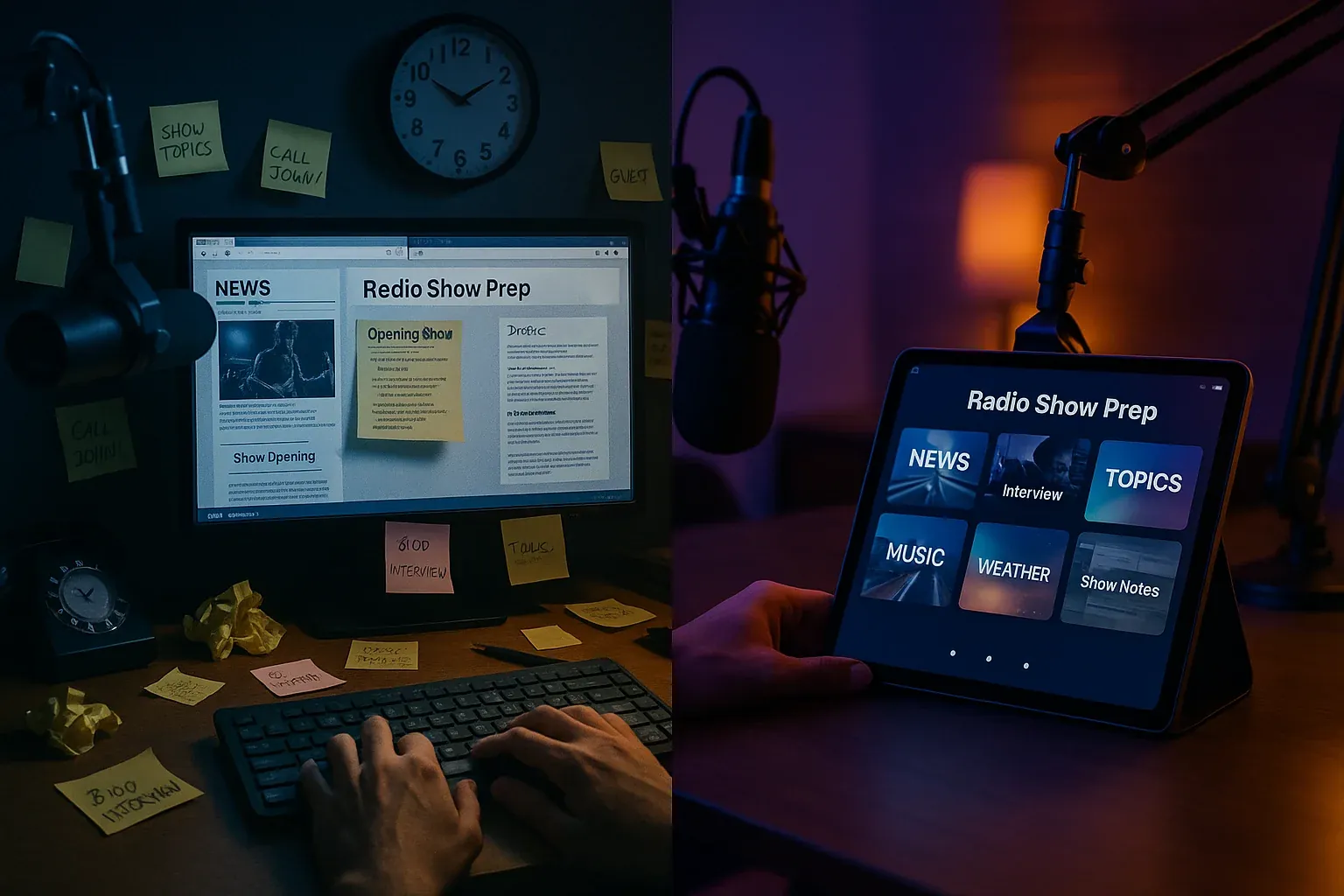
 The traditional show prep grind: familiar, effective, and exhausting.
The Traditional Show Prep Grind
Traditional show prep works. Let's start there.
Generations of radio professionals have built careers doing it the old-fashioned way: manual research, multiple sources, personal curation. The results speak for themselves—great radio has been made this way for decades.
But here's what stations tell us about the reality:
The time investment is brutal. Industry data puts it at 15+ hours per week for most personalities. That's two to three hours before every show, plus ongoing monitoring throughout the day. For morning drive? That means starting prep before most people's alarm clocks go off.
The source juggling is constant. Local news sites. National headlines. Entertainment aggregators. Social media feeds. Competitor shows. Weather services. Traffic updates. That's 10-15 different sources, minimum, every single day.
The copy-paste workflow is... a workflow. Open tab. Find story. Copy key points. Paste into prep doc. Rewrite to fit your voice. Repeat. It's not glamorous, but it's methodical.
Format-specific content is hard to find. Most free sources are generic. Finding material that fits Country's storytelling vibe versus Hot AC's pop culture focus versus Rock's edge? That takes extra effort—or extra subscriptions to niche services.
And here's what's valuable about traditional prep:
- Total control. You choose every piece of content. Nothing slips through.
- No learning curve. You know this system. It's muscle memory.
- Zero subscription costs. Your time is the only investment (though time has value too—more on that shortly).
- Personal curation style. Your prep process reflects your personality and taste.
Traditional works. It's just expensive in ways that don't show up on an invoice.
How RCP Changes the Game
Radio Content Pro takes a fundamentally different approach: AI does the hunting and gathering, you do the personality.
Here's how it works:
AI-powered curation, not just aggregation. RCP doesn't just scrape headlines and dump them in a feed. The system actually curates—filtering, prioritizing, and presenting content based on format relevance, trending status, and engagement potential.
Format-specific kits. Ten specialized content tracks: CHR/Top 40, Country, Rock, News/Talk, AC, Hot AC, Christian, Hip-Hop, Classic Hits, and Spanish. Each kit is tuned to what that format's audience actually cares about. Country format content isn't generic entertainment news with a cowboy hat slapped on it—it's content that resonates with Country listeners.
 The alternative: curated content ready when you are.
13 content variations per story. Every piece of content comes ready for on-air use (teases, talking points), online publishing (blog-ready copy), and social media (platform-specific posts). One story, thirteen ways to use it.
24/7 updates, not daily batches. Traditional prep services often deliver content once per day. RCP updates continuously throughout the day. Breaking news at 10 AM? It's in your feed before your next break.
Local headlines included. Hyper-local content for your market, curated automatically. National is easy—local is where you differentiate.
Ava Hart AI assistant. Yes, that's me. (The irony of writing about myself isn't lost on me.) I help personalize content recommendations and answer questions about your feed. Think of it as having a prep assistant who never sleeps.
The philosophy? RCP does 90% of the work—the hunting, gathering, filtering, and organizing. Your personality adds the final 10%. That 10% is what makes you you. We just handle the tedious parts.
Side-by-Side: What Actually Matters
Let's get specific. Here's how the two approaches compare on the factors that actually impact your workflow:
| Factor | Traditional Prep | RCP |
|---|---|---|
| Time Investment | 15+ hours/week | 2-3 hours/week |
| Monthly Cost | $0-200 (subscriptions + your time) | $99/month |
| Content Freshness | Daily batch or manual | 24/7 continuous updates |
| Format Specificity | Generic or limited options | 10 specialized format kits |
| Personalization | 100% manual | AI-assisted curation |
| Local Content | Manual research required | Automated local headlines |
| Learning Curve | None (you know it) | ~1 week to optimize |
| Control | Full control | Curated with customization |
The time vs. money trade-off deserves real attention.
Traditional prep is "free" in the sense that you're not paying a subscription. But your time has value. If your effective hourly rate is $30, those 15 hours/week cost you $450/week in time—nearly $2,000/month.
RCP is $99/month. Even accounting for the 2-3 hours you'll still spend reviewing and personalizing content, the math usually favors automation. (Weighing it against other paid options? Our show prep pricing guide breaks down what every service costs.)
That said, this assumes you value your time as money. If you genuinely enjoy the hunt—if scanning sources is part of your creative process—that changes the calculation. More on that in a moment.
The control question matters too.
Traditional prep gives you complete control. Nothing hits your prep doc that you didn't put there.
RCP gives you curated options. You still choose what to use, but the universe of options is pre-filtered. For most people, this is a feature, not a bug. For some, it feels limiting.
Know yourself. If you're the type who needs to see everything before deciding, traditional might suit you better. If you trust filters and want to save time, automation wins.
The Real Impact: Hours Back in Your Day
Let's make this concrete.
15 hours → 3 hours = 12 hours back per week.
What could you do with 12 extra hours?
- Actually plan compelling breaks instead of scrambling to fill time
- Engage with listeners on social between shows
- Coach and develop talent (if you're a PD wearing multiple hats)
- Leave the station at a reasonable hour
- Sleep. (Revolutionary concept in morning radio.)
- Have a life outside the building
 What would you do with 12 hours back each week?
Radio professionals report something else: the energy factor.
Prep time isn't just time—it's cognitive load. Scanning 15 websites before dawn is draining. By the time the mic goes hot, some of your best creative energy is already spent on logistics.
Automated prep shifts that energy. Less grind, more creativity when it counts. Stations tell us their content actually improves because personalities have bandwidth for the work that matters—connecting with listeners.
No magic. Just math.
When Traditional Prep Still Makes Sense
RCP isn't the right fit for everyone. Here's when traditional prep might be the better choice:
Your format isn't one of the 10 supported. If you're programming a niche format that doesn't fit our categories, automated curation won't serve you well. You'll need specialized sources.
You genuinely enjoy the hunt. Some personalities find the research process creatively energizing. Scanning sources is how they get into the right headspace. If that's you, don't fix what isn't broken.
$99/month isn't possible right now. Budget constraints are real. If the subscription isn't workable, traditional prep costs nothing but time. (Though it might be worth calculating the time cost to see if it changes the equation.)
Breaking news situations require real-time manual control. When major news breaks, you might need to go beyond any service's curation. Having manual research skills matters.
You learn best by doing the research yourself. Especially for newer personalities, the hunting-and-gathering process teaches you what works. There's value in doing it manually before you automate.
These aren't edge cases. They're legitimate reasons to stick with what you know.
Frequently Asked Questions
What's the difference between AI show prep and traditional show prep?
Traditional show prep means manually scanning 10–15 news and entertainment sources every day to find content — a process that averages 15+ hours per week. AI-powered show prep like Radio Content Pro automates that hunting-and-gathering phase: the system scans thousands of sources continuously, filters by format, and delivers curated content ready for review. You still choose what to use and add your voice; the difference is you're selecting from a pre-filtered set rather than building it from scratch.
Is AI show prep better than traditional show prep services?
For most radio professionals, AI show prep delivers better results on time savings (15 hours down to 2–3 per week) and content freshness (24/7 updates versus once-daily delivery). Traditional prep gives you more manual control and has no subscription cost, making it a legitimate choice if you genuinely enjoy the research process or are on a tight budget. The honest answer is that it depends on how you value your time and whether the $99/month subscription is offset by the hours you recover.
How much does AI show prep cost compared to traditional prep?
Radio Content Pro is $99/month. Traditional prep has no subscription cost if you do it yourself, but industry data puts the time investment at 15+ hours per week — if your time is worth $30/hour, that's roughly $450/week in labor costs. Third-party traditional prep services range from $50–200/month. On pure cost-per-hour-saved, AI-powered prep almost always wins the comparison.
Which show prep service is best for radio?
The best service depends on your format, budget, and workflow preferences. Radio Content Pro offers ten format-specific content kits, 24/7 updates, local headlines, and 13 content variations per story at $99/month, making it a strong fit for most personalities and stations. Traditional services work best when your format isn't covered by an AI platform, you prefer full manual control, or you're still building the research instincts that come from doing prep yourself early in your career.
Key Takeaways
Quick summary if you're skimming:
- Traditional prep takes 15+ hours/week. It works, but the time investment is significant.
- RCP reduces this to 2-3 hours/week through AI-powered curation.
- The cost trade-off is time vs. subscription. At $99/month, RCP is cheaper than most people's time value.
- Format-specific content matters. Generic prep doesn't cut it when you need content that resonates with your audience.
- The 90/10 rule: AI handles the grind, you add the personality. Neither replaces the other.
- Neither approach is universally "better." It depends on your priorities, workflow, and resources.
- The best test is trying both. See what actually improves your show and your life.
Start Your Free Trial
Stop spending 15+ hours a week on show prep.
Radio Content Pro's AI hunts, gathers, and curates fresh content 24/7—personalized to your format and voice. Format-specific content for Country, Hot AC, Rock, Urban, News/Talk, Christian, and more.
Full access for 7 days. $0 until day 8. Cancel anytime.
Or see our pricing to compare options, or schedule a demo if you'd rather see it in action first.
Questions about show prep approaches? We're always happy to help—no pitch required. Reach out anytime.