
It's 4 AM. Your prep sheet is blank. You've got three hours until the mic goes hot, and every story you pull up feels stale, overdone, or irrelevant to your audience. Sound familiar? If you're doing morning show prep for radio the same way every day — hunting for content from scratch — the problem isn't your effort. It's your system.
Most morning shows run on a "hunt and gather" model. Every day starts at zero. You scan headlines, scroll social media, check a few sources, and hope something sticks. It works — until it doesn't. Until you hit a slow news week. Until the topics dry up mid-show and you're vamping through the C-break.
Building a morning show content pipeline changes that equation entirely. Instead of hunting for content every morning, you build a system that feeds your prep automatically — a steady flow of topics, angles, and segments that keeps your content backlog stocked week after week.
We've covered 30 morning show content ideas and the principles behind great prep before. This guide is about the operating system underneath all of it — the pipeline that keeps those ideas flowing so you never stare at a blank page again.
Why Morning Shows Need a Pipeline, Not Just Prep
Here's the math that makes the case. A typical four-hour morning show needs 3-4 unique content pieces per show — topics with enough depth to fill a break, drive phones, or spark a social media post. Over five days, that's 15-20 unique pieces of content per week.
Without a pipeline, that's 15-20 individual hunts. Every. Single. Week.
Daily prep is a sprint. You find what you need for today and move on. A pipeline is a supply chain — a system that continuously feeds content into your prep process so the daily sprint is shorter, faster, and less stressful.
The difference shows up on-air. Hosts who operate on a pipeline sound confident because they have options. They're choosing between good topics, not scrambling for any topic. They have backup material for slow days. They have recurring segments pre-loaded weeks in advance.
Stations that treat content like a supply chain consistently outperform those doing daily scavenging. The best morning shows we work with don't spend more time on prep — they spend their time differently. Less searching, more selecting. Less panic, more perspective. If your daily routine still feels like a grind, check our 15-minute daily prep checklist — but come back here to build the system that makes that checklist even faster.
The Four Stages of a Morning Show Content Pipeline
Every effective content pipeline runs through four stages: Scanning, Selecting, Personalizing, and Delivering. Think of it like a radio station's music scheduling system — you don't pick songs randomly each hour. You build a library, categorize it, rotate it, and schedule it. Your content pipeline works the same way.
Stage 1 — Scanning: Cast a Wide Net
The first stage runs mostly on autopilot. Your job is to set up 5-7 content sources that continuously feed raw material into your pipeline without requiring daily effort.
Sources by category:
- National trending: Google Trends, X/Twitter trending, Reddit front page, Apple News top stories
- Local news: Your market's newspaper RSS feed, local TV station sites, community Facebook groups, city subreddit
- Entertainment/pop culture: TMZ, People, Billboard, streaming platform trending lists
- Format-specific: Country? Nashville news wires. Sports? ESPN and local team feeds. Talk? Wire services and opinion pages.
- Listener-generated: Text line submissions, social media mentions, voicemail topics from previous shows
- Seasonal/calendar: National day calendars, upcoming holidays, local event listings, sports schedules
The goal: 30-50 raw content signals flowing into your pipeline every day without you actively searching for them. Set up RSS readers, Google Alerts, or social media lists once — then let them run.
One rule that matters: diversify your inputs. If all your sources are national news, you'll sound like every other morning show in the country. The pipeline only works when the raw material is varied enough to give you options. Check our master list of content idea sources for more input categories.
Stage 2 — Selecting: The Daily Filter
Scanning gives you 30-50 signals. Now you need 4-5 for today's show. This stage is where pipeline operators separate from content hoarders.
The speed triage:
For each piece of raw content, ask three questions:
- Does my audience care? Not "is this interesting to me" — does the 35-year-old commuter in my market care about this today?
- Can I add something? If you can only read the headline and move on, it's not radio content. You need an angle, a question, or a personal take.
- Is there a phone/text hook? The best morning show content invites participation. If you can't imagine a listener responding, it might be a one-liner, not a break.
Run every piece of raw content through those three questions. It takes about 10 seconds per item. In five minutes, you've filtered 30-50 signals down to 8-10 candidates.
From those 8-10, pick your top 4-5 for today. But here's the pipeline secret: bank the rest.
The "yes/maybe/bank it" triage changes everything. Topics that pass the first filter but don't make today's show go into your content bank — a rolling backlog of pre-vetted topics you can pull from on slow days. Not everything expires. A "where were you when..." question works any day. A "this or that" debate stays fresh for weeks. For a deeper dive on selection criteria, see the three-filter system for selecting prep content.
Stage 3 — Personalizing: Make It Yours
Raw content is generic. Your show's perspective makes it radio-worthy. This is the stage that separates great morning shows from forgettable ones — and it's the stage most hosts skip when they're rushed.
The personalization formula:
[Topic] + [Your show's take] + [Listener hook] = Air-ready content
Examples:
- National story: "Celebrity X is trending for doing Y" → Your take: "Has anyone here ever done something embarrassing that went viral?" → Listener hook: "Text us your story — 55512"
- Study or stat: "New study says Americans spend 4 hours a day on their phones" → Your take: "I checked my screen time last night and I'm ashamed" → Listener hook: "What's your screen time? Be honest."
- Local event: "The county fair starts this weekend" → Your take: "We're ranking the top 5 fair foods — and funnel cake is NOT number one" → Listener hook: "Call us if you disagree"
Without personalization, you're just reading the internet on-air. With it, you're creating moments that listeners remember and talk about. This is the stage where not personalizing content becomes the most common show prep mistake we see.
AI tools handle a lot of the heavy lifting here. Feed a raw topic into an AI assistant and it can generate five talk-break angles, three listener poll questions, and a social media post in seconds. You pick the one that fits your show's voice and run with it.
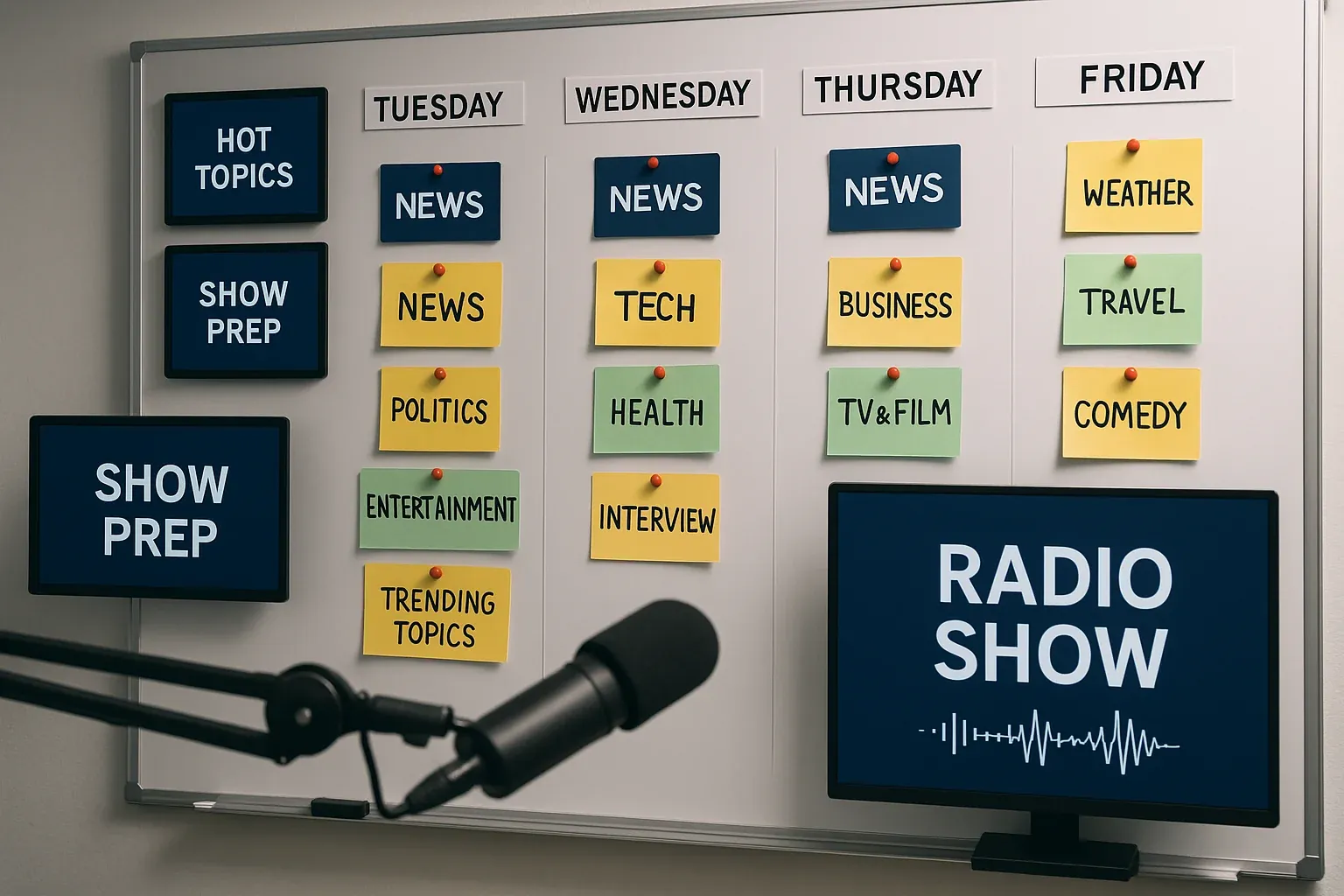
Stage 4 — Delivering: From Prep Sheet to On-Air
The final stage is organizing your personalized content for delivery. This isn't about reading from a script — it's about having a clear, scannable prep document that lets you make fast decisions in the moment.
Organize by break position:
- A-break (top of hour): Your strongest topic. High energy, high talkability. This is the one that gets listeners to stay past the first commercial break.
- B-break: Your phone/text topic. Something that invites participation and fills time naturally.
- C-break: Lighter fare. A game, a "this or that," a fun fact that transitions into music cleanly.
- Below the fold: Two backup topics in case something falls flat or breaking news kills your planned content.
One page. Ranked by energy. Backups ready. That's your deliverable.
After the show, spend two minutes on a post-show review. What connected? What fell flat? What goes back in the content bank for another day? This feedback loop is what makes the pipeline smarter over time.
The Weekly Pipeline Rhythm
Daily execution is only half the system. The weekly rhythm is what keeps your pipeline full long-term.
Sunday evening (20 minutes): Scan the week ahead. Check the calendar for holidays, local events, sports schedules, and cultural moments. Load these as "guaranteed content" — the anchors you know are coming regardless of the news cycle. A morning show with three pre-loaded topics per day before Monday even starts is a morning show that never panics.
Monday through Thursday (15 minutes each): Run the four-stage pipeline daily. Monday sets the week's tone and energy. By Thursday, you should be banking Friday content too.
Friday (30 minutes): This is the pipeline's maintenance day. Batch-prep the content bank. Scan for evergreen topics — questions, debates, games, and recurring segment ideas that work any week. Look ahead two weeks for seasonal content. Prep any recurring segments for the following week.
The "never dry" math: Every Friday batch session should add 5-10 topics to your content bank. After one month, you have 20-40 banked topics. After three months, you have 60-120 banked topics ready to pull at any time. You'll never start from zero again.
Total weekly pipeline time: 15 minutes per day (×5) + 20 minutes Sunday + 30 minutes Friday = 2 hours and 5 minutes per week. That's less time than most morning show hosts currently spend prepping for a single day.
The payoff compounds. Every week your bank grows. Every week your daily filter gets faster because you've already got backup material. Every week your show sounds more prepared — not because you're working harder, but because the system is doing its job. For the full strategic foundation, see our complete radio show prep guide.
How AI Changes the Morning Show Pipeline
AI doesn't replace the pipeline — it supercharges Stages 1 and 2. The scanning and selection stages, which used to eat most of a host's prep time, are exactly what AI tools handle best.
What AI does for your pipeline:
- Curates 30-50 daily content signals automatically from across the web — no manual RSS setup required
- Filters for your format, market, and audience demographics before you ever see a headline
- Generates talk-break angles, listener poll questions, and social media posts from raw topics
- Surfaces "this day in history" content, celebrity birthdays, and cultural moments matched to your playlist era
- Identifies local news hooks that national sources miss
What AI can't replace:
- Your relationship with your audience. The inside jokes, the running bits, the callbacks to last week's show — that's human context no algorithm replicates.
- Local instinct. Knowing that the high school football coach just got fired, or that the new taco spot downtown is the talk of the neighborhood — that's community intelligence.
- On-air delivery. The pause before a punchline, the tone shift when a caller shares something real, the improvisation when a topic takes an unexpected turn. That's craft.
At Radio Content Pro, we built the platform around this pipeline model. Your daily dashboard handles Stages 1 and 2 — content arrives curated and format-matched every morning. Ava Hart, our AI content assistant, helps with Stage 3 — personalizing topics to your station's voice, market, and style in seconds. The result: see how Radio Content Pro's AI handles the first two pipeline stages and you'll understand why stations using AI-powered pipelines report cutting prep time by 70% while increasing content variety.
The hosts who sound the most prepared in 2026 aren't spending more time on prep. They're running a pipeline — and letting AI handle the parts that used to eat their mornings.
FAQ
How do you prepare content for a morning radio show? Build a four-stage content pipeline: (1) scan 5-7 diverse sources for 30-50 daily content signals, (2) filter down to 4-5 topics using audience relevance and talkability criteria, (3) personalize each topic with your show's perspective and a listener hook, and (4) organize by break position for delivery. The system runs in about 15 minutes daily once established, plus a weekly batch session to keep your content bank stocked.
How far in advance should you prep a morning show? Daily prep should happen the night before or morning-of for timely content. But the pipeline itself runs continuously — a Friday batch session stocks your content bank with 5-10 evergreen topics weekly, so you always have backup material. After two to three months of consistent pipeline operation, you should have 30 or more banked topics at any given time.
How many topics does a morning show need per day? A typical four-hour morning show needs 15-20 unique content pieces per week — roughly 3-4 per show day. Your content pipeline should deliver 4-5 filtered, personalized topics daily so you have options and can drop what doesn't fit the show's energy that morning.
Can AI replace morning show prep? AI handles content scanning and initial selection — about 70-80% of the gathering work. But personalization, local knowledge, and on-air delivery instinct are human skills that AI supports rather than replaces. The most effective approach is an AI-powered pipeline for content gathering paired with human creativity for the final 10-20% that makes content yours.
Key Takeaways
- Stop prepping from scratch every day — build a pipeline that feeds your daily prep automatically
- The four stages: Scanning → Selecting → Personalizing → Delivering
- A Friday batch session stocks your content bank so slow news days are covered
- After 2-3 months of pipeline operation, you'll have 30+ banked topics at any time
- AI handles the scanning and selection stages; you own the personalization and delivery
- Total pipeline time: under 2 hours per week for an always-stocked morning show
Ready to simplify your show prep?
Try RCP free for 7 days. $0 until day 8