
Radio broadcasting is entering 2026 at an inflection point. The industry that many wrote off as "dying" just posted its smallest year-over-year decline among all traditional media—just 0.9%, according to Borrell Associates. Meanwhile, streaming audio is projected to grow 9.2%.
That's not a contradiction. It's an opportunity.
The stations that thrive in 2026 won't be the ones that ignore change or chase every shiny new technology. They'll be the ones that strategically adopt what works while doubling down on radio's irreplaceable strengths: live programming, local connection, and human authenticity.
This article examines the seven most significant radio industry trends for 2026 and, more importantly, what you can actually do about them. No abstract predictions here—just actionable insights from working with stations across every format and market size.
Mid-2026 check-in (updated June 9): Now that we're halfway through the year, one trend is clearly outrunning the rest — AI moving from experiment to everyday operation. NAB Show 2026 put it center stage, and the picture stations report on the ground tracks the forecasts below. We've gone deeper on both since this piece first published: see what NAB 2026 signaled about the future of show prep and our full 2026 state of AI in radio broadcasting. The other six trends are holding; the AI one is accelerating.
1. AI integration moves from experiment to operation
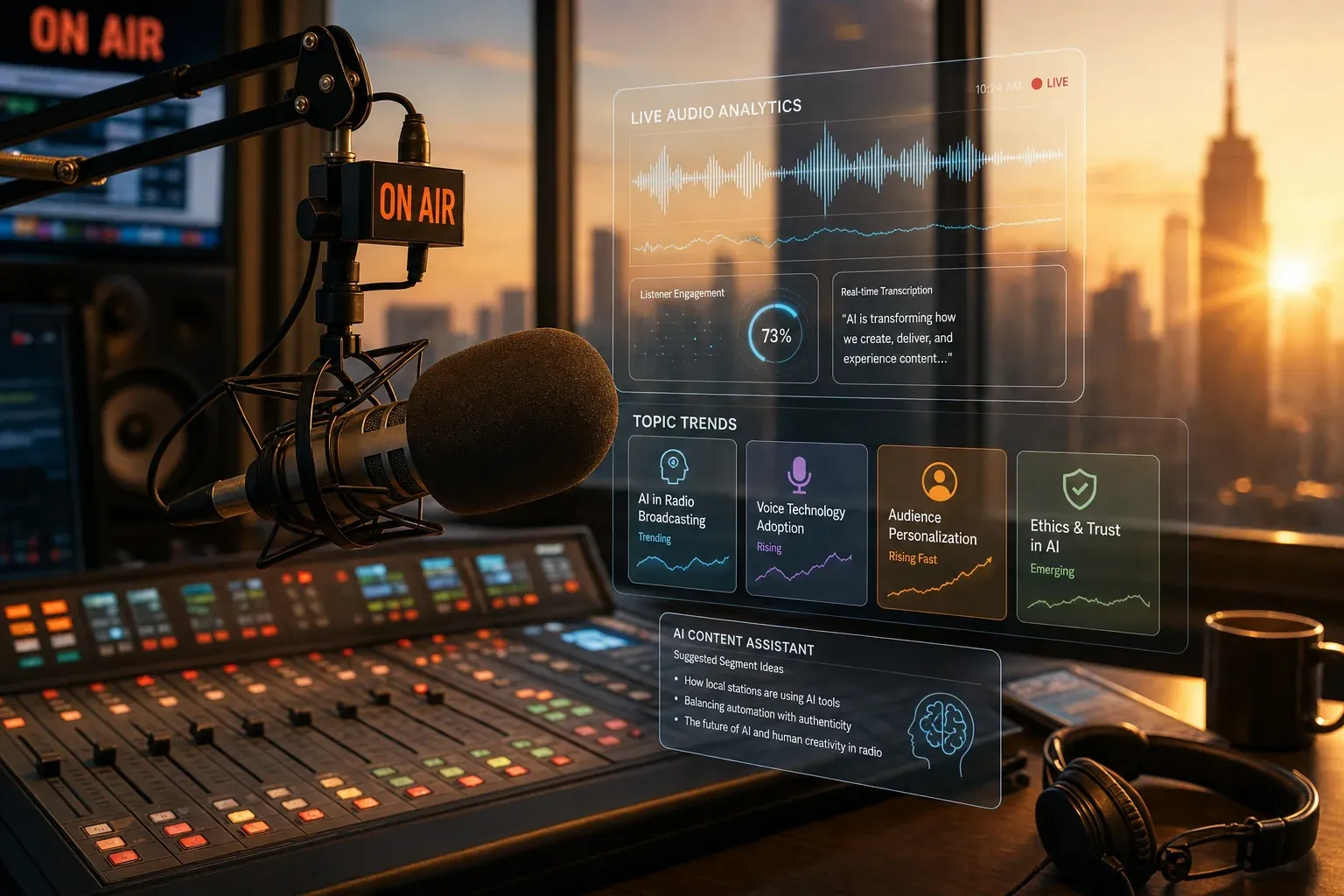
2026 marks the year AI stops being a "nice to have" and becomes operational infrastructure. The World Radio Day 2026 theme says it best: "Radio and Artificial Intelligence"—with the explicit emphasis that AI is a tool, not a replacement.
Here's what that looks like in practice. Tools like Futuri Media's AI systems can now create content automation: an AI DJ, AI news host, or AI podcast host that handles specific tasks within your workflow. Super Hi-Fi's AI-powered Program Director can produce countdown shows in minutes instead of hours.
But the stations we work with aren't using AI to replace talent. They're using it to eliminate the tedious work that burns talent out.
Think about your typical morning show prep workflow. Someone spends hours aggregating news, filtering for relevance, formatting talking points. That's exactly what AI excels at. The personality still adds context, humor, and local connection—that irreplaceable 10% that makes radio matter.
What you can do: Audit your workflows for time-consuming, repetitive tasks. Content aggregation, news summarization, and scheduling optimization are low-hanging fruit. Start there before tackling anything creative. If you're curious how this works in practice, check out our guide on how AI is transforming radio content creation and our rundown of the AI tools radio stations are actually using in 2026.
2. The local content renaissance
Here's a stat that should get your attention: 63% of consumers report reacting more positively to localized advertising, according to BIA Advisory Services. National brands are investing more heavily in community-level campaigns, particularly in verticals like real estate, dining, and leisure.
Why? Because loneliness is at an all-time high, and people crave authentic community connection.
Radio's competitive advantage isn't just that you're local—it's that you can feel local. You can reference the mayor's gaffe at the grocery store. You know that the highway construction is making everyone late. Your morning host has kids at the same schools as your listeners.
Streaming services can personalize playlists. They can't personalize community.
Coleman Insights puts it perfectly: radio should leverage "curation vs. infinite choice, local DJs vs. algorithms, live events vs. on-demand, shared experiences vs. personalized content." The stations winning right now are the ones leaning into that distinction, not away from it.
What you can do: Inventory your hyperlocal content opportunities. Local news, community events, listener call-ins, station events—these aren't old-fashioned. They're your moat. If you're running RCP Local, you've already got the infrastructure to automate local news while keeping it authentic.
3. Digital audio convergence accelerates
The lines between broadcast radio, streaming, and podcasting continue to blur—and that's a good thing for stations that embrace it.
Streaming audio is expected to grow 9.2% in 2026, faster than OTT video and any other individual ad format tracked by Borrell. CTV/OTT ad spending is projected to reach $3.6 billion (a 9.7% year-over-year increase). The industry is clearly moving toward integrated digital+broadcast strategies.
The podcast evolution is particularly interesting. The format is shifting toward "enhanced podcasts" featuring interactive chapters, immersive soundscapes, clickable links in descriptions, and accessible text transcripts. These aren't gimmicks—they're accessibility and engagement improvements that your station's podcast content should adopt.
Radio stations that view streaming and podcasting as competition are missing the point. These are distribution channels. Your morning show can be live on FM, streaming on your app, and available as an on-demand podcast by noon—reaching listeners wherever they consume audio.
What you can do: Audit your digital distribution. Is your best content available where your listeners actually spend time? If you're producing great on-air content that never leaves the broadcast signal, you're leaving audience growth on the table.
4. The advertising attribution revolution
Radio sales in 2026 isn't just a battle for dollars—it's a perception battle.
There have always been clients who left because stations couldn't prove their campaigns worked. But now stations must also deal with buyers who believe "radio is dead" before you even walk in the door. Proving ROI isn't optional anymore; it's the baseline expectation.
The good news: Borrell Associates notes that radio is demonstrating a model other legacy media have struggled to execute—integrating digital advertising in ways that lift total revenue. Stations that pair broadcast spots with digital attribution are winning business that pure-digital competitors can't serve.
Political advertising will be significant in 2026, with BIA forecasting $9 billion in midterm election spending. That's strong demand for local TV, streaming, and hybrid video inventory. Radio stations positioned to capture audio's share of that spend need attribution tools to prove their value.
What you can do: If you can't prove a campaign worked, you can't defend your rates or win renewals. Invest in attribution tools and train your sales team to lead with data. The stations that can show results will capture the budgets that "gut feel" advertisers used to provide.
5. Authentic talent becomes a premium asset
AI-generated voices are becoming more common. That makes having a genuine, audience-relating personality more valuable, not less.
Here's the industry consensus: 2026 will be shaped by AI, and the question is how to use this technology to improve processes without suffering a degradation of product quality. The answer isn't "less human"—it's "more human where it matters."
Your talent's personality, their connection to the community, their ability to read the room and pivot when something unexpected happens—these are irreplaceable. The stations that cut corners on talent investment are the ones losing to competitors who didn't.
Think about what makes you stay tuned through a commercial break. It's not the playlist algorithm. It's the tease from the host about what's coming up. It's the inside joke the morning show has been building all week. It's the personality you feel like you know.
That's radio's competitive advantage. AI can't fake it.
What you can do: Invest in your talent. Give them time for prep (or tools that reduce prep time so they can focus on delivery). Coach them on building authentic audience connection. The stations with the best talent relationships will outperform those trying to automate their way around the talent investment. For fundamentals, revisit our radio show prep guide.
6. Content format innovation creates opportunities
At least three stations have debuted in the past several weeks built around "Yacht Rock" in some form—two launching since New Year's Eve. NRG's KZOT (Yacht Rock 1180) Omaha spun off from "Yacht Rock Weekends" on Adult Hits sister KOOO.
Is Yacht Rock the future of radio? Probably not universally. But it signals something important: there's room for format experimentation and niche positioning in a market that many assumed was saturated.
The podcast evolution mentioned earlier also applies here. Interactive chapters, immersive soundscapes, and enhanced accessibility features aren't just for podcasts—they're content innovations that radio can adopt for on-demand content and digital extensions.
Format innovation isn't about chasing trends. It's about finding underserved audiences and serving them better than anyone else. The station that owns a niche completely will outperform the station that competes for the middle of a crowded format.
What you can do: Look for underserved niches in your market. Is there a format or daypart that nobody's doing well? Is there an audience segment that's being ignored? Format innovation doesn't require a complete rebrand—sometimes it's a weekend specialty show that builds a devoted following.
7. Audience engagement gets reimagined
Coleman Insights' 2026 wishlist includes a powerful insight: radio's growth won't come from doing more, but from doing less while doing it better.
The stations winning audience engagement aren't the ones cramming more content into every break. They're the ones being intentional about every listener touchpoint. Quality over quantity. Depth over breadth.
Community-building is the counter to streaming's isolation. Shared experiences—live events, morning show moments everyone talks about, the local story that's your station's story—create loyalty that personalized algorithms can't replicate.
Fighting loneliness through authentic connection isn't just good programming philosophy. It's a business strategy. Listeners who feel connected to your station don't switch when a competitor offers one more song in a row.
What you can do: Audit your engagement touchpoints. Are you creating moments that listeners want to share? Are you building community or just filling airtime? The difference matters more in 2026 than ever. For content inspiration, see our radio content ideas guide.
Key takeaways
- AI adoption is no longer optional—but it should augment human creativity, not replace it
- Local content is your competitive moat against streaming giants who can't replicate community connection
- Digital presence must complement broadcast, not compete with it
- Proving advertising ROI is table stakes—attribution tools aren't optional anymore
- Authentic talent is more valuable than ever as AI voices become commonplace
- Format innovation creates opportunities for stations willing to serve underserved niches
- Community connection beats algorithmic personalization every time
Frequently asked questions
Is radio still relevant in 2026?
Absolutely. BIA forecasts show radio having the smallest year-over-year decline (just 0.9%) among traditional media, while streaming audio grows 9.2%. Radio's unique strength—live, local, human connection—positions it well for an era when consumers crave authentic community experiences over algorithm-driven isolation.
How is AI changing radio broadcasting?
AI is shifting from experimental to operational in 2026. Tools now automate content aggregation, show prep research, and scheduling—freeing talent to focus on creativity and audience connection. The World Radio Day 2026 theme emphasizes AI as a tool to support broadcasters, not replace the human connection that makes radio matter.
What's the biggest opportunity for radio stations in 2026?
Local content and community connection. With 63% of consumers responding more positively to localized advertising, stations that invest in hyperlocal programming and authentic local personalities will differentiate themselves from streaming alternatives that can personalize content but can't personalize community.
Ready to simplify your show prep?
Try RCP free for 7 days. $0 until day 8