
Radio advertising brought in $9.4 billion last year. Sounds healthy, right?
It's not the whole story. Core radio ad revenue has declined 2.2% annually since 2022. Meanwhile, digital revenue just hit a record $2.3 billion — up 8.3% compound annual growth over the same stretch. Two trend lines, heading in opposite directions.
The sales teams winning in 2026 aren't the ones clinging to the old playbook. They're the ones who figured out which pages to keep and which to rip out.
I've spent the last few months talking to sellers, managers, and buyers across every market size. Here's what's actually moving the needle — and what's quietly killing deals.
The numbers tell two stories
Let's start with the data, because it's more nuanced than most headlines suggest.
The RAB's latest Digital Benchmarking Report — covering nearly 3,800 stations across 513 markets — shows digital revenue now represents 24.4% of total radio industry revenue. The average station pulled in $511,873 in digital revenue last year. Average market clusters hit $2.3 million.
And it's accelerating. Borrell Associates forecasts digital revenue will grow another 9.5% in 2026, pushing past $2.5 billion. Gordon Borrell put it plainly: "Digital has moved from being a nice add-on to a primary growth engine."
But here's the part people miss: three-fourths of radio buyers haven't adopted station digital products yet. That's not a crisis. That's a massive, untapped sales opportunity sitting right in front of you.
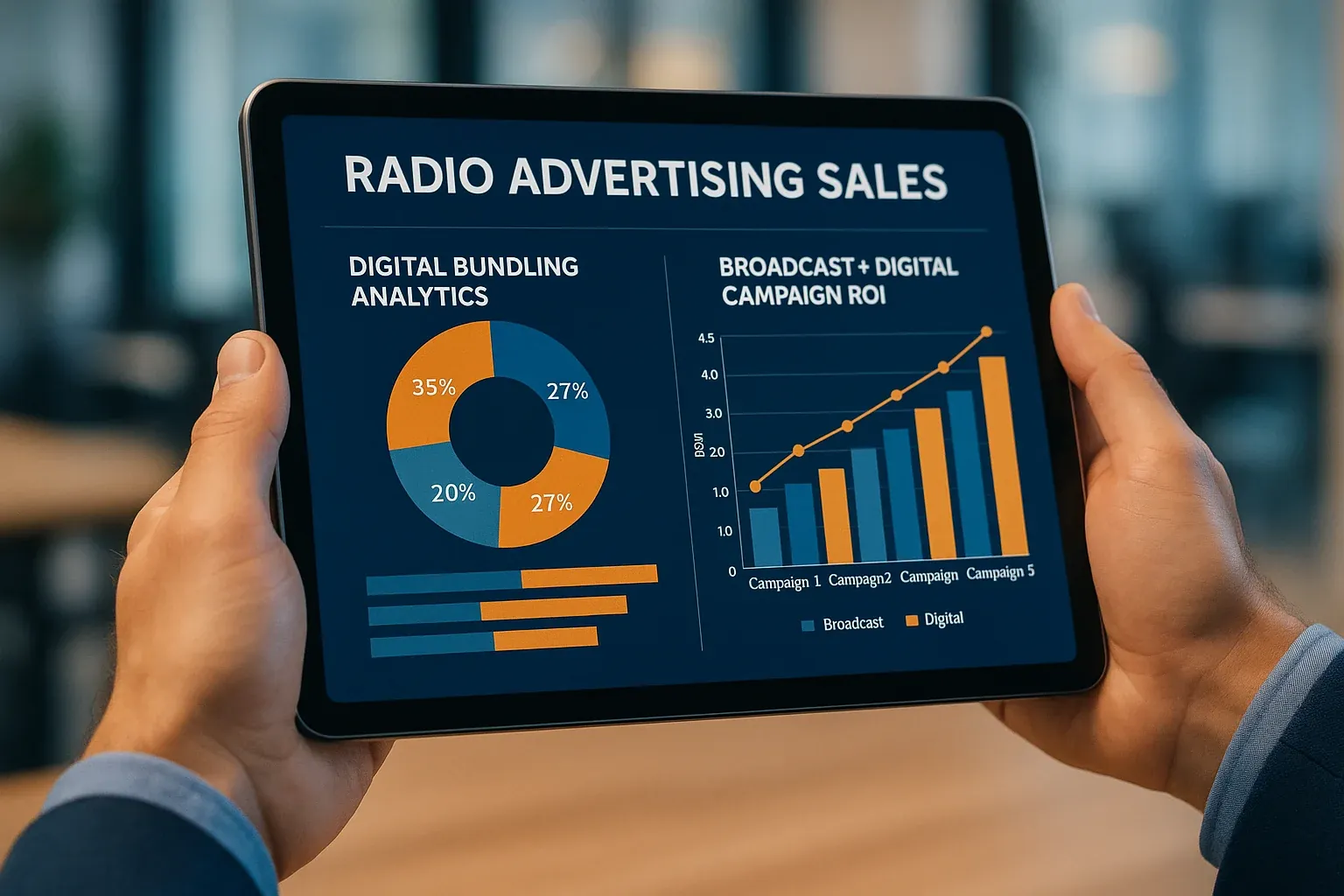
What's working: digital bundling
The top 5% of radio clusters are generating three to four times more digital revenue than similar-sized competitors. What separates them? They don't sell radio. They sell integrated campaigns.
Broadcast plus digital pairings are outperforming either channel alone. Think about it from the advertiser's perspective: radio drives reach and awareness while digital captures the conversion. It's the most powerful pairing in modern local advertising, and the stations proving it with data are winning budgets that used to go entirely to Google and Meta.
Here's what a strong bundle looks like in practice. A local auto dealer runs drive-time spots for brand awareness, paired with geo-targeted display ads retargeting listeners who visited the dealership website within 24 hours. The radio spot creates the interest. The digital follow-up captures the lead. And the station owns attribution for both — which means the client renews.
RAB President Mike Hulvey nailed it: "Advertisers are recognizing digital services as part of radio's marketing toolbox." The sellers who've internalized that aren't pitching spots anymore — they're pitching solutions.
Local businesses now employ three times more in-house marketing professionals than a decade ago. These buyers are savvier than ever. They want integrated campaigns with clear performance data, and they're comparing your pitch to what Facebook's business manager offers. If your bundle doesn't include reporting, you're bringing a knife to a data fight.
If you want to dig deeper into proving campaign value to advertisers, our guide on radio advertising ROI breaks down the full attribution framework.
What's working: host-read ads and live reads
Here's a data point that should change how you sell: host-read ads deliver double the lift compared to prerecorded spots. Double. That's not a marginal improvement — it's a completely different tier of performance.
Why? Because listeners trust their hosts. When your morning show personality recommends a restaurant or a local business, that carries the weight of a personal recommendation. No programmatic display ad can compete with that. And consider the broader audio landscape: AM/FM radio still commands 64% of ad-supported audio share, dwarfing Spotify at 6% and Pandora at 5%. That's not a shrinking medium — that's the dominant one.
The smartest sellers in 2026 are positioning on-air talent as brand ambassadors — authentic voices that extend across social media, podcasts, and live events. One industry executive told Radio Ink that radio personalities "need to become authentic social influencers," and they're right. Your talent isn't just your programming asset. They're your most valuable sales tool.
Think about the math. Adding AM/FM radio to a digital-only ad plan increases reach from 33% to 74% of the U.S. population. That's a stat your sellers should have memorized. When a local business owner says "I just use Facebook ads," the response writes itself.
This connects directly to why building listener loyalty matters so much for your revenue story. Loyal listeners don't just tune in — they act on what they hear.
What's working: hyperlocal campaigns
Sixty-three percent of consumers react more positively to localized advertising. That's according to BIA Advisory Services, and it tracks with everything I'm seeing in the market.
National brands are pushing more budget into community-level campaigns, especially in real estate, dining, and leisure. And radio has a structural advantage here that no digital platform can replicate.
As Loyd Ford wrote in Radio Ink just last week: "No algorithm understands a town like a local broadcaster."
That's not nostalgia talking. It's strategy. Your sellers know which businesses just opened, which are struggling, and which local events are coming up. They can design campaigns rooted in actual community context — not keyword targeting, not demographic overlays, but genuine local insight.
The stations winning local ad dollars in 2026 are the ones whose sellers show up as community marketing consultants, not just ad reps with rate cards. They're walking into meetings with ideas, not just inventory. "Here's a Valentine's Day campaign tied to three local restaurants and our morning show" lands differently than "here are our Q1 rates."
iHeartMedia's 2026 outlook puts it sharply: audio "deserves a bigger footprint in the media mix." But that bigger footprint only happens if sellers can articulate why — with local proof points, not national averages.
What's not working: selling reach without proof
Here's the uncomfortable truth: radio delivers $12 for every $1 spent, according to Nielsen. It reaches 92% of American adults monthly. AM/FM holds 64% of ad-supported audio share.
And yet less than half of marketers believe radio advertising is effective.
Why the disconnect? Because most stations still walk into sales meetings with reach numbers and gut feelings while competing against digital platforms that produce attribution reports at the click of a button. In 2026, proving ROI isn't a nice-to-have. It's the baseline expectation.
The RAB study found that sales training is the single most important driver of digital revenue growth. Not new technology. Not better products. Training your team to talk about attribution, connect campaigns to measurable outcomes, and present data confidently.
If your sales team can't answer "how will I know this worked?" with specific metrics, you're losing deals to platforms that can. Understanding how AI is transforming radio content creation can help your team pitch smarter across the entire sales process.
What's not working: ignoring the digital shelf
Three-fourths of radio buyers haven't adopted your digital products. That's an opportunity, sure — but only if your sellers know how to pitch them.
Too many stations have sellers who are great at the broadcast side but freeze up when the conversation turns to programmatic, social, or streaming. The generational pairing strategy — combining veteran sellers' negotiation skills and local knowledge with younger digital natives' platform fluency — is one of the smarter moves I've seen this year.
One sales manager told me they make mentorship flow both directions. Experienced reps teach client relationship nuance. Newer sellers push experimentation with digital tools and data. It works because it respects what both sides bring to the table.
The client education angle matters too. Radio Ink's reporting on top digital sellers emphasizes one thing above all: "Teach them how targeting, reporting, and multi-platform strategy actually work." Your clients don't need to understand the plumbing. They need to understand why their phone rang more on Tuesday after the morning spot aired.
The sales teams that treat digital as someone else's job are falling behind fast. By the end of 2026, the must-have capability will be translating platform complexity into clear actions tied to business outcomes. If your sellers can't do that, start the training now.
What's not working: over-commercialization
Radio World's analysis for 2026 hit on something that sales teams need to hear: the average listener attention span is seven seconds. Seven. If your station doesn't capture attention immediately, you've lost them to Spotify or silence.
Excessive commercial breaks create the kind of mental fatigue that pushes listeners away. And here's the sales paradox: fewer, better-placed spots actually perform better for advertisers. Higher quality inventory commands premium pricing. Listeners stay through the break. Advertisers get better results.
The philosophy gaining traction is "doing less while doing it better." That means fewer spots per break, tighter execution, and premium positioning — not a race to fill every available second with inventory.
It's a hard conversation to have with a sales manager chasing quarterly numbers. But the stations that resist the temptation to over-commercialize are building more valuable audiences — which means more valuable inventory long-term.
Key takeaways
The radio sales landscape in 2026 comes down to a few clear patterns:
- Digital bundling is the growth engine. Stations pairing broadcast with digital attribution are winning budgets. Three-fourths of buyers haven't adopted yet — that's your runway.
- Host-read ads deliver double the lift. Position your talent as brand ambassadors across every platform, not just on-air.
- Hyperlocal is your moat. No algorithm can replicate genuine community knowledge. Sell that advantage.
- Attribution is now mandatory. If you can't prove it worked, you'll lose to someone who can.
- Train for digital fluency. Pair veteran sellers with digital natives. Make mentorship bidirectional.
- Resist over-commercialization. Fewer, better spots build more valuable audiences and command premium rates.
The sales teams thriving right now aren't necessarily the ones with the best products or the biggest markets. They're the ones that adapted their approach to match what buyers actually want: integrated solutions, measurable outcomes, and authentic community connection.
The old playbook isn't dead. But the chapters that still work look very different from the ones that don't. For more on the broader shifts shaping the industry this year, check out our full breakdown of radio industry trends to watch in 2026.
FAQ
What's the biggest change in radio sales in 2026?
The shift from "spot sales" to "integrated audio solutions" is the defining change. Buyers want packages that combine broadcast reach, streaming, podcast, and digital display — not standalone 60-second spot buys. Sales teams that can sell integrated solutions are seeing rate premiums; teams still selling pure spot inventory are losing share to digital audio platforms.
Is digital radio revenue really growing while core radio declines?
Yes. BIA forecasts 2026 radio digital revenue at $2.5B — up 9.5% year-over-year — while core broadcast advertising declines approximately 2.2% per year. The net is that total radio industry revenue is roughly flat to slightly up, but the composition is shifting rapidly toward digital. Stations that don't have a digital sales motion are losing revenue even when their broadcast ratings are healthy.
What kinds of sponsors are radio sales teams winning in 2026?
Integrated digital buyers (brands that want a combined broadcast + streaming + podcast package), local service businesses (home services, auto, healthcare) that benefit from radio's local-authority positioning, and community-event sponsors (fairs, festivals, school partnerships) that pair broadcast reach with digital amplification. Categories that are tougher: national spot-only buys, short-flight campaigns, and pure price-driven tactical buys. Which categories are in-market also shifts by season — see our guide to summer radio sales for the verticals that buy specifically in the Q3 book.
How should radio sales teams structure commission in 2026?
Move commission structures to reward integrated sales, not just broadcast spot volume. Teams seeing the best results use tiered commission — higher rates for multi-channel integrated buys, lower rates for pure broadcast-only deals. This aligns seller incentives with the actual revenue mix buyers want to purchase.
What's the single biggest radio sales mistake we should avoid in 2026?
Continuing to lead with "our cume is X, our rate is Y" against buyers who want outcomes. The sellers that win in 2026 lead with the buyer's business problem (retention, new customer acquisition, market expansion), show how radio solves it, and then back up the pitch with broadcast reach, digital engagement, and measurable outcome data. The old "reach and frequency" pitch alone loses deals it would have won five years ago.
Ready to simplify your show prep?
Try RCP free for 7 days. $0 until day 8