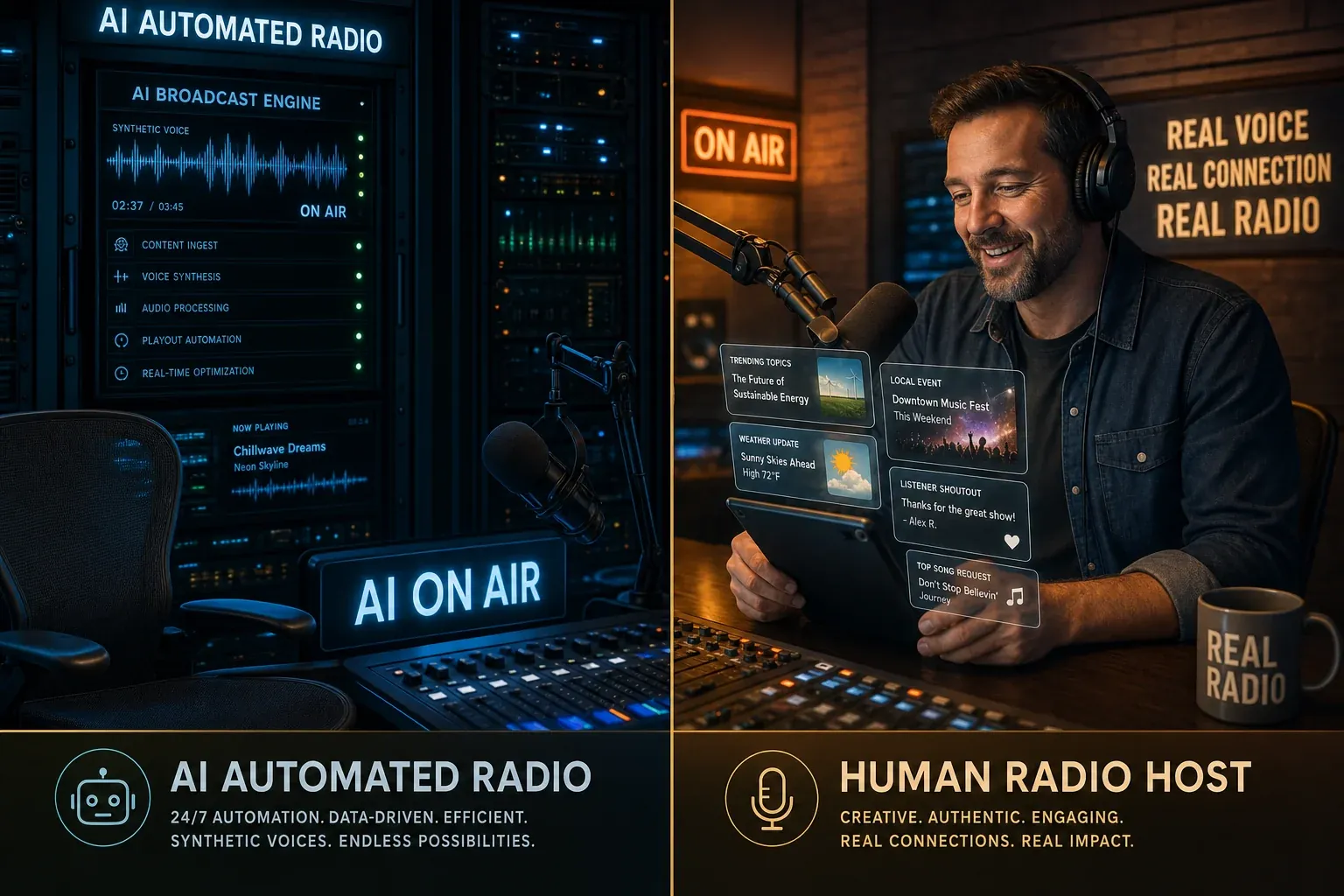

The radio industry talks about "AI" as if it's one thing. It isn't. Two categories of products are both being marketed under the same word, they do nearly opposite things, and stations are signing contracts for one when they actually needed the other. The vendors aren't lying — they're just using the same shorthand for products built on different premises.
This piece is the honest version: what an AI radio host is, what AI show prep is, where each fits, and the four-question framework that tells you which one your station should be evaluating. Definitions, tradeoffs, a side-by-side, and a decision rule you can run in five minutes.
The Two Categories, Defined
Strip the marketing copy off both sides of the AI conversation in radio and you're left with two cleanly different products.
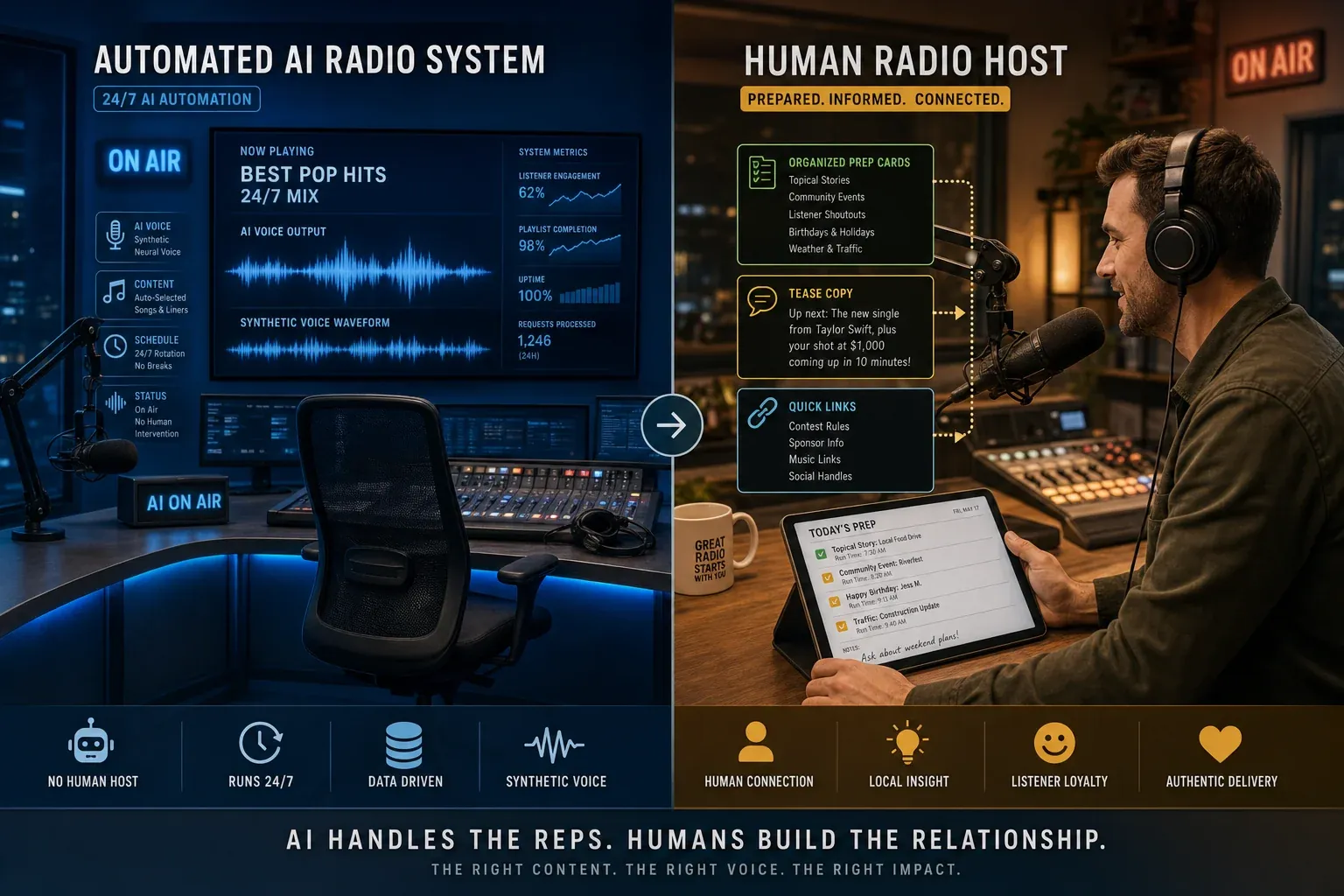
AI radio host — synthetic voice plus AI-generated content plus automated playout, packaged to fill airtime that used to be filled by a live or voice-tracked human. The product replaces a position. Examples in the category: Futuri's RadioGPT, AI Radio Bot, and the voice-AI components inside platforms like Quu.
AI show prep — research, daily content, format-tuned teases, social copy, and digital companion articles delivered to a human host's inbox or dashboard. The product augments a position. Examples in the category: Radio Content Pro, TopicPulse, and AI ShowPrep.
The distinction matters because the buying decision is fundamentally different. One question is should this airshift exist with a human in it? The other is how do I make the human in this airshift more effective? Vendors blur the line because "AI for your station" sells better than the more honest pitch. The blur is also where stations get burned — buying replacement when they meant to buy augmentation, or vice versa.
What an AI Radio Host Actually Does
The mature version of an AI radio host stitches three things together: a cloned or synthesized voice, an LLM that writes the talk breaks, and an automation system that schedules everything against your music log. The output is a finished hour of radio with no human in the chain.
Voice quality has crossed a threshold most PDs haven't fully internalized. Industry tests where listeners try to identify which segment is AI are now genuinely hard — a handful of years ago they were a parlor trick, today they're a coin flip in some formats. The question isn't "can it sound like a person?" anymore. It's what kind of person, doing what kind of show, and whether your audience would care if they knew.
When AI radio host fits:
- Overnight automation in markets where you'd otherwise be running unattended satellite or syndicated programming
- Secondary or HD subchannels in a cluster where a live talent budget was never going to exist
- Voice-tracked dayparts where the talent was already producing breaks in batches and the differentiator was administrative, not creative
- Specialty streams (genre-specific spinoffs of a main signal) that need a presenter but can't justify a salaried one
Where the friction shows up:
- Union and AFTRA talent contracts that explicitly cover synthetic-voice replacement
- Sponsor reads where the advertiser bought a personality endorsement, not a generic delivery
- EAS and live emergency response, which the FCC still expects a human to manage in a meaningful way
- Listener trust under disclosure rules — the regulatory floor on AI disclosure is moving, and what's permissible today may require explicit on-air labeling tomorrow
- The talent pipeline. A station that staffs zero live dayparts produces zero people who could be promoted into a market manager role in five years
For the stations doing this well, AI hosts are filling the slots that were already being filled by absentee programming. The mistake is using them as a budget cut against live dayparts that were performing.
What AI Show Prep Actually Does
AI show prep runs in the other direction. The product doesn't replace anyone — it makes the people already at the mic more effective. A typical workflow:
- The platform monitors thousands of news, music, and culture sources continuously.
- It filters and ranks stories against your station's format profile (Country looks for different stories than CHR; News/Talk looks for different stories than both).
- It writes ready-to-deliver elements — teases, talk break copy, social posts, full digital articles — in the voice your show actually uses.
- Your morning show, midday personality, or afternoon drive host opens the dashboard at 4 AM and finds prep that's already format-aware.
The promise is time, not headcount. Stations using a mature AI show prep system report saving 10+ hours a week per show on the parts of prep that used to be manual — story scanning, tease drafting, social copy, digital companion writing. The hours don't disappear from the building; they get reallocated to the work that actually moves ratings.
When AI show prep fits:
- Any live daypart where the talent is stretched (so, almost all of them)
- Stations in tight markets that can't justify a dedicated content team but still want their on-air to sound prepped
- Multi-station clusters that need format-specific prep across CHR, Country, AC, and News/Talk without doubling staff
- Talent who are personality-strong but research-weak — the AI handles the ingestion, the talent handles the delivery
Where the friction shows up:
- It still requires a human at the mic. The ROI is talent retention and content quality, not labor cost replacement.
- Generic AI prep (the kind that just summarizes Google News) underdelivers; format-specific prep is the version that actually helps.
- Workflow integration matters more than feature lists. Prep that doesn't fit how your show actually runs at 5:30 AM never gets used.
The frame I'd use: AI show prep does roughly 90% of the manual content work. Your talent supplies the 10% that makes it sound like your show — the local references, the personality, the on-air relationship with your audience. That last 10% is also the only part listeners actually care about.
Side-by-Side: Where the Two Categories Actually Differ
| AI Radio Host | AI Show Prep | |
|---|---|---|
| What it does | Replaces a host position | Augments a host position |
| Output | Finished audio hours | Prep, teases, social, digital copy |
| Best fit dayparts | Overnights, automation, HD subchannels | Live morning, midday, drive |
| Setup time | Weeks (voice clone + log integration) | Days |
| Typical cost band | $$$ enterprise + per-station fees | $99–$1,500/mo subscription, no-contract options exist |
| Talent impact | Eliminates the position | Frees up the position's time |
| Listener disclosure | Increasingly required | None typically required |
| Sponsor read flexibility | Limited (pre-cloned) | Full (human delivers) |
| Risk if you pick wrong | Listener trust, talent pipeline, contract exposure | Underinvestment in prep tooling |
| Representative products | RadioGPT, AI Radio Bot, voice-AI add-ons | Radio Content Pro, TopicPulse, AI ShowPrep |
The table above is the part most "AI for radio" pieces skip — they describe the products without naming the categorical differences, which is exactly why so many stations are buying confused.
Which One Fits Your Station? A 4-Question Framework
You don't need a 30-minute discovery call to know which category you're in. Run these four questions and the answer is usually obvious.
1. Are you trying to fill airtime, or improve airtime?
If the slot you're solving for currently runs unattended automation, syndicated filler, or a generic voice track from another market — you're filling airtime. AI radio host is the right category to evaluate. If the slot already has a live host and the problem is that they're underprepped, overworked, or running on fumes — you're improving airtime. AI show prep is your category.
2. Do you have live talent in the dayparts where you'd apply this?
If yes, almost any AI deployment that touches those dayparts should be augmentation, not replacement. Replacing performing live talent with AI is one of the few moves in radio that lights up morale, contracts, listener trust, and trade press all at once. Almost never worth it. (The broader industry context lives here.)
3. What's your listener-trust tolerance?
Some audiences are categorically sensitive to AI on the air — News/Talk in particular, where credibility is the product. Others (overnight CHR, beat-driven specialty streams) are less so. Be honest about which one your station is. The listener-trust math doesn't care about the budget math.
4. What's the actual budget reality?
AI host platforms tend to land in enterprise pricing — multi-station group commitments, integration services, voice licensing. AI show prep is closer to a SaaS subscription, often $99/month for a single-station deployment with no contract. The conversation with your CFO is fundamentally different in the two categories. Don't let an enterprise sales cycle convince you you're solving a problem you're not.
The 80% rule we see: stations that score "improve airtime, live talent, medium-to-high trust sensitivity, SaaS budget" should be looking at AI show prep. Stations that score "fill airtime, no live talent, lower trust sensitivity, enterprise budget" can responsibly evaluate AI hosts. Stations that score mixed — most of them — usually want a hybrid.
The Hybrid Most Stations Actually Need
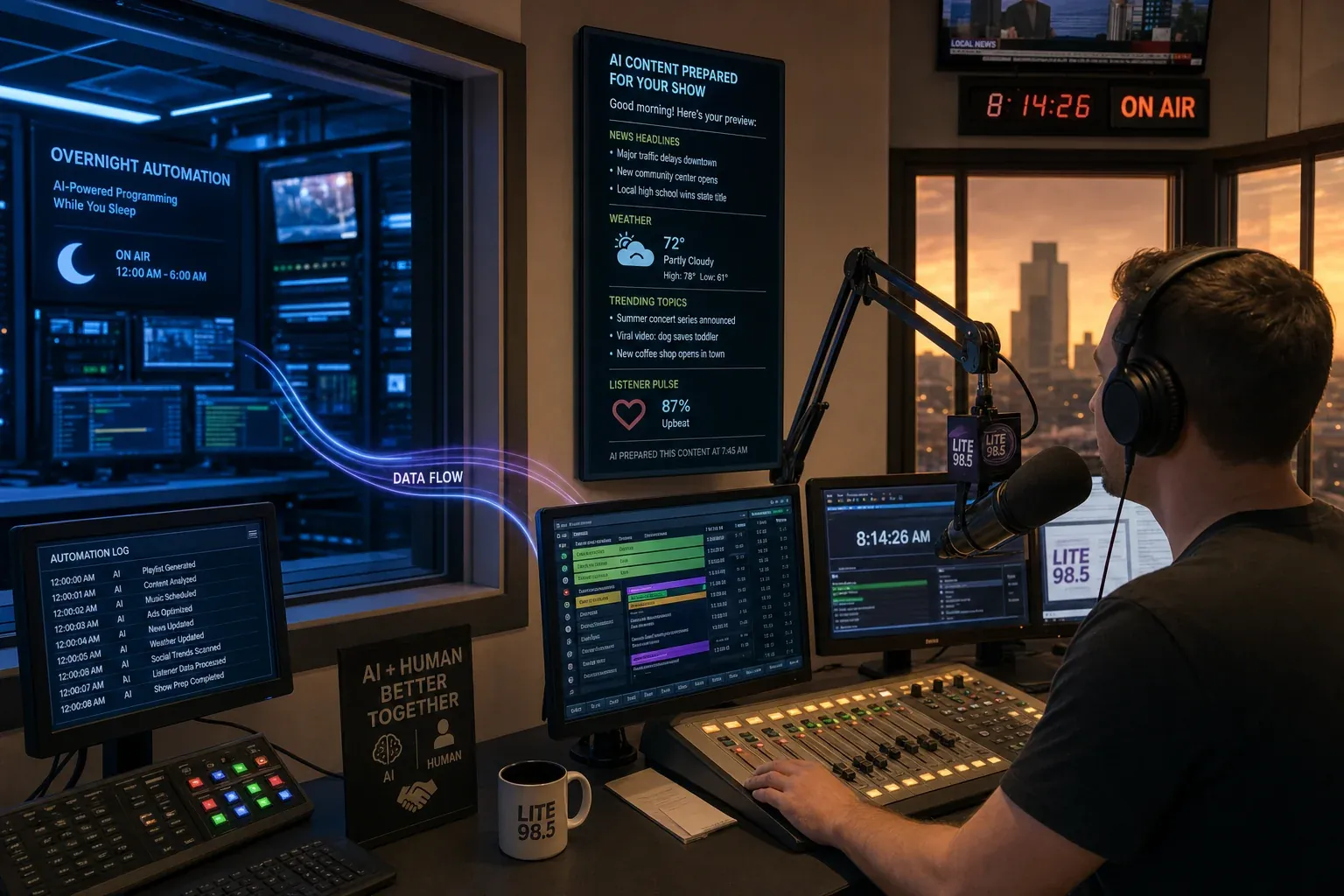
Almost no one I'd advise should go all-in on either side of this category split. The realistic deployment for a typical AM/FM cluster in 2026 looks more like this:
- Live dayparts (morning, midday, drive) get AI show prep to lift the talent already there.
- Overnight, weekend non-music hours, and HD subchannels get AI host automation instead of unattended satellite filler.
- The cluster's News/Talk station — and any heritage personality with deep audience trust — stays human-everywhere on principle, with AI prep behind the scenes.
That hybrid is what "AI for radio stations" actually looks like once you take the marketing layer off. It's also where most groups end up after a year of trial and error, because the alternative — picking a single category and forcing it across every signal — almost always under-delivers somewhere.
If your station is at the augmentation end of that hybrid and you want to see what format-specific AI show prep looks like for your format, that's the live demo conversation worth having. The category fit matters more than the brand pick.
Want a personalized walkthrough?
Schedule a 15-minute demo with our team.
FAQ
Will AI replace radio hosts?
In any meaningful way, no — not the live, audience-facing dayparts that drive ratings. AI is replacing the airtime that was already filled by automation, syndication, or unattended voice tracking. The hosts whose job is the relationship with their audience aren't being replaced; the hosts whose job was filling time often already weren't doing it live.
Is AI show prep the same as ChatGPT?
No. ChatGPT is a general-purpose text model. AI show prep platforms are built around radio's specific workflow — format profiles, dayparts, tease structure, sponsor-aware copy, and integration with how a show actually runs at 5 AM. Plenty of hosts use ChatGPT alongside an AI prep platform; almost no station can run on ChatGPT alone.
How much does an AI radio host cost?
Costs vary widely and most vendors don't publish public pricing. Enterprise AI host platforms typically land in multi-thousand-dollar monthly ranges per station, plus integration and voice licensing. AI show prep, by comparison, runs from around $99/month for a single-station SaaS deployment up through enterprise tiers for multi-station groups. The pricing categories are different enough that comparing them line-by-line usually doesn't make sense.
Do listeners need to be told if their station uses AI?
Disclosure rules are evolving. The FCC has been actively considering on-air disclosure requirements for AI-generated content, and several state-level rules already require disclosure in political advertising. The safest current posture for AI host content is to assume disclosure is coming and design your imaging accordingly. AI show prep, because the human host is still delivering the content, generally doesn't carry the same disclosure exposure.
Can a station use both AI host and AI show prep?
Yes — and most stations that take AI seriously end up doing exactly that. AI show prep on the live dayparts where talent is stretched, AI host automation in the slots that were already running unattended. Treating them as a category choice instead of an either/or is how the deployment usually works in practice.
What's the difference between AI show prep and traditional show prep services?
Traditional services like the long-running prep sheets deliver static content on a daily or weekly cadence. AI show prep updates continuously, filters by format, and generates the prep in deliverable form (teases, social, digital) instead of leaving the host to translate it. Most stations evaluating the switch are coming off a traditional service that's started to feel slow against an audience that moves at internet speed. (Side-by-side of three AI show prep services here.)