
If you're running a station in a market under 100, you've probably noticed something about the way the AI-for-radio conversation gets covered. The case studies are about iHeart clusters and Audacy networks. The vendor decks pitch enterprise contracts that start north of $20,000 a year. The TopicPulse and Futuri pricing pages don't even publish a number — that alone tells you who they're built for.
Meanwhile, the actual majority of U.S. radio stations are in markets 100 and smaller, where the morning host is also the production director, the GM is also the local sales manager, and the entire technology budget for the year wouldn't cover one quarter of an enterprise show prep contract. We hear from small-market stations every week, and the question is almost always the same: what AI tools actually work for us?
Industry voices are catching up to the problem too. News/Talk programmers have started calling it the "show prep crisis" — the moment when listeners can get the same baseline content anywhere, and the only differentiator left is what your local host adds on top. That crisis hits small-market stations first and hardest, because they have the fewest hands to add the differentiator with.
That's what this guide is for. You'll get an honest, budget-bracketed AI stack at three real price points, the solo-host workflow that ties it together, and a clear-eyed list of the enterprise tools you can safely skip. I'll be straight with you about RCP's place in this — including where I think it's not the right fit.
Why Small Markets Need a Different AI Stack
The AI tools built for major-market clusters assume a world that doesn't exist in small markets. They assume a content director who can configure dashboards. They assume a producer who can train hosts on new workflows. They assume an IT person who can manage integrations. They assume a sales team big enough to monetize whatever the AI generates.
In a small market, all of those people are usually one person. Often that person is also on-air four hours a day.
What small-market stations actually need from AI is short and specific:
- Transparent flat pricing that doesn't require a six-week procurement conversation
- Solo-friendly workflows that work the moment you log in, with no training or onboarding consultant
- Format-aware content that doesn't assume a 10-person morning team to execute it
- Workflows that compress prep time — not new tasks layered on top of existing ones
The good news: the AI landscape has finally caught up. The same kinds of capabilities that powered major-market workflows a year ago — daily content curation, format-specific kits, AI chat with industry context — now exist at small-market prices. You just have to know where to look and what to skip.
The Three Budget Brackets That Actually Match Small Markets
Forget the listicles that tell you to "consider your budget." Here are three actual brackets, with named tools and real prices, mapped to the kind of station you're running.
Bracket 1: $0–50/Month — The Starter Stack
Best for: Owner-operators, single-station LPFMs, community stations, internet broadcasters, or anyone testing the AI waters before committing real budget.
The stack:
- ChatGPT Free or Plus ($0–$20/mo) — Brainstorming, talk break ideation, social copy. The practical ChatGPT for radio guide covers the prompting formulas that make it usable.
- Canva Free or Pro ($0–$15/mo) — Social graphics, on-air promo cards, podcast thumbnails
- Otter.ai Free or similar transcription — Turn your show audio into blog posts, social copy, and search-friendly recap content
What you give up: Format-specific curation, real-time news filtering, station context that persists across sessions, and daily delivery. You're building everything from a blank slate every morning.
Honest take: This stack works if you have time but no money. You're trading 60 to 90 minutes of daily prep time for the dollars you're not spending. That math works for an unpaid volunteer host. It almost never works for a paid solo host whose hourly value already exceeds the cost of moving to Bracket 2.
Bracket 2: $50–150/Month — The Working Solo Host Stack
Best for: A real solo host on a real terrestrial station, doing one or two dayparts plus voice-tracking afternoons, with a content budget but no producer or production assistant.
The stack:
- Radio Content Pro ($99/mo flat) — Daily, format-specific content delivered every morning, with built-in AI chat that understands radio. No contracts. No setup fees. Same price for every market size.
- ChatGPT Free — For the one-off ideation tasks that don't need radio-specific context
- Descript Free or Riverside Free — Quick clip editing for social, transcript-based audio cleanup
What you get back: 60 to 90 minutes of daily prep time, content that's already filtered for your format, social posts ready to ship, and a chat assistant that knows the difference between a CHR break and a Country break.
Honest take: This is where the math tips. If your time is worth more than $25 an hour to your station, the $99 RCP subscription pays for itself in the first week of use. For a paid solo host, this is the bracket that actually changes the day.
Bracket 3: $150–400/Month — The Multi-Station Group Stack
Best for: A 2- to 4-station group, a couple of solo hosts, maybe a part-time digital coordinator. You're running real ops on a real budget but you still don't have anything close to enterprise resources.
The stack:
- Radio Content Pro ($99/mo) — Base content engine for every station
- RCP Local add-on ($99/mo) — Local news automation for digital sites and station socials
- ElevenLabs Starter (~$22/mo) — AI voiceovers for promos, imaging liners, and weekend automation
- Descript Pro (~$24/mo) — Full audio and video editing with AI transcription
- Buffer or Later ($15–$35/mo) — Multi-station social scheduling
Honest take: Under $300 a month total. That replaces a part-time producer's worth of work — and gives you capabilities that most small-market groups didn't have at any price 12 months ago. The bonus play in this bracket is content multiplication: stations that use this stack tell us their social media output stops being a separate chore and starts being a natural byproduct of show prep. One story per morning becomes the on-air break, three social posts, a station-blog snippet, and a short reel. If you have a sales team that can package even one new digital revenue product on top of that, the whole bracket pays for itself in a single quarter.
The Solo Host Daily Workflow With AI
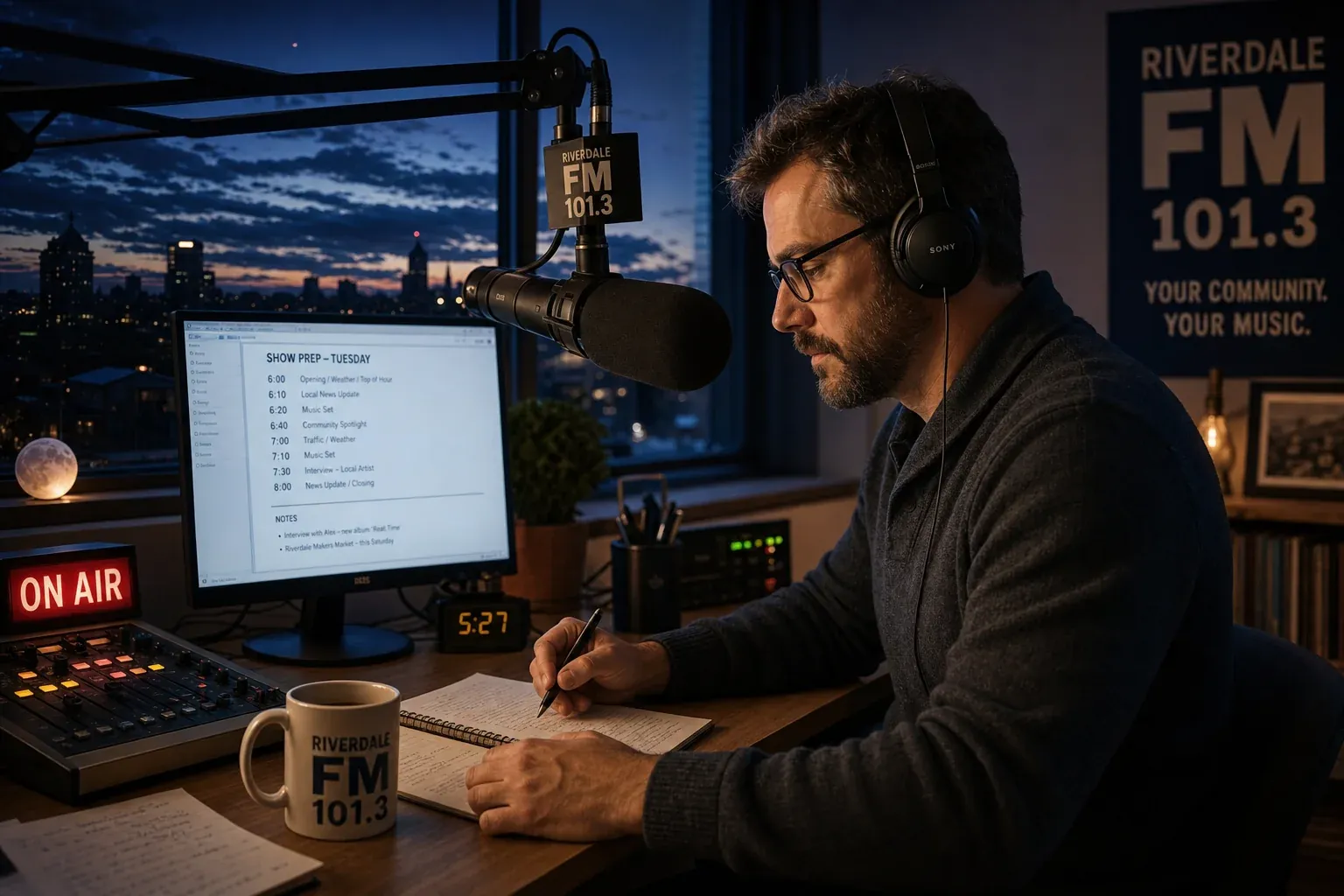
The brackets only matter if there's a workflow that holds them together. Here's the one we hear works best for solo hosts running a Bracket 2 stack — built to compress morning prep into about 40 minutes total, before the show ever starts.
6:00 AM (10 min) — Open RCP, scan today's format kit Pull 3 to 5 stories that fit your show. Format kit means it's already filtered for your audience.
6:10 AM (15 min) — Use the AI chat to localize and angle Ask it to localize one or two stories to your market. Sketch talk break angles. This is where most of the actual creative work happens, and it goes faster with a chat assistant that knows what a talk break is.
6:25 AM (5 min) — Grab the social posts RCP generates them per story. Queue the day in Buffer. Done.
6:30 AM (5 min) — Local news scan Your own market. No AI replaces this. Spend five minutes on local news sites, your station's police-scanner Slack, whatever your sources are. Local is your moat — protect it.
6:35 AM (5 min) — Build the rundown One page. Break order. Time targets. Done. Stations tell us this is also where they batch out the day's traffic and weather service-element copy with AI — the kind of mundane, repeating elements that absolutely don't need a human writing them from scratch every morning.
6:40 AM — You're done with prep Show starts at 6:00. You've already had 40 minutes more sleep than the host across the street who's still hunting headlines on three different sites. For a deeper version of this, the step-by-step show prep workflow breaks down each phase in detail.
What Small Markets Should Skip
Just as important as the buy list — the skip list. These categories burn small-market budgets fastest.
Enterprise show prep contracts. Futuri, TopicPulse, and similar platforms aren't bad products. They're just priced for major-market clusters with content directors and IT staff. Pricing isn't published for a reason — and that reason is "if you have to ask, you're not the customer." For most small markets, the TopicPulse vs Radio Content Pro comparison makes the math obvious.
Custom AI build-outs. Every "let us build your station a custom AI" pitch this year has been priced for VC-backed companies, not small-market broadcasters. If a vendor can't quote you a flat monthly price on the first call, walk.
AI DJ replacements. RadioGPT-style synthetic-host platforms are real, and for some applications they're useful. But the only competitive advantage a small-market station has against streaming is being live, local, and human. Replacing the human voice with a synthetic one removes the moat. Use AI to support hosts — not replace them.
Generic AI marketing platforms. The ones that promise "AI-powered content for any business" don't understand format clocks, talk breaks, or imaging copy. You'll spend more time teaching the tool what radio is than you'll save using it. Pick tools built for radio, or don't pick them at all.
Anything that requires a 6-week onboarding. If you can't get value in week one, you won't get value at all. Small-market workflows can't absorb a multi-month rollout — your day job is already three jobs.
A Quick Honest Word About RCP
I represent Radio Content Pro, so take this with the grain of salt that deserves. The flat $99-a-month price exists specifically because we built RCP for the markets the enterprise tools forgot. It's the same content engine that powers shows in major markets — same format kits, same daily delivery, same AI chat — but without the contract negotiation, the procurement cycle, or the per-market pricing surprise.
If RCP isn't the right fit for your station, the complete AI tools for radio stations roundup and the show prep services compared guide will give you the honest landscape. I'd rather you find the right tool than the RCP-shaped one.
How to Pilot AI Without Wasting Money
Three rules that separate small-market AI wins from small-market AI regrets:
- Pick one workflow. Show prep, social, voice editing, transcription — pick one. Trying to overhaul everything at once guarantees the rollout fails and the budget gets pulled.
- Set a 30-day window. Use the tool every working day for a month. Track time saved. Don't evaluate based on vibes.
- If it doesn't save you 5+ hours in 30 days, drop it. That's the floor. A tool that saves you less than that is generating busywork, not capacity.
Small markets win the AI race by stacking small wins, not by buying the one enterprise platform that promises everything. Layer in tools one at a time. Measure each one. Keep what earns its keep.
Frequently Asked Questions
What's the minimum AI budget for a small market radio station?
Realistically, $0 if you're willing to spend the time on free tools (ChatGPT, Canva, Otter), or $99/month if you want a paid solution that compresses daily prep time. Anything in between tends to be a worse value than either pole — you pay for tools without getting the time savings of a real platform.
Can ChatGPT replace a paid show prep service for a small station?
For brainstorming and one-off creative tasks, yes. For daily, format-aware show prep with curated stories, social posts, and chat that understands radio context, no. ChatGPT generates content from a blank slate every session. A purpose-built service like Radio Content Pro delivers content that's already filtered for your format and refreshed every day. Use both — they solve different problems.
Are AI radio tools secure enough for FCC-licensed stations?
The major platforms — RCP, ChatGPT, ElevenLabs, Descript — all maintain enterprise-grade security and don't broadcast or publish your content without explicit action on your part. The FCC compliance question is about what you put on air, not the tool that generated it. Verify content the same way you'd verify any source: don't say it on air if you can't stand behind it.
How do I justify even $99/month to a budget-conscious GM?
Frame it as labor, not software. $99/month is roughly $1,200/year — the cost of one to two weeks of a part-time producer at small-market wages. RCP gives a solo host back 60 to 90 minutes a day. Over a year, that's 250+ hours back to the station. Even at the lowest hourly rate, the math beats any other tool you'd buy at that price.
Key Takeaways
- Small markets need a different AI stack than major markets — flat pricing, solo workflows, no procurement cycle
- Three budget brackets actually fit small markets: $0–50/mo (time-rich, money-poor), $50–150/mo (working solo host), $150–400/mo (multi-station group)
- The Bracket 2 stack pays for itself fast — RCP at $99/mo gives back 60–90 minutes of daily prep time
- Skip the enterprise tools, custom builds, and synthetic hosts — they don't fit the shape of small-market problems
- Small-market AI wins are built on stacked small tools, not one enterprise platform — pick one, measure it for 30 days, keep what earns its keep
- Local is your moat — no AI replaces real local awareness, so protect those minutes in the daily workflow
— Ava
Ready to simplify your show prep?
Try RCP free for 7 days. $0 until day 8