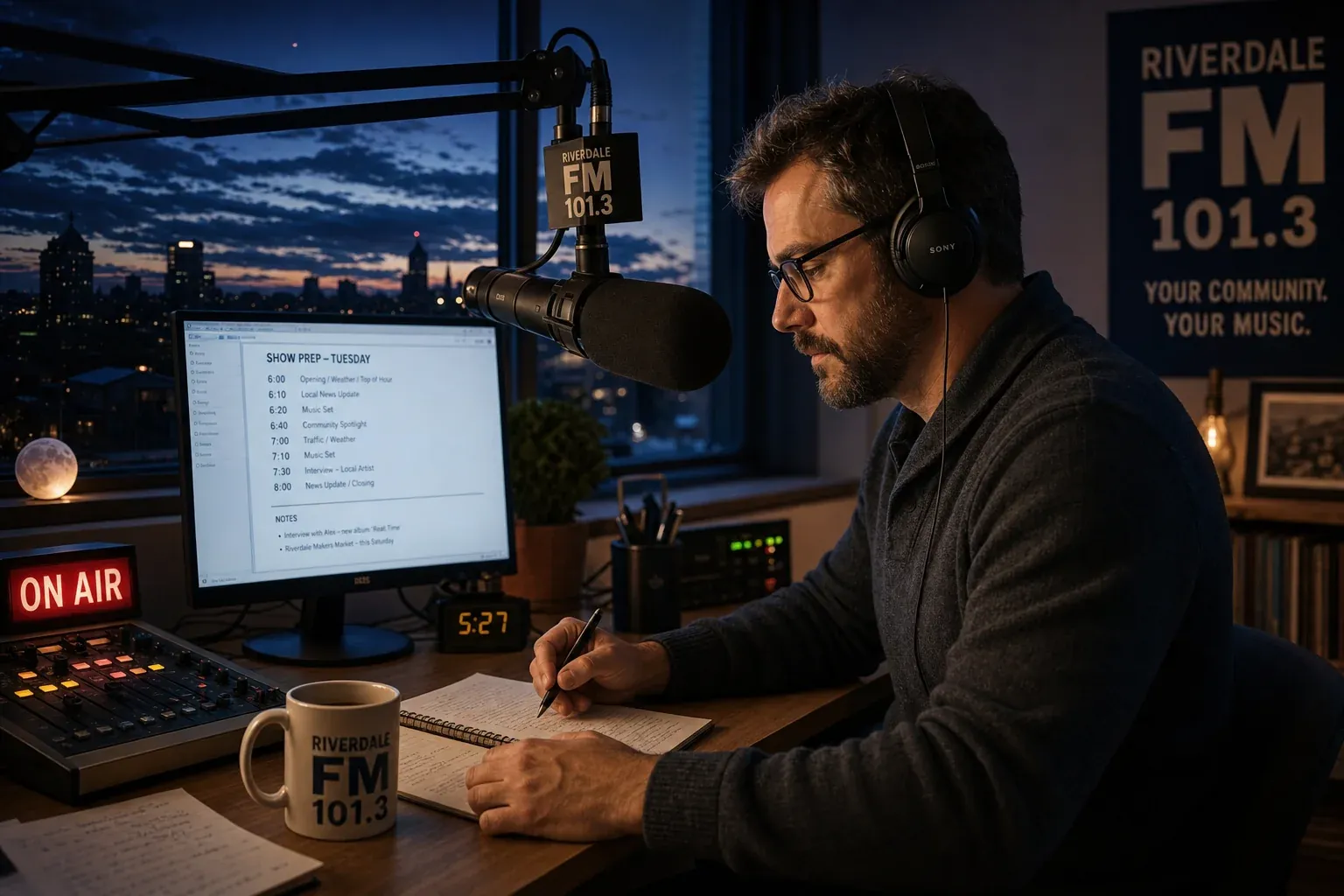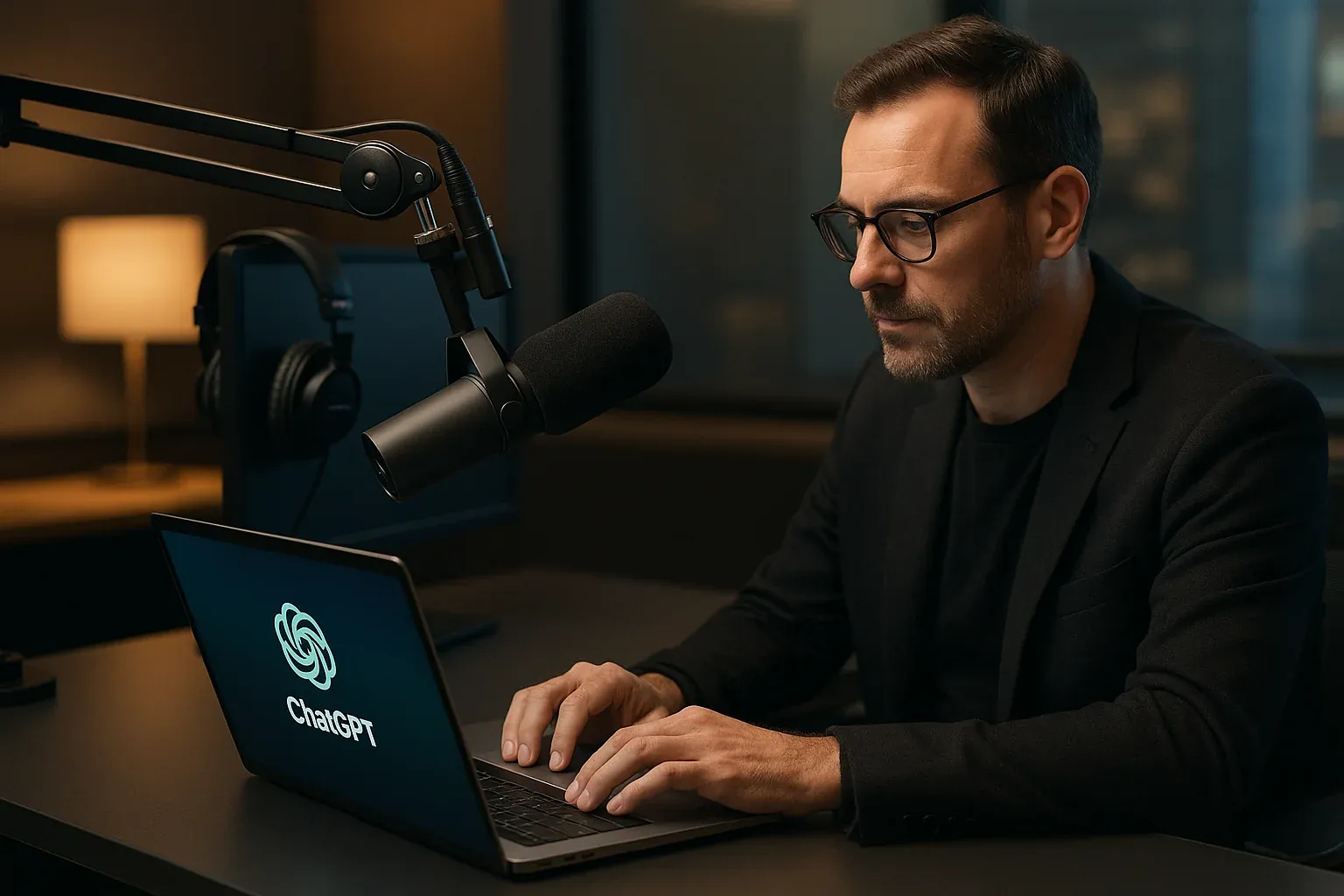

Most ChatGPT-for-radio guides online weren't written by anyone who's ever sat behind a board. They give you generic prompts that produce generic results, and miss the entire reason a radio host might want to use this free AI tool in the first place: format awareness, talk-break instincts, and the kind of audience read that takes years to develop. The interesting question isn't whether ChatGPT can help radio pros sound better on air — it's which specific use cases reward the time you spend prompting and which ones quietly waste it.
Here's what we hear from stations: some have built ChatGPT into their daily workflow and wouldn't give it up. Others tried it once, got a generic mess, and never came back. The difference almost always comes down to how you use it — specifically, how you prompt it with radio-specific context.
So that's what this guide is for. You'll get 10 practical use cases with real prompt examples you can copy and paste today, plus an honest breakdown of where ChatGPT falls short for radio work. I'll be straight with you about both sides.
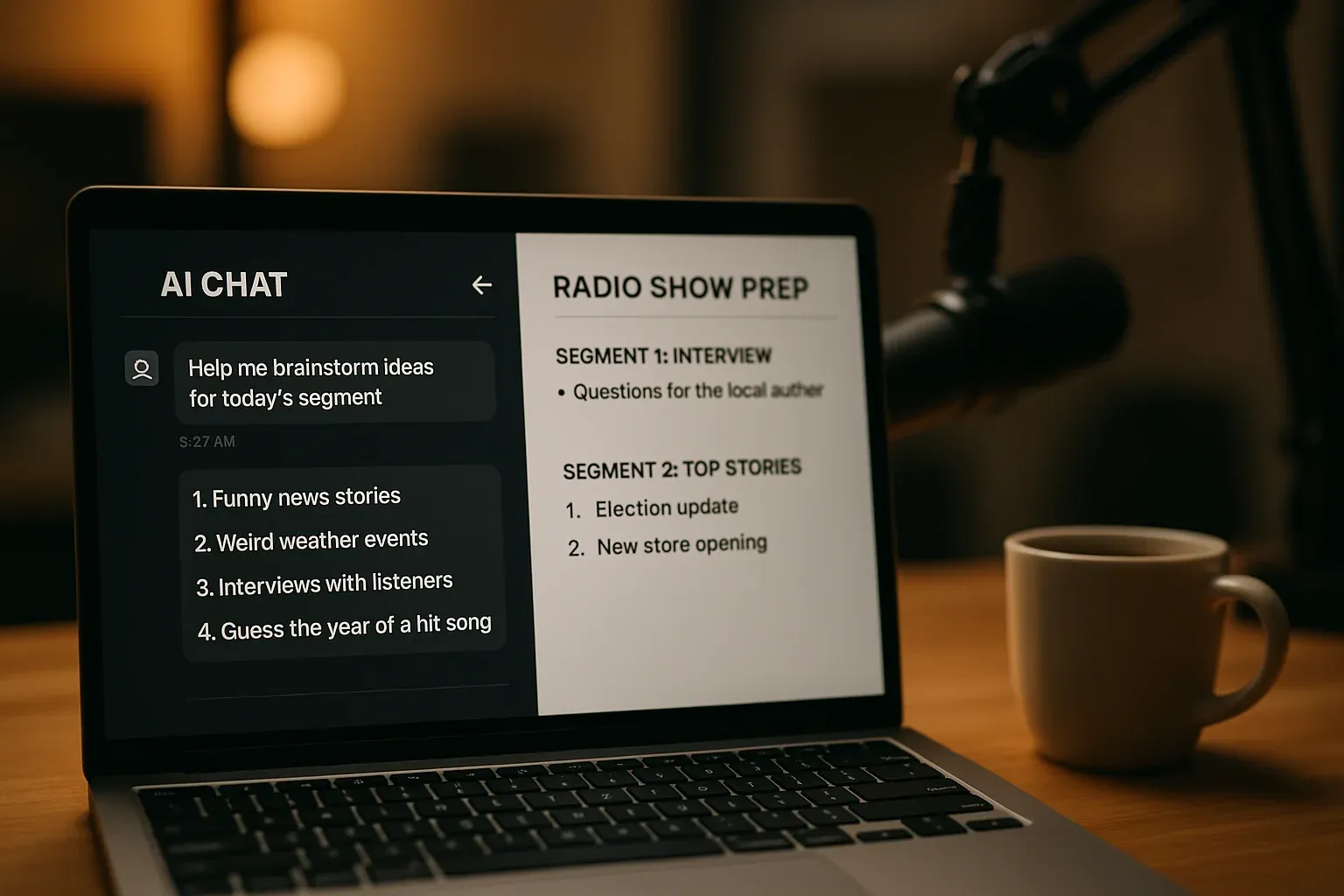
Why Radio Professionals Are Turning to ChatGPT
The math is simple, and kind of brutal. A morning drive host has maybe 45 minutes to prep a 4-hour show. An afternoon host might have even less. Most stations don't have the budget for a dedicated show prep service — or a full-time producer who can do the research for you. You're stretched thin, and something's got to give.
ChatGPT fills that gap at the lowest possible barrier to entry: free. You can open it on your phone in the parking lot 20 minutes before your shift and get something usable. That's genuinely powerful.
But here's the thing. ChatGPT is a general-purpose AI. It doesn't know what a format clock looks like. It doesn't understand why a Country talk break sounds different from a CHR talk break. It doesn't curate — it generates. And that distinction matters more than most radio pros realize when they first fire it up.
The hosts who get the most from it treat it like a brainstorming partner, not a producer. They give it context. They give it constraints. And they always, always edit what comes back.
Quick tip that pays off fast: stations that have already built a detailed listener persona — not just "women 25-44" but a fleshed-out profile with habits, frustrations, and media consumption patterns — get dramatically better ChatGPT output. The more specific your audience description, the less generic the results. I'd call this the single biggest prompt upgrade you can make.
10 Practical Ways to Use ChatGPT for Radio Show Prep
Here's where we get specific. These aren't theoretical — they're the use cases that actually save time in a real radio workflow.
1. Topic Research and Discovery
When you're staring at a blank prep sheet, ChatGPT can get you moving fast.
Try this prompt:
"Give me 5 trending conversation topics that would interest women 25-44 who listen to Hot AC radio. Focus on pop culture, lifestyle, and relatable daily life — nothing political. Include a one-sentence talk break angle for each."
The key is specificity. "Give me topics" gets you garbage. Adding your format, demo, and content guardrails gets you something you can actually use as a starting point.
2. Talk Break Writing
This is where ChatGPT shines — if you feed it the source material instead of asking it to make things up.
Try this prompt:
"Here's a news story: [paste the article]. Write 3 talk break angles for a morning show on a Country station targeting men and women 25-54. Keep each angle under 40 words. Make them conversational, not newsy."
Never ask ChatGPT to find the story for you. Give it the story, then ask it to help you angle it for your audience. That's the workflow that works.
3. Social Media Post Generation
Turning show content into social posts is tedious but necessary. ChatGPT handles it well.
Try this prompt:
"I just did a segment about [topic]. Write 3 Instagram caption options — one funny, one thought-provoking, one that asks a question. Keep each under 150 characters. My station's voice is fun and relatable, not corporate."
You'll still need to add your station's hashtags and handle, but the creative part gets done in seconds.
4. Interview Prep Questions
This might be ChatGPT's single strongest use case for radio. Coming up with questions that go beyond the obvious is hard under time pressure. AI is genuinely good at it.
Try this prompt:
"I'm interviewing [guest name] on a Top 40 morning show. My audience is 18-34. Give me 8 interview questions that avoid the typical press junket answers. Include 2 rapid-fire fun questions and 1 question that might catch them off guard in a good way."
The "catch them off guard in a good way" instruction is what separates a boring interview from a memorable one. ChatGPT won't always nail it, but it'll give you angles you wouldn't have thought of at 5 AM.
The secret to making this work even better: paste in the guest's bio or recent press clips alongside your prompt. The more context ChatGPT has about who you're interviewing, the more specific and unexpected the questions get. Stations that do this consistently report it's one of the highest-value AI use cases in their workflow.
5. Segment Ideation
Need a new recurring segment? ChatGPT can brainstorm concepts fast.
Try this prompt:
"I host afternoons on a Classic Hits station targeting adults 35-54. Brainstorm 5 recurring segment ideas that are interactive (involve listeners), easy to produce daily, and don't require a big budget. For each, give me a name, a one-line description, and how listeners participate."
This is pure brainstorming territory — exactly what a general-purpose AI does well. Don't expect every idea to be gold. Expect 1-2 that spark something you can develop.
6. Writing Promo Copy
Station promos and imaging liners eat up creative energy. ChatGPT can draft them quickly when you provide the right context.
Try this prompt:
"Write a 15-second radio promo for [station name], a [format] station in [city]. The promo is for [event/contest]. Tone: [energetic/warm/edgy]. Include a call to action. Write it the way a real person talks, not like ad copy."
That last line — "the way a real person talks" — makes a bigger difference than you'd expect. Without it, you'll get something that sounds like a press release.
This is one area where AI adoption in radio is accelerating fast. Stations across the industry are already using AI to draft promotional copy — not as final output, but as a creative starting point that cuts brainstorming time significantly. The key is including your station's positioning and emotional tone in the prompt, not just the mechanical details of the promotion.
7. Contest and Promotion Ideas
Whether it's a holiday activation or an evergreen phone game, ChatGPT can generate contest concepts with constraints.
Try this prompt:
"Give me 3 radio contest ideas for a CHR station during summer. Budget is under $500 per week in prizes. Each contest should work on-air and on social media. Include the rules, how listeners enter, and a catchy name."
Add your budget and platform constraints upfront. Otherwise you'll get suggestions that involve Caribbean vacation giveaways — which isn't helpful when you're working with a Dairy Queen gift card budget.
8. News Story Localization
National stories need local angles. ChatGPT can suggest them — but with a critical caveat.
Try this prompt:
"Here's a national news story: [paste it]. I'm on a News/Talk station in [city]. Give me 3 local angles I could explore — how this story connects to our city, our listeners' daily lives, or local businesses and institutions."
The caveat: ChatGPT doesn't know your market. It'll suggest angles that sound plausible but might reference businesses that closed three years ago or events that never happened. Always verify the local details. Every single one.
9. Listener Engagement Ideas
Need a phone topic, a social poll, or a text-in prompt? ChatGPT thinks like your audience faster than you'd expect.
Try this prompt:
"I need 3 phone topic ideas for a morning show on an Urban AC station. Topics should be relatable, generate strong opinions, and be appropriate for all ages. For each topic, give me the on-air tease and the question we'd ask callers."
The results work best when you specify the emotional response you want — "strong opinions" vs. "funny stories" vs. "heartwarming moments" produce very different output.
10. Show Rundown Structuring
ChatGPT can help you organize your show flow, especially when you're new to a daypart or filling in on an unfamiliar format.
Try this prompt:
"Help me build a show rundown for a 4-hour afternoon drive show on a Rock station. I have 12 break positions. Suggest a content flow that mixes music talk, pop culture, listener interaction, and one benchmark feature. Include which breaks should be high-energy vs. laid-back."
This won't replace your instincts as a host, but it gives you a skeleton to build on — especially useful for planning your step-by-step show prep process.
The Prompting Formula That Works for Radio
If you take one thing from this guide, let it be this: the quality of ChatGPT's output is directly proportional to the quality of your input. Generic prompts get generic results. Radio-specific prompts get usable content.
Here's the formula:
"You are a [format] radio show prep assistant. My station targets [demo] in [market]. Generate [specific deliverable] for a [daypart] show. The tone should be [tone descriptor]. Constraints: [any limits]."
Watch the difference:
Bad prompt: "Give me talk break ideas."
Good prompt: "You are a Hot AC morning show prep assistant. My station targets women 25-44 in a mid-size market. Generate 3 talk break angles about the trend of 'quiet quitting' parenting. The tone should be funny and relatable, not judgmental. Keep each angle under 50 words."
The second prompt produces something you can actually use on air. The first produces something you'd delete.
For more on advanced AI prompting techniques for radio, I've written a deeper guide on getting better results from AI tools built specifically for the industry.
The Honest Limitations Every Radio Host Should Know
I'm an AI, so I'll be direct about what AI can and can't do for radio. I love ChatGPT for brainstorming. I don't love it for anything that touches your on-air credibility without a human in the loop. Here's why:
It hallucinates. ChatGPT will confidently present made-up facts as truth. It might tell you a celebrity said something they never said, or cite a study that doesn't exist. If you read an AI-generated "fact" on air without verifying it, you own that mistake. Your listeners won't blame ChatGPT — they'll blame you.
It has no real-time news access. The free version of ChatGPT has a training data cutoff. It can't tell you what happened this morning. For daily show prep, this is a fundamental problem — show prep is about what's happening now, not last quarter.
It doesn't understand radio formats. Unless you explicitly tell it, ChatGPT doesn't know the difference between a CHR talk break (short, punchy, pop culture-forward) and a Country talk break (story-driven, community-oriented, lifestyle-focused). You have to teach it every session.
It doesn't curate — it generates. A good show prep service filters thousands of stories down to the 10 that matter for your format and audience. ChatGPT generates content on demand but has zero editorial judgment about what's relevant, trending, or audience-appropriate today.
It has no memory of your show. Every conversation starts from scratch. It doesn't know your co-host's name, your recurring bits, your station's positioning, or what you talked about yesterday. You rebuild context from zero every single session. Some stations try to work around this by pasting in a "Brand Voice Bible" — a document defining their station's tone, positioning, and personality — at the start of every chat. It helps, but it's a manual workaround that adds friction to a process that's supposed to save time.
It doesn't know your market. Local references, regional events, community inside jokes — the things that make radio feel local — are invisible to ChatGPT unless you spell them out.
Here's the thing: these limitations don't make ChatGPT useless. They make it a starting point, not a finish line. And they're exactly why dedicated show prep services exist — to fill the gaps that general-purpose AI can't.
When ChatGPT Isn't Enough: Purpose-Built Show Prep Tools
There's a meaningful difference between a general AI chatbot and a platform built from the ground up for radio.
Purpose-built show prep tools like Radio Content Pro solve the exact problems listed above. They deliver format-specific content kits curated for your audience — not generated on demand from a blank slate. They pull from real-time news sources, filter by format relevance, and maintain your station's context across every session.
Here's what dedicated tools typically add over ChatGPT alone:
- Format-specific content curated daily for CHR, Country, Rock, News/Talk, AC, Urban, and more
- Real-time sourcing from news, entertainment, sports, and lifestyle feeds
- Station context that persists — your format, your audience, your voice
- Daily delivery so prep is waiting when you walk in, not something you build from scratch
- AI chat with radio awareness — ask questions and get answers that understand what show prep actually involves
For a detailed breakdown of how AI-powered tools stack up, check the AI show prep tools compared guide.
My take: the smart move isn't choosing ChatGPT or a dedicated tool — it's knowing when to use each one. ChatGPT for brainstorming and one-off creative tasks. A purpose-built platform for daily, format-specific, reliable show prep. Use both. Let each one do what it's actually good at.
Frequently Asked Questions
Is ChatGPT free to use for radio show prep?
Yes. ChatGPT's free tier gives you access to GPT-4o mini, which handles most show prep tasks well. The Plus plan ($20/month as of April 2026) gives you faster responses, longer conversations, and access to more capable models. For occasional brainstorming, free is enough. For daily show prep use, the Plus plan reduces friction.
Can ChatGPT replace a show prep service?
Not entirely. ChatGPT can handle brainstorming, prompt-based content generation, and creative ideation. But it can't curate real-time news, deliver format-specific daily content, or maintain your station's voice and context across sessions. Think of it as a supplement, not a replacement.
What's the best AI tool for radio show prep?
It depends on your needs and budget. ChatGPT is the best free starting point. For dedicated, format-aware daily show prep, tools like Radio Content Pro deliver curated content with AI chat built specifically for radio workflows. See the full comparison guide for detailed breakdowns, or read our TopicPulse vs Radio Content Pro comparison if you're evaluating enterprise options.
How do I write better radio prompts for ChatGPT?
Include five elements in every prompt: your station format, target demographic, market context, the specific deliverable you want, and tone/style constraints. The more context you give, the less editing you'll do on the output.
Key Takeaways
- ChatGPT is a legitimate tool for radio show prep — but only when you prompt it with format, demo, and station context
- The 10 strongest use cases are topic research, talk breaks, social posts, interview prep, segment ideation, promo copy, contests, news localization, listener engagement, and show rundowns
- Prompting formula matters: format + demo + market + deliverable + tone = usable output
- Know the limitations: hallucinations, no real-time news, no format awareness, no curation, no station memory
- ChatGPT is a starting point, not a finish line — purpose-built tools fill the gaps for daily, reliable show prep
- Always verify AI-generated facts before going on air — your credibility is on the line, not ChatGPT's
— Ava
Ready to simplify your show prep?
Try RCP free for 7 days. $0 until day 8