
Hand a Country morning show a segment written for a Hip-Hop station and watch it die on air. The topic might be fine, the writing might be clean — but the fit is wrong, and listeners feel it instantly. The reference lands flat, the tone is off, the angle assumes a different life. This is the single biggest reason generic show prep underperforms: it treats "radio" as one audience when radio is actually a dozen distinct audiences who happen to share a delivery medium.
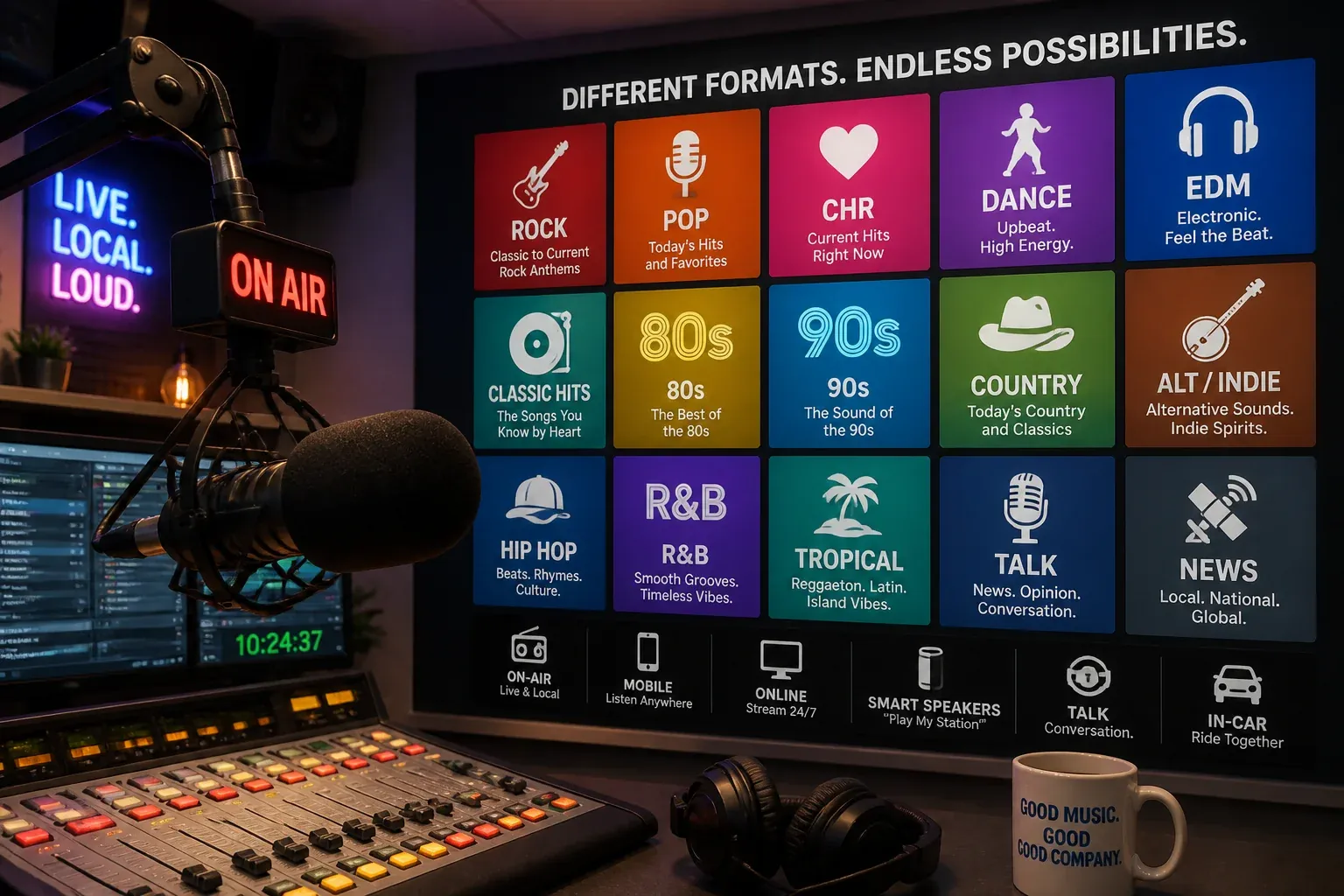
Format-specific content isn't a luxury or a nice-to-have. It's the difference between sounding like you were made for your listeners and sounding like you were made for everyone (which means no one). This guide breaks down why format matters so much, walks through the ten major formats, and points you to a prep playbook for each.
Why Format-Specific Content Matters
The format isn't just the music — it's a whole worldview. Each format's audience has different values, references, humor, pace, and reasons for listening. A few examples of how the same story changes by format:
- A new viral trend: CHR reacts in real time and makes a bit of it; News/Talk asks what it means; Country may skip it entirely if it doesn't fit the lifestyle.
- A celebrity story: Hot AC plays it light and shareable; Hip-Hop reads the cultural significance; Classic Hits frames it through nostalgia.
- A local cookout: Country leans backyard-and-family; Urban leans community-and-culture; Sports ties it to the game on the TV.
Generic prep flattens all of that into one beige version that fits none of them well. True format-specific prep understands the audience, not just the playlist — and that's what makes content feel native instead of borrowed.
The 10 Radio Formats (and How to Prep for Each)
Radio Content Pro builds format-specific content streams ("format kits") for ten distinct formats. Here's each one, with its prep playbook where we have a deep-dive guide:
- Hot AC — RCP Buzz. Broad-appeal, shareable, pop-culture-forward. See the Hot AC format kit and Inside RCP Buzz. Prep playbooks: adult contemporary show prep and CHR / Top 40 show prep.
- Country — RCP Country. Authenticity, community, storytelling. See the Country format kit, Inside RCP Country, and the country radio show prep playbook.
- Rock — RCP Edge. Edge, directness, no corporate polish. See the Rock format kit and Inside RCP Edge.
- Regional Mexican — RCP El Grito. Culturally rooted, community-centered, bilingual. See the El Grito format kit and Inside RCP El Grito.
- Hip-Hop — RCP Hip-Hop. Culture-first, fast, being early matters. See the Hip-Hop format kit and Inside RCP Hip-Hop. Prep playbook: urban radio show prep.
- News/Talk — RCP Info. Depth, credibility, informed analysis. See the Info format kit, Inside RCP Info, and the talk radio show prep guide.
- Adult Contemporary — RCP Mainstream. Warm, relatable, the workday companion. See the Mainstream format kit, Inside RCP Mainstream, and the adult contemporary show prep guide.
- Christian — RCP Spirit. Faith, family, encouragement, community. See the Spirit format kit and Inside RCP Spirit.
- Tropical — RCP Tumbao. Vibrant, cultural, community-celebrating. See the Tumbao format kit and Inside RCP Tumbao.
- Urban AC — RCP Urban. Culture, community, grown-folks connection. See the Urban format kit, Inside RCP Urban, and the urban radio show prep guide.
Two more format-prep playbooks worth bookmarking even though they map across kits: sports radio show prep and classic hits show prep.
How to Adapt Content Across Formats
If you run multiple stations or formats, the skill is taking a strong story and re-angling it per format rather than rewriting from scratch:
- Keep the topic, change the lens. Find the angle each audience cares about — community, culture, nostalgia, analysis, comedy.
- Match the tone and pace. CHR is fast and high-energy; AC is warm and steady; News/Talk is measured. Same facts, different delivery.
- Swap the references. The pop-culture touchpoints that land differ sharply by format and demo. Localize and update them.
- Respect the values. What's fair game in one format may fall flat or feel off in another. Authenticity means knowing the line.
The complete radio show prep guide covers the foundational daily system that underpins all of this, and our best show prep services comparison breaks down the tools.
Where RCP Fits
Producing genuinely format-specific content for even one format is a daily grind; doing it across a cluster of stations is nearly impossible by hand. That's the core of what Radio Content Pro does — ten distinct, format-tuned content streams, each built for its audience and refreshed around the clock, with Ava Hart on hand to tailor any of it to a specific show's voice. The goal is simple: every show sounds like it was made for its listeners, because it was.
Frequently Asked Questions
Why does radio content need to be format-specific?
Because each format serves a distinct audience with different values, references, humor, and reasons for listening. The same story has to be angled differently for Country versus Hip-Hop versus News/Talk. Generic content flattens those differences into a version that fits no audience well, and listeners can tell instantly.
What radio formats does Radio Content Pro support?
Ten: Hot AC (Buzz), Country, Rock (Edge), Regional Mexican (El Grito), Hip-Hop, News/Talk (Info), Adult Contemporary (Mainstream), Christian (Spirit), Tropical (Tumbao), and Urban AC. Each has a dedicated format kit with content built specifically for that audience.
How do I adapt one story across multiple formats?
Keep the topic but change the lens, tone, and references for each audience, and respect each format's values. A viral story becomes a fast bit on CHR, a cultural read on Hip-Hop, and an analysis segment on News/Talk — same facts, different delivery. The skill is re-angling, not rewriting.
Is format-specific prep really better than generic show prep?
Yes. Generic prep is obvious to listeners — content that wasn't written for them lands flat and erodes the host-listener connection. Format-specific prep understands the audience, not just the music, which is what makes a show sound native to its format instead of borrowed.
Can one tool deliver content for different formats?
Yes — that's exactly what RCP's format kits do, delivering ten distinct, format-tuned content streams from one platform. Stations running multiple formats can pull format-perfect content for each without building it all by hand.
The Bottom Line
What kills on Country dies on Hip-Hop, and listeners feel the mismatch immediately. Format-specific content is how you sound made-for-your-audience instead of made-for-everyone. Whatever you program, prep to the format — and lean on tools that make format-perfect content sustainable day after day.
Find your format and see content built for it — browse the format kits or start a free 7-day trial.