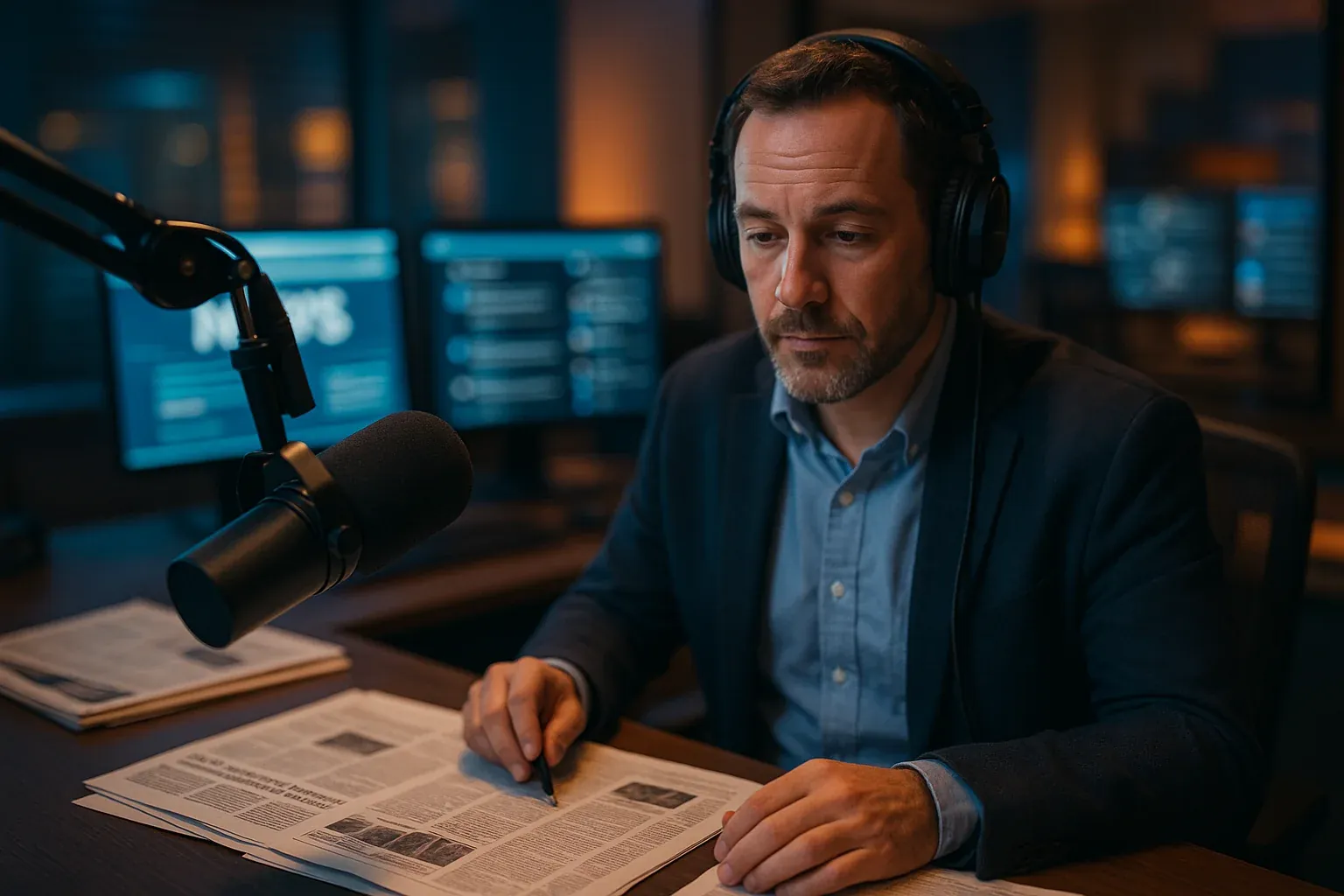

The story breaks at 5:47 AM. A factory in your market just announced 400 layoffs. By 6:15, the mayor has released a statement. By 6:30, three council members have contradicted each other on X. Your show starts at 9. You had a full rundown planned — immigration policy in hour one, school board controversy in hour two, open phones in hour three. All of it is now irrelevant.
This is talk radio show prep at its most demanding. Your content has a shelf life measured in minutes, not days. The audience isn't tuning in for the news — they already read it on their phone while brushing their teeth. They're tuning in for your take on it. Your angle. Your ability to cut through the noise and tell them what it means, why it matters, and what they should be angry or excited about.
And that's exactly what makes talk radio show prep fundamentally different from every other format in broadcasting. You're not curating entertainment. You're building arguments, managing conversations, and navigating live audience interaction — all while the story keeps moving underneath you.
This guide is the prep system built for that reality. Not generic "pick trending topics" advice that applies to every format. This is talk-radio-specific: topic selection frameworks, caller management techniques, breaking news protocols, and the daily routine that gets you from coffee to mic in under an hour.
Why Talk Radio Prep Is a Different Animal
News/Talk is the number one radio format in America by audience share — and it's not close. Over 10% of all radio listening goes to News/Talk stations. Yet dedicated show prep resources for talk radio barely exist. The morning zoo has comedy services. Country has Nashville wires. Sports has stat feeds. Talk radio? You're mostly assembling it yourself from a dozen browser tabs and a gut feeling.
Here's what makes talk prep uniquely demanding:
- Depth over breadth. A music-format host needs 30 seconds of material per talk break. A talk host needs 15-45 minutes of informed commentary on a single topic. That's not more content — it's fundamentally different content. You need research, context, data points, and counter-arguments, not just a hook and a punchline.
- The audience is informed and opinionated. Talk radio listeners are news consumers by nature. They've already seen the headline. They've read the first three paragraphs. They have a position. If you're just reading them the news, you've already lost. If you're looking for common traps that undermine show prep quality, see our guide to show prep mistakes that kill ratings.
- Callers are your content. In every other format, callers are a bonus. In talk radio, they're the show. Managing callers — screening them, framing them, knowing when to let them run and when to cut — is a core prep skill, not an afterthought.
- Breaking news changes everything. You can plan a perfect four-hour show and have it blown up by a single story at 8:57 AM. Talk radio hosts need a breaking news protocol, not just a rundown.
- The political minefield. Talk radio lives at the intersection of news, opinion, and controversy. Knowing how to enter a sensitive topic — finding the right angle that generates conversation without generating complaints — is an art form that requires advance thought.
If you need the general foundation first, our complete radio show prep guide covers fundamentals that apply across all formats. This guide builds on those principles with talk-radio-specific strategies.
The Talk Radio Daily Prep System
The best talk hosts we work with don't spend all morning prepping. They run a system — one that balances research depth with the speed that talk radio demands.
The Night-Before Scan (15 Minutes)
Talk prep starts the night before. Not because you need to — but because your subconscious works overnight.
- Scan the evening news cycle. What stories are developing? What's dominating X and cable news? Don't go deep — just register what's moving. You're planting seeds that your brain will process while you sleep.
- Flag 2-3 potential A-block topics. These might change by morning, and that's fine. But having a starting framework means you're not starting from zero at 6 AM.
- Check your local beat. City council agendas, school board meetings, local court decisions. The best talk radio content is often local stories that nobody else is talking about yet — and those stories usually surface in the evening.
The Morning Deep Dive (45-60 Minutes)
This is where prep becomes a show. The morning routine is longer than a music-format host's because talk radio demands deeper preparation — but it's still under an hour if you run the system.
Step 1: News scan and triage (15 min) Pull from 4-5 sources that cover your show's territory. National wire, local paper, one opinion source you disagree with (this is where your best takes come from), social media trending, and your show prep checklist. You're scanning for stories that pass one filter: will my audience have a strong opinion about this?
Step 2: Topic selection and ranking (10 min) Pick 3-4 topics ranked by this framework:
- Heat level. How emotional is this topic? Higher heat = more calls.
- Local relevance. Can you connect it to your market? National stories with a local angle always outperform pure national topics.
- Debate potential. Are there two legitimate sides? Topics where "everyone agrees" are death in talk radio. You need friction.
- Freshness. Is this the first day this story is in the conversation, or day three? Day-one stories have the most energy. By day three, you need a new angle or you're recycling.
Step 3: Build your positions (15 min) For each topic, answer three questions before you go on air:
- What's my take? (Not "both sides." Pick one. Own it.)
- What's my strongest supporting point? (One stat, one quote, one example.)
- What's the best argument against my position? (Knowing the counter-argument makes you stronger, not weaker. It also tells you what callers will say.)
Step 4: Prep your caller bait (5 min) Every topic needs a "phone question" — the specific prompt that makes listeners pick up the phone. This is the difference between "What do you think about the factory closure?" (weak) and "The mayor says 400 jobs will be replaced within a year. Do you believe him? I don't. Change my mind." (strong). The best phone topics raise the stakes and take a position that demands a response.
Step 5: Pull supporting material (5 min) Audio clips, quotes, data points, social media posts. You don't need a research staff — you need 2-3 pieces of evidence per topic that make you sound prepared without sounding like you're reading a term paper. If you're running Radio Content Pro, your Info Kit has already curated the day's headlines, trending stories, and talk-break material. Pull what fits, then customize with Ava Hart to match your voice and market.
The Show-Day Mindset
Talk radio prep works when you internalize one principle: you are not a news anchor. You are a conversation leader. Your job isn't to inform — it's to provoke thought, challenge assumptions, and give your audience a space to engage with the issues that matter to them.
That mindset changes everything about how you prep. You stop asking "What happened?" and start asking "What does this mean?" You stop collecting facts and start building arguments. You stop hoping callers will call and start engineering topics that make it impossible for them not to.
Talk Radio Segment Ideas That Work
A good prep routine gets you ready. Great segments keep listeners locked in through the commercial breaks. Here are the formats that work across news/talk radio.
Daily Staples
Build your show skeleton around repeatable segments:
- The Opening Monologue. Your strongest topic, your sharpest take, delivered in the first 10-15 minutes before you open the phones. This sets the tone. It tells your audience what kind of show today is going to be. Don't bury the lead — come out swinging.
- The Devil's Advocate. Take the opposite position from your audience on a story everyone agrees about. "Everyone's blaming the CEO. Here's why the union is actually the problem." You don't have to believe it — you have to argue it well enough to get callers fired up.
- Caller's Court. Structured call-in segment where listeners make their case in 60 seconds. You respond. Audience votes via text or social media. It turns passive listening into active participation — which is what keeps people tuned in.
- The Local Angle. Take a national story and drill into what it means for your market. "Washington just passed a new infrastructure bill. Here's exactly how much money is coming to [your city] and what it's being spent on." Local specificity is talk radio's superpower.
Weekly Features
Give listeners appointment reasons to tune in:
- Monday Mailbag. Read and respond to listener emails and social messages from the weekend. Low prep, high engagement. Listeners love hearing their name on air.
- Newsmaker Wednesday. Weekly interview with a local newsmaker — mayor, police chief, school superintendent, business owner. Not a softball conversation. Prep 5-7 questions, but be ready to follow the interesting answer, not your script.
- Friday Hot Takes. Rapid-fire opinions on the week's stories. 30 seconds each, no filter. Listeners can agree or disagree via text in real time.
- The Rant Line. Dedicate a segment to unscreened voicemails from listeners. Play the best ones on air. React live. It's raw, authentic, and builds community.
Need more topic ideas that drive calls? See our list of radio show topics that get phones ringing.
Caller Management: The Talk Radio Skill Nobody Teaches
In talk radio, caller management isn't a nice-to-have — it's the show. A great caller segment can be the best radio of the week. A bad one can empty a time slot. Here's what the best talk hosts do differently.
Screening That Sets Up Success
Your screener (or your own pre-screening if you're running solo) should capture three things before a caller goes on air:
- Their position. Are they for or against your take? You need to sequence callers — don't stack three agreers in a row.
- Their story. "I disagree" is not enough. "I disagree because I worked at that factory for 12 years" — that's a caller.
- Their energy. Can they articulate their point in 30 seconds? Some callers have great stories and zero delivery. Know that before they hit the air.
Framing the Caller
Never put a caller on air cold. Frame them for the audience first: "Next up is Mike from Riverside. Mike worked at the plant for 12 years and says the mayor's plan is fantasy. Mike, make your case." That 10-second setup transforms a random call into a story. The audience is already leaning in before Mike says a word.
Knowing When to Cut
The hardest skill in talk radio: ending a call that's going nowhere. Three signals it's time to move on:
- The caller is repeating themselves.
- The energy has dropped — you can hear it in your own voice.
- You've made your point and they've made theirs. Don't beat a dead horse.
A clean "Mike, appreciate the call. Let's hear the other side — who disagrees?" is always better than letting a segment die on the vine.
Breaking News Protocol
Every talk radio host needs a plan for when the plan falls apart. Here's a framework.
Level 1: Developing story. A story is gaining traction but isn't urgent. Mention it in your current segment, tease deeper coverage in the next hour. Don't abandon your rundown — weave it in.
Level 2: Significant local event. Something happened in your market that your audience will expect you to address. Finish your current segment, pivot in the next break. Lead with what you know, acknowledge what you don't, and open the phones for local reaction.
Level 3: Major breaking news. National emergency, local disaster, political bombshell. Drop everything. Go live. Don't pretend to have information you don't. "Here's what we know right now" is the most powerful phrase in talk radio. Update every 10-15 minutes. Let callers share what they're seeing and hearing. You are now your community's town square.
The key in every scenario: acknowledge the story before your audience beats you to it. If listeners know something you haven't mentioned yet, you lose credibility fast.
How AI Is Changing Talk Radio Prep in 2026
Let's be direct about AI and talk radio: it will never replace a good host with a strong take. But it is changing what you spend your prep time on.
What AI does well for talk prep:
- Curates headlines from hundreds of sources before you wake up
- Summarizes long policy documents, court rulings, and reports into talk-ready bullet points
- Tracks how topics are trending across social platforms in real time
- Generates multiple angles on a story so you can pick the sharpest one
- Writes first-draft social posts and show teases
What AI can't do:
- Have a genuine opinion. The "I think the mayor is lying and here's why" moment — that's you.
- Read caller energy. Knowing when to push back and when to let someone talk — that's instinct built from experience.
- Navigate controversy with judgment. AI doesn't understand your market, your audience's boundaries, or the difference between a provocative topic and a career-ending one.
- Build trust. Your listeners tune in because they trust you — your voice, your consistency, your willingness to say unpopular things. That's not automatable.
At Radio Content Pro, our Info Kit for News/Talk delivers curated content specifically for talk formats — trending stories, policy summaries, talk-break material, and caller topic starters — updated every five minutes, not once a day. And with Ava Hart, you can turn any headline into a fully formed talk-break angle in your voice, for your market, in seconds.
The hosts winning in 2026 use AI to eliminate the 90% of prep that's curation busywork, so they can spend their time on the 10% that makes great talk radio: forming opinions, building arguments, and connecting with their audience.
FAQ
How do you prep for a talk radio show? Start with a 15-minute night-before scan of developing stories and local news. Then run a 45-60 minute morning routine: scan 4-5 news sources, rank topics by heat level and debate potential, build your positions with supporting evidence, and prep specific caller prompts for each topic. The best talk hosts don't just find topics — they build arguments and engineer conversation starters.
What makes a good talk radio topic? The best topics have three qualities: emotional heat (people care deeply), debate potential (there are two legitimate sides), and local relevance (you can connect it to your market). A national story that your listeners have no stake in will fall flat. A local story that everyone agrees about won't generate calls. The sweet spot is a topic where your audience is divided and emotionally invested.
How do you get more callers on talk radio? Stop asking open-ended questions like "What do you think?" Instead, take a strong position and challenge your audience to respond: "The school board made the wrong call. If you disagree, I want to hear from you." Specific, provocative prompts outperform vague invitations every time. Also consider using text-in and social media polls to lower the barrier to participation — not everyone wants to call, but many will text.
What's the best show prep service for talk radio? Look for a service that updates continuously (not a morning-only email dump), curates specifically for news and talk formats, and offers AI-powered customization. Generic music-format prep services miss the depth that talk radio requires. Radio Content Pro's Info Kit delivers curated headlines, policy summaries, talk-break material, and caller topic starters with updates every five minutes and AI personalization through Ava Hart. See our full comparison of show prep services.

The Bottom Line
Talk radio show prep is fundamentally different from every other format — and it deserves better than the generic "pick trending topics" advice that dominates the search results today. Your audience is informed, opinionated, and demanding. They don't need a news reader. They need a conversation leader who shows up prepared to argue, engage, and connect.
Build the system. Run the night-before scan. Rank your topics by heat and debate potential. Build your positions before you open the mic. Engineer caller topics that make participation irresistible. And when the big story breaks, have a protocol — not a panic.
The best talk radio isn't about knowing everything. It's about having a take and the preparation to defend it. Your audience doesn't need an expert on every topic. They need someone who's done the work, formed an opinion, and is ready to have a real conversation about it.
Ready to simplify your show prep?
Try RCP free for 7 days. $0 until day 8