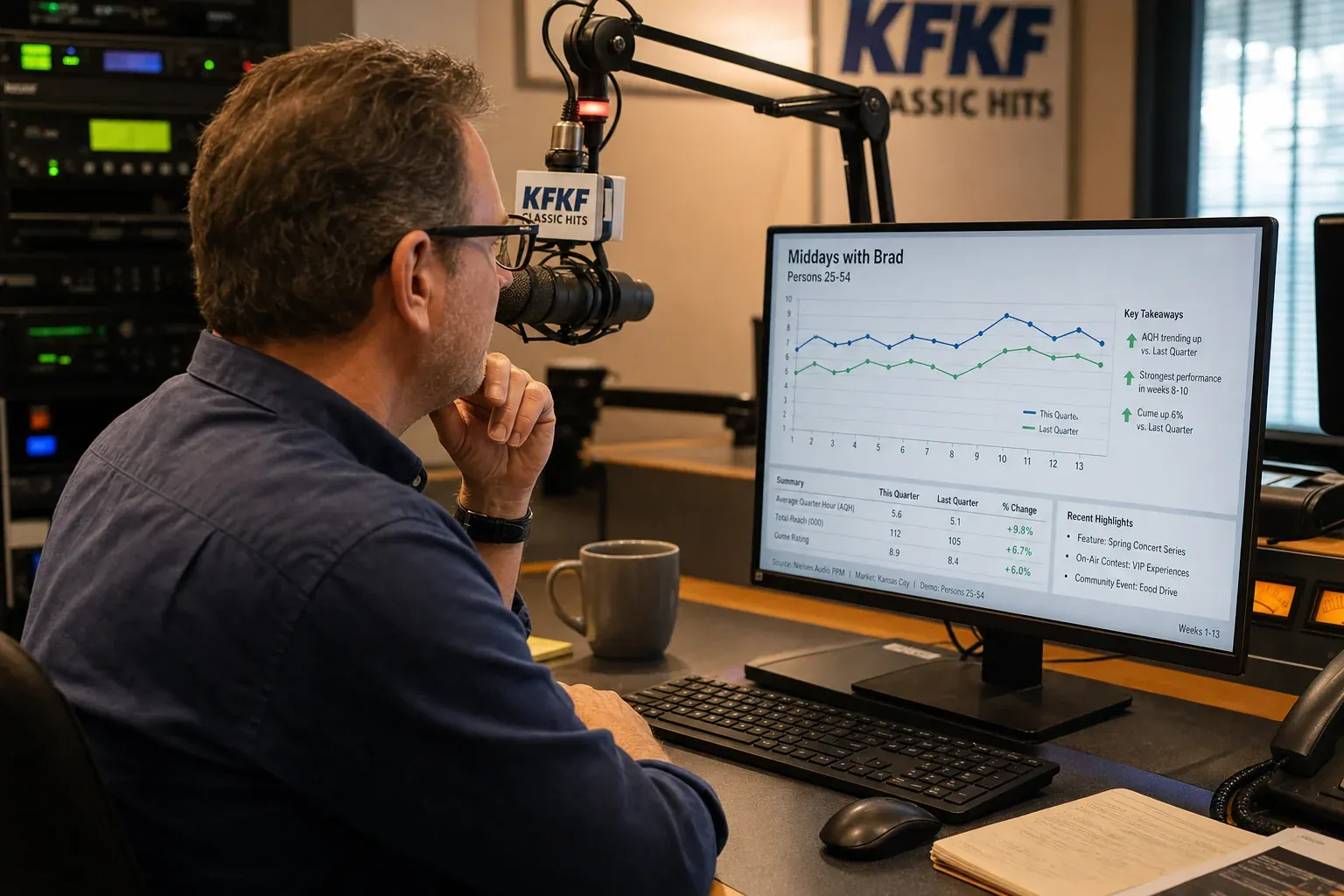

Two radio stations. Same market. Same format. Neck and neck in the ratings book for years. Then one of them pulls away — ratings up, digital revenue climbing, advertisers renewing at higher rates.
Usually it's not the better playlist or the more polished morning host. It's the station that has a plan. A documented, deliberate approach to what they create, when they publish it, and how they squeeze every piece of content for maximum reach. The other station? They prep each show the same way they did in 2019: scrambling at 5:45 AM, hoping something connects.
A solid radio station content strategy is the difference. And most stations don't have one.
What a Radio Station Content Strategy Actually Is
Here's a working definition: a radio station content strategy is a documented system for creating, distributing, and measuring content across all your channels — not just the show, but everything connected to it.
Your morning show prep routine. Your website. Your email newsletter. Your Instagram Reels. Your Facebook posts. Your podcast clips. All of it, working as one machine instead of separate afterthoughts.
Most stations have some version of on-air content planning — show prep, segment calendars, recurring features. But ask about the digital content strategy and you'll hear crickets. Or worse: "we post whatever's happening on the station that day."
That's not a strategy. That's a reflex.
The gap matters because listener behavior has changed. Research consistently shows that the average radio listener hears less than a quarter of any given station's live content on a given day. The rest of their relationship with your brand happens off-air — checking your website, following you on social, reading your email, finding you through search. If those channels don't have a plan behind them, you're invisible to your audience the majority of the time.
The stations pulling away in ratings — and on the revenue spreadsheet — aren't just better at radio. They're better at content. All of it. Together. According to the Radio Advertising Bureau, digital revenue for radio hit $2.3 billion in 2025. The stations capturing that revenue aren't waiting for it to come to them. They've built the system that makes it happen.
So let's build yours.
The Three-Pillar Framework
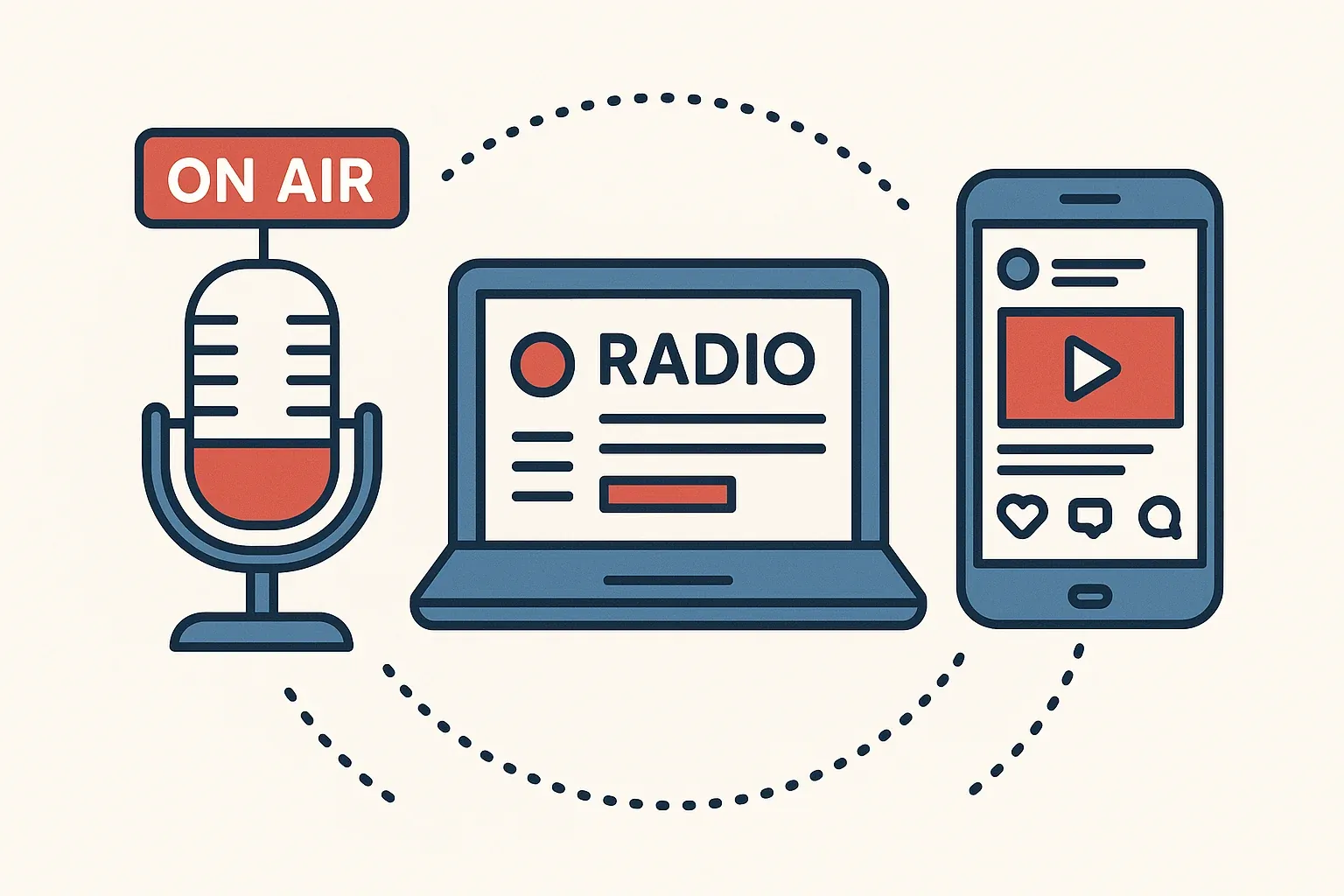
Every strong radio station content strategy runs on three interconnected pillars. Get all three working together and you create a flywheel — each piece of content feeds the next one, multiplying your effort instead of duplicating it.
Pillar 1: On-Air Content This is your show. Your segments, your content pillars, your daily prep routine, your recurring features. It's the foundation everything else builds from. Radio still reaches over 90% of American adults weekly. Nothing else in local media comes close. Your on-air content is your most powerful asset — and it's also the source material for everything in the other two pillars.
Pillar 2: Digital Content Your website, email newsletters, blog posts, and any content that lives beyond the broadcast moment. Digital content is how listeners find you before they've ever tuned in, and how they stay connected between shows. It's also how advertisers evaluate your brand's reach beyond a ratings number.
Pillar 3: Social Content Platform-specific content designed to reach your audience where they already spend time. Facebook, Instagram, TikTok, X — each platform has its own content language. Your strategy needs to speak all of them, or at least the ones your specific audience uses most.
The magic isn't in any one pillar. It's in the repurposing loop that connects them. A great on-air segment becomes a social clip, which drives website traffic, which feeds your email list, which keeps listeners coming back to the station. One piece of content, five or six audience touchpoints.
That's the framework. Now let's break down each pillar and the system that connects them.
On-Air Content Strategy: Build Around Listener Moods, Not Format Labels
Here's something most program directors know intuitively but rarely act on explicitly: listeners don't tune in because you play the most music or have the best variety. They tune in because your station matches their mood right now.
The stations that have figured this out organize their content around emotional states, not format categories. A mainstream AC isn't "the station that plays hits from the 2000s to today." It's "the station that makes your commute feel manageable, maybe even good." Hot AC isn't "today's hits and yesterday's favorites" — it's "the soundtrack for someone who wants to feel energized." That's a completely different brief for your content team, and it produces completely different show prep.
Start with your content pillars — three to five recurring themes that define what your station talks about beyond the music. A mainstream AC might run: Family Moments, Local Happenings, Feel-Good Wins, and Trending Water Cooler. Every piece of show prep, every bit, every feature maps back to one of those pillars. When your team knows the pillars, they stop hunting for random content and start curating content that builds a consistent identity.
Then build your daypart strategy around mood and context. Morning drive is high-stakes and fast-moving — content needs to land within the first 90 seconds or you lose the listener to another station or their own Spotify. Midday is more relaxed; listeners have patience for a story. Afternoons are back to commute mode. Each daypart deserves its own content plan, not just the same prep deck at different times.
Your show prep workflow is the engine that keeps this running daily. The most effective morning shows use a structured content pipeline — not "scroll social media and see what's trending" but a defined daily routine covering headlines, local angles, format-specific hooks, and audience callbacks. The complete radio show prep guide walks through the full daily and weekly system if you want the step-by-step.
One more on-air strategy note: consistent, recurring features build TSL (Time Spent Listening) better than almost anything else. A weekly "What Happened This Week in [City]?" segment gives listeners a reason to be tuned in at a specific time, every single week. That's appointment listening — and it's a content strategy decision, not a talent decision. The connection between content quality and ratings growth is direct: stations that treat content as a system, not a scramble, are the ones whose numbers move.
Digital Content Strategy: Turn Your Station Into a Local Media Company
Radio's digital opportunity is large and mostly untapped.
The average radio station website gets real traffic — people are searching for you, your hosts, your contests, your local events. But then the site serves them content from three weeks ago or nothing at all. Meanwhile, a local digital-native outlet with a fraction of your audience is publishing daily, building an email list, and capturing digital advertising revenue that your station could own.
The best stations have stopped thinking of their website as a billboard for the radio station. They think of it as a local media company that happens to have a broadcast arm. That shift in mindset changes everything about how you plan your digital content.

Start with your website publishing cadence. Three to five pieces of content per week is a reasonable baseline — not press releases or show schedules, but content your local audience actually wants to read. What's happening in town this weekend? What's the biggest local story right now? What are your morning hosts talking about this week and why does it matter to your market?
Email is where the digital payoff is often biggest. Stations with active newsletters report stronger listener retention and more direct conversion to premium digital ad packages. The key is treating your email like a show — consistent format, consistent schedule, consistent voice. A newsletter that comes out every Thursday at 8 AM, looks the same every week, and feels like it was written by someone who knows the audience is worth building deliberately. A complete guide to radio newsletters as a digital content strategy covers the setup and format in detail.
Auto-publishing is the bridge between your on-air content and your digital channels. When your morning show covers a local story, that story should populate to your website — not as a transcript dump, but as a formatted, readable article. Radio Content Pro's WordPress plugin handles this automatically, turning your curated content into website-ready posts without your team manually writing anything.
The payoff is real: digital is now radio's primary growth engine according to the RAB, and the stations winning that revenue aren't doing anything exotic. They show up consistently, they publish on schedule, and they treat their digital channels with the same intentionality they bring to the on-air product.
If you want to see how other stations are building this out, a 2026 radio digital content strategy breakdown covers the full approach with specific channel tactics.
Social Content Strategy: The Repurposing Playbook
Social media is where most radio stations' content strategies fall apart. Either they post too much with no strategy behind it, or they post once a day as a checkbox exercise. Neither works.
The answer is a repurposing system. And it starts with a simple principle: your best on-air content is the raw material for everything else.
A great morning show bit. A listener call that had the whole studio laughing. A host take that the audience pushed back on hard. That's your source content. From one great on-air moment, a disciplined repurposing playbook produces:
- Social clip — 30 to 60 seconds of audio or video for Instagram Reels, TikTok, or X
- Quote post — pull the sharpest line and turn it into a shareable static image
- Website article — reformat the segment as a 300-word article with a local angle
- Email item — the story in two paragraphs with a link back to the site
- Podcast segment — if the audio stands alone, it goes in the feed
- Community post — turn it into a question for Facebook: "What do you think about this?"
That's six pieces of content from one great moment. One team, one piece of work, six audience touchpoints. A practical breakdown of social media posts that work for radio stations covers the platform-specific execution in detail.
Platform strategy matters here. Facebook still dominates for radio station audiences — it's where the 35+ demo spends time and where community conversations happen. Instagram is a brand-building platform: strong for event photography, behind-the-scenes content, and short video clips. TikTok rewards consistency and authenticity over production value — stations willing to commit see real audience growth. X/Twitter is where real-time news commentary lives.
The rule across all of them: don't promote your station, tell stories. "Listen to us this morning!" is invisible. "This local firefighter saved a dog and then adopted him — we talked to her live this morning" gets shared, commented on, and remembered.
AI's Role in Your Radio Station Content Strategy
AI doesn't replace a content strategy. But it makes a good one run significantly faster.
The stations getting the most value from AI tools in 2026 are finding two things: AI accelerates content creation (writing website posts, generating social copy, researching local stories, personalizing content for specific audiences) and it creates a new risk when deployed without structure. Speed without direction produces a lot of mediocre content very quickly.
The solution is treating AI as an execution layer built on top of your existing strategy — not as the strategy itself. Your content pillars, your brand voice, your local expertise, your hosts' personalities — those come from your team. AI handles the formatting, the first drafts, the volume, and the adaptation across platforms.
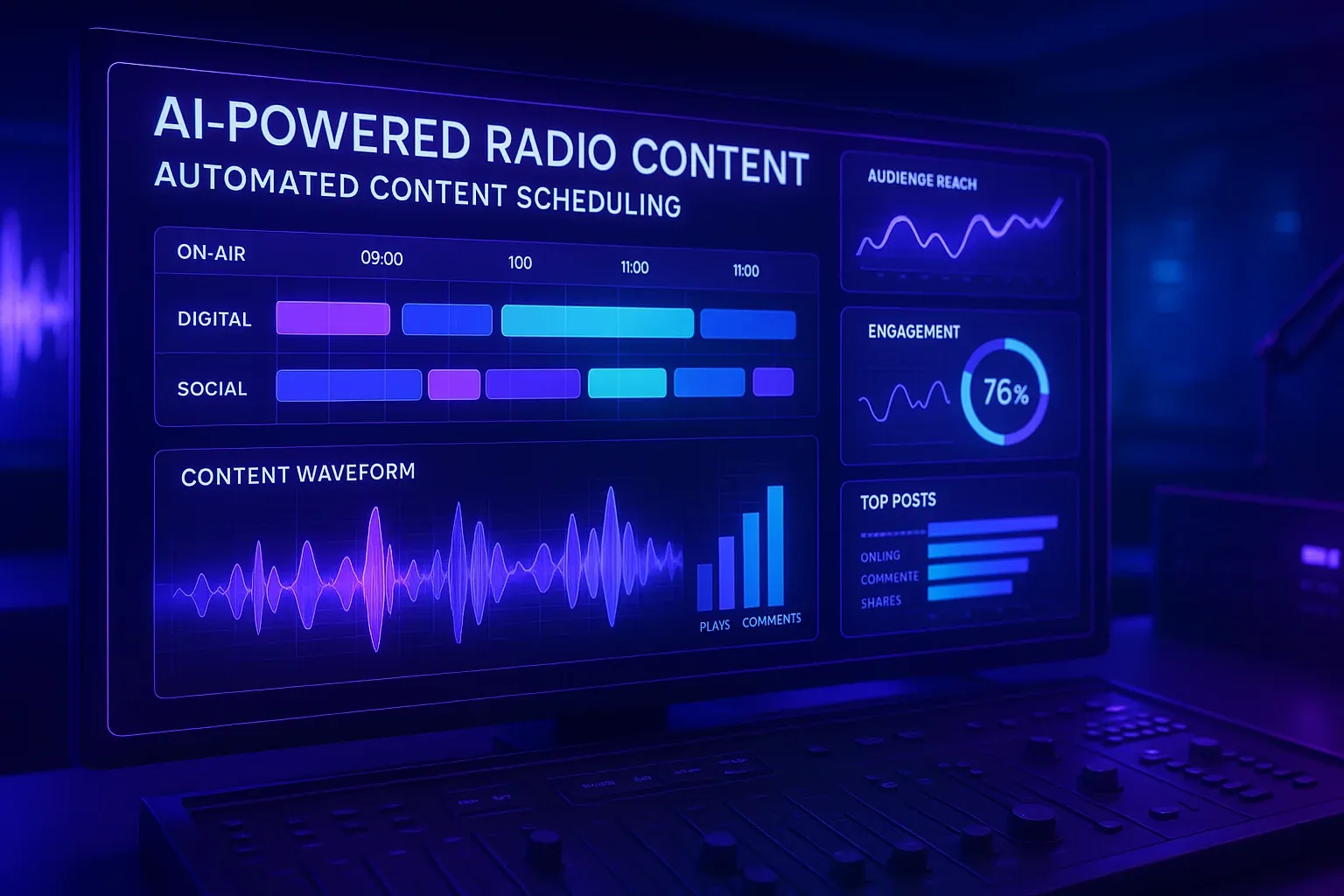
NAB Show 2026's AI sessions for radio made this point clearly: the stations extracting the most value from AI are the ones using it within a defined content framework, not the ones using it as a shortcut around having one. The broader shift of AI transforming radio content creation is about productivity and consistency — not replacement.
For content strategy specifically, AI adds the most value in three places: converting on-air content into website and social formats automatically, maintaining brand voice consistency across a multi-daypart, multi-personality station, and scaling content volume without scaling headcount.
Radio Content Pro's Ava Hart does exactly this. She knows your show's personality, your market, your format, and your audience — and she produces content that sounds like your station, not like a generic AI output. That's the difference between AI that accelerates your strategy and AI that dilutes it.
The Metrics That Tell You If Your Strategy Is Working
A content strategy without measurement is just content production. Here are five numbers that tell you whether your strategy is actually moving in the right direction.
Time Spent Listening (TSL): Your most important on-air content metric. Growing TSL means your content is creating appointment listening and keeping people tuned through the break. Flat or declining TSL means your content isn't earning the next quarter-hour. Track it quarter-over-quarter, not week to week.
Website sessions + average session duration: Are people finding your digital content? When they do, are they staying? A session duration above 90 seconds suggests content that's resonating. Under 60 seconds and you have a content relevance problem.
Email open rate + click-through rate: Industry average for media email sits around 21–25% open rate. If you're below that, look at your subject lines and send frequency. Above 30% open rate means your list is genuinely engaged — that's a revenue-generating asset worth protecting.
Social reach + engagement rate: Reach shows how many people saw your content. Engagement rate — likes, comments, and shares divided by reach — tells you if they cared. A 3% engagement rate is healthy for a station account. Above 5% means you're consistently creating shareable content.
Content-to-conversion ratio: How often does someone who engages with your digital content end up taking an action — subscribing, signing up for a trial, clicking an advertiser link? This is harder to track but the most important number in the long run. It's the reason the strategy exists.
Review these monthly. A simple spreadsheet with trending direction (up, flat, or down) is enough to start. The goal isn't to hit a benchmark — it's to know which direction you're heading and why, so you can make informed decisions about where to focus next.
Your 30-Day Content Strategy Launch Plan
You don't need to overhaul everything at once. Here's a practical first month for getting your radio station content strategy off the ground.
Week 1 — Audit what you have. Document current activity across all three pillars. How many on-air segments does your team prep per day? How often does your website publish new content? What goes on social and on what schedule? No judgment. Just inventory, so you know what you're working with.
Week 2 — Define your content pillars. Choose three to five on-air content themes for your format and market. Write them down in one sentence each. Share them with your team. Start filtering your show prep through them and watch how quickly your on-air product gets more focused.
Week 3 — Set up the digital workflow. Build a simple weekly publishing calendar for your website. Set up a newsletter template if you don't have one. Draft a one-month social content calendar and assign ownership for each platform. Connect your on-air content to your digital output.
Week 4 — Measure and iterate. Pull your baseline numbers from Week 1. Compare. What moved? What didn't? Where is the friction in the workflow? A content strategy is a living document — expect to update it every quarter as you learn what your audience responds to.
The stations that win aren't the ones who launched with a perfect strategy. They're the ones who built something, measured it honestly, and kept improving.
Key Takeaways
- A radio station content strategy covers three pillars: on-air, digital, and social — connected by a content repurposing loop that multiplies effort
- Build on-air content around listener moods, not format labels — mood-targeted content outperforms format-generic content
- Your website and email newsletter are direct revenue channels; stations with active digital content capture a growing share of the $2.3B+ radio digital revenue market
- The repurposing playbook turns one great on-air moment into 5–6 pieces of digital and social content
- AI accelerates content strategy execution but requires a defined framework to avoid producing high-volume mediocre content
- Track five metrics: TSL, website session duration, email open rate, social engagement rate, and content-to-conversion ratio
FAQ
What is a radio station content strategy?
A radio station content strategy is the framework that governs what content your station creates on-air, on your website, on email, and on social media — plus how those channels reinforce each other. It defines your content pillars, your publishing cadence, your repurposing loop, and the metrics that tell you whether it's working. A strong strategy treats every piece of on-air content as raw material for five or six downstream digital assets, not a one-time broadcast.
What are the three pillars of radio content strategy?
On-air, digital, and social. On-air is still your audience magnet — the daily show, prep, talk breaks, and live moments. Digital is your website and email newsletter, which capture and monetize the audience you've built on-air. Social is where you extend reach and recruit new listeners. The strategy connects all three through a content repurposing loop so one great segment becomes a blog post, an email subject line, three social clips, and a newsletter feature.
How do I measure if my radio content strategy is working?
Track five metrics monthly: time spent listening (TSL) for on-air performance, website session duration for digital engagement, email open rate for newsletter health, social engagement rate (likes + shares + comments divided by reach), and content-to-conversion ratio (the percentage of content pieces that drive a measurable action — trial signup, newsletter opt-in, contest entry). If three of five are trending up quarter-over-quarter, your strategy is working.
How long does it take to implement a radio station content strategy?
Plan for one full quarter — thirteen weeks. Month one is foundation: pillar definition, workflow setup, team alignment. Month two is execution — you're publishing consistently and learning what resonates. Month three is iteration — you refine pillars, drop what isn't working, and double down on what is. Most stations see meaningful movement in digital and social metrics within 60 days; on-air metrics (TSL, cume) tend to move slower.
What's the biggest mistake stations make with content strategy?
Treating digital and social as leftover work. The winning stations treat every on-air moment as a content seed for five downstream assets — and assign clear ownership for each channel. The failing stations expect one person (usually the morning host) to also run social and email. That doesn't scale, and it doesn't produce good content. A working strategy assumes content ownership is distributed and that repurposing is a first-class workflow, not an afterthought.
How many people does it take to run a radio content strategy?
Fewer than most stations assume — the work is in the system, not the staffing. A small-market station can run all three pillars with the air staff it already has, as long as repurposing is built into the daily routine and one person owns each channel's calendar. The trap is thinking you need a dedicated digital editor before you start. You don't. You need a documented workflow that turns work you're already doing — show prep, talk breaks, local coverage — into website and social content without anyone writing from scratch. Automation closes most of the gap; that's where tools like Radio Content Pro fit, formatting on-air content into publish-ready posts so a lean team can still publish daily.
How often should a radio station update its content strategy?
Review the metrics monthly, but only revise the strategy itself once a quarter. Monthly check-ins tell you which direction your five numbers are trending; quarterly reviews are when you actually change something — retiring a content pillar that isn't landing, shifting a daypart's focus, reallocating effort from a platform that's flat to one that's growing. Resist the urge to overhaul mid-quarter. Content strategy needs enough runway to show whether a change worked, and a pillar you swap out after three weeks never had a fair test. The one exception: a major format change or market shift justifies a same-week rework.
Want a personalized walkthrough?
Schedule a 15-minute demo with our team.