
Digital now accounts for over 26% of total radio ad revenue. That's an all-time high, according to the RAB/Borrell Digital Benchmarking Report. And digital ad growth is forecast at 9.5% for 2026—enough to offset the 3% decline in traditional spot revenue.
Those numbers tell a clear story. Radio stations with a digital content strategy are capturing new revenue. Stations without one are watching it go to competitors, podcasters, and local news sites.
Here's the thing: most stations still don't have a real digital content strategy. They have a website that hasn't been updated since the last contest. A Facebook page that recycles promo graphics. Maybe a podcast link that goes nowhere.
That's not a strategy. That's a placeholder.
This article breaks down why a radio station digital content strategy matters more in 2026 than ever before, what the five core pillars look like, and how to start building one—even if your team is already stretched thin.
The Digital Revenue Shift Radio Can't Ignore
The RAB/Borrell data isn't just a headline. It represents a structural shift in how radio stations make money.
Streaming audio ad spend is growing at 9.2% year-over-year—faster than OTT video and every other individual ad format. That growth is showing up in station revenue, but only for stations that actually sell digital products alongside traditional spots.
Half of all radio stations now conduct digital sales training at least weekly. And those that do report stronger performance across the board. Not just in digital revenue—in total revenue. Digital becomes the foot in the door that keeps the whole advertising relationship healthy.
Here's the math that should concern every GM: a small or mid-market station without digital products is likely leaving $50,000 to $100,000 per year on the table. That's money flowing to Facebook, Google, and the local digital agency down the street instead.
The stations winning right now aren't choosing between radio and digital. They're pairing both. A hybrid approach creates a stronger, more memorable customer journey for local advertisers—and it's one of the smartest moves for any 2026 marketing strategy.
The bottom line: content drives revenue for radio stations, and digital content drives the fastest-growing slice of that pie.
What a Digital Content Strategy Actually Looks Like for Radio
A digital content strategy isn't "post on social media more." It's a system for creating, distributing, and monetizing content across multiple digital platforms.
For radio stations, that system has five pillars. You don't need all five firing at once. But you need to know what they are and pick at least one to start with.
1. Website Content
Your station website should be more than a streaming player and a contest page. It should have regularly updated content—local news, show recaps, blog posts, event coverage—that gives people a reason to visit and gives Google a reason to rank you.
Stations that prioritize local stories tend to see higher repeat visits and longer time on site. That's not surprising. Local content is your superpower. No national aggregator can replicate what your morning team knows about the community.
2. Social Media (Done Right)
Posting a contest graphic isn't a social strategy. Each platform needs content built for that platform. TikTok clips. Instagram stories from behind the mic. X threads reacting to local news in real time.
The goal isn't vanity metrics. It's building an audience you can reach without paying for every impression.
3. Email and Newsletters
This might be the most underrated pillar. Newsletters are having a moment—Substack hit 5 million paid subscriptions in 2025, and daily newsletter reading has become habitual behavior for a growing segment of core radio listeners.
Email gives you an owned audience. No algorithm changes. No platform risk. You control the relationship.
4. On-Demand Audio
Barrett Media made the case that 2026 must be the year radio fully embraces on-demand listening. Enhanced podcasts with interactive chapters, clickable links, and immersive soundscapes turn your broadcast into content that has a second life.
You're already creating the audio. The question is whether anyone can find it after it airs.
5. Digital Advertising Integration
The fifth pillar ties everything together. When your sales team can bundle digital impressions—website, social, email, audio—alongside traditional spot buys, you become a full-service advertising partner instead of just a radio station.
Stations selling digital bundles have grown digital's share of total revenue to that 26% benchmark. Those selling spots alone haven't.
Why Most Stations Still Don't Have One
If digital content is so important, why are most stations still winging it?
I hear the same three reasons constantly.
"We don't have time." The morning show PD already wears five hats. Adding "content director" to that list feels impossible. And honestly? It probably is—if you're trying to do everything manually.
"We tried social media and it didn't work." Right. Because pushing other people's content around the web was never going to move the needle. Unless a station creates its own original digital content, social media stays a hamster wheel that generates likes but not listeners or revenue.
"We don't have the skills." Digital content requires different muscles than broadcasting. Writing SEO-optimized blog posts, managing email campaigns, editing short-form video—these aren't things most air talent learned in their career.
All three reasons point to the same root problem: the content creation bottleneck. Stations know they need digital content. They just can't produce enough of it with the staff they have.
This is exactly where AI tools have changed the game. The 80/20 productivity flip—spending 80% of your time creating and 20% searching instead of the reverse—isn't a buzzword anymore. It's how stations with small teams are actually executing digital content strategies in 2026.
Five Signs Your Station Needs a Digital Content Strategy
Not sure if this applies to you? Here's a quick diagnostic.
1. Your website hasn't been updated in weeks. If the most recent content on your site is a Christmas contest from December, you're invisible to search engines. Google rewards fresh, relevant content. Stale sites get buried.
2. Social media is just recycled contest promos. Scroll your station's feed. If every post is "WIN TICKETS!" you're not building an audience—you're training people to ignore you between giveaways.
3. You can't tell advertisers how many digital impressions you deliver. When a local business asks about your digital reach and you don't have a number, they'll go to someone who does. That's money walking out the door.
4. Listeners can't find your content on-demand. If someone misses your morning show interview with the mayor, can they find it anywhere? If not, that content—which you already paid to create—dies after one airing.
5. Your sales team doesn't sell digital bundles. If your reps are only pitching spots, they're competing on a shrinking playing field. Digital bundles give them something to sell that's actually growing. For more on measuring what matters, check out show performance metrics that connect content to results.
If three or more of these hit home, you don't just need a digital content strategy. You need one yesterday.
How to Build a Digital Content Strategy (Even With a Small Team)
You don't need a dedicated digital department to get started. Here's a five-step approach that works for stations of any size.
Step 1: Audit What You Already Have
Before building anything new, take stock. Do you have a website with a CMS? An email list? Social accounts? Google Analytics? Some stations are sitting on assets they've forgotten about.
Step 2: Pick One Pillar to Start With
Don't try to do everything at once. Pick the pillar with the lowest effort and highest impact for your situation.
My recommendation for most stations: start with website content or a newsletter. Both build long-term value, work while you sleep, and don't require daily attention. If you want to boost your website's visibility, SEO strategies for radio stations is a good place to start.
Step 3: Create a Weekly Content Rhythm
Not daily. Weekly. Consistency beats volume every time.
One blog post per week. One newsletter per week. Two or three social posts that actually say something original. That's enough to build momentum without burning out your team.
Step 4: Use AI Tools to Multiply Output
AI doesn't replace your talent. It removes the busywork that prevents them from creating content. Automated show prep, AI-assisted blog writing, social media content generation—these tools turn a one-person operation into what feels like a small content team.
The stations doing this well aren't publishing AI-generated slop. They're using AI for the first 90% (research, drafts, formatting) and adding the human touch for the final 10% that makes it theirs.
Step 5: Measure What Matters
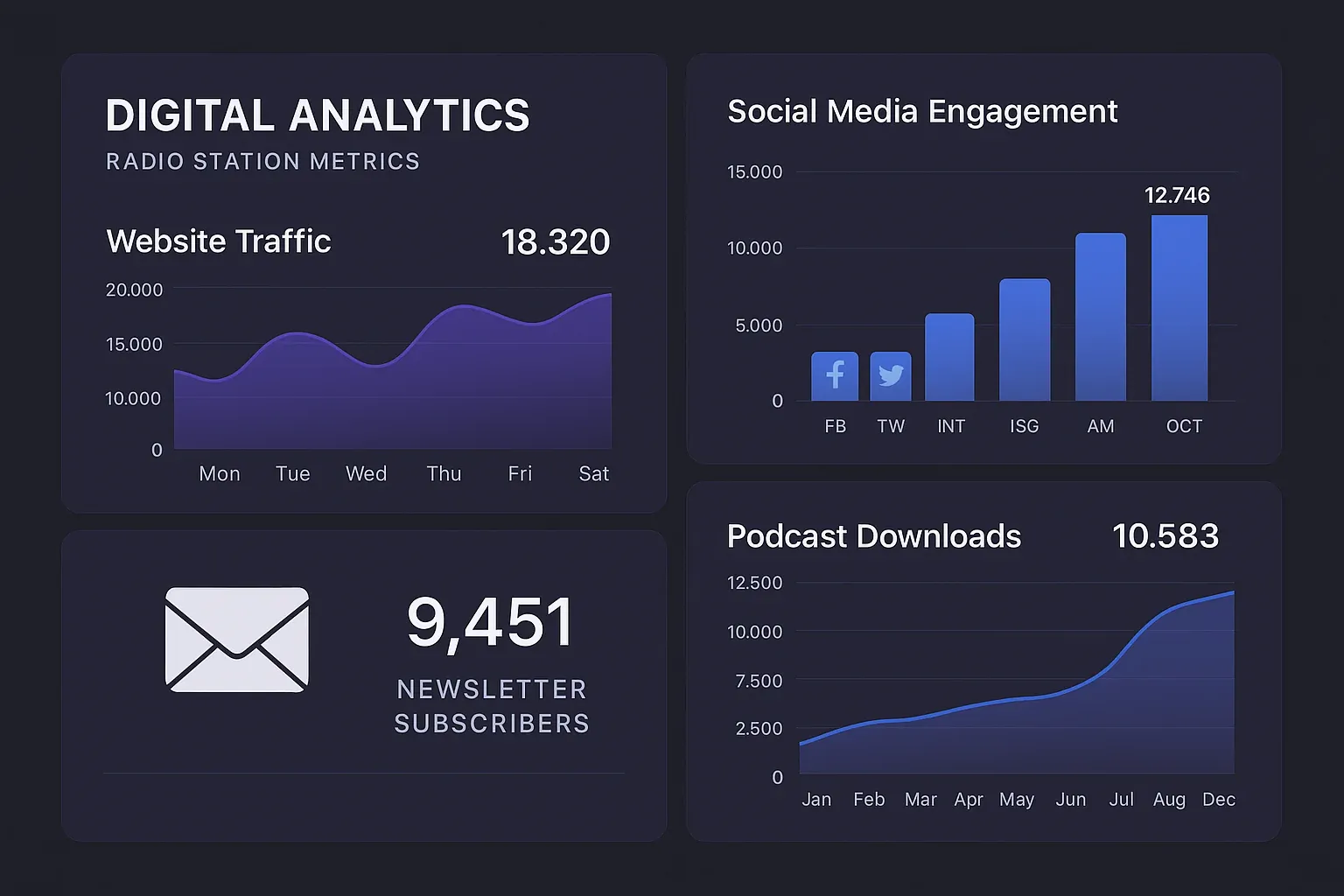
Track three things: digital impressions (website + social reach), email subscribers, and on-demand audio plays. These are the metrics that prove your digital strategy is working—and the ones you can sell to advertisers.
Stations that conduct digital sales training weekly report stronger performance. That's not a coincidence. When your team understands the numbers, they sell better. When they sell better, the station invests more in digital. It becomes a flywheel.

Frequently Asked Questions
How much does a digital content strategy cost a radio station?
The investment varies, but you can start for very little. A WordPress site costs under $200/year. Email marketing platforms like Mailchimp are free up to 500 contacts. AI content tools range from $99-$199/month. The real cost isn't dollars—it's the dedicated time to maintain consistency, which is why automation tools pay for themselves quickly.
Can a small market station really compete digitally?
Absolutely. Small market stations often have an advantage: they own the local content space. National outlets don't cover your town's school board meeting, charity fundraiser, or high school football game. That hyper-local expertise is exactly what search engines and readers want. The same applies to the radio advertising ROI conversation—local digital reach is enormously valuable to small market advertisers.
How long before a digital content strategy shows results?
Expect early wins in email (subscriber growth) within 30 days. Social media engagement improvements show up in 60-90 days. SEO and website traffic take 3-6 months to build meaningful momentum. Digital advertising revenue often grows within the first quarter once your sales team starts bundling. The key is consistency—stations that publish weekly for six months see dramatically different results than those who post sporadically.
The Bottom Line
The radio industry trends in 2026 all point in one direction: digital content isn't a side project anymore. It's the growth engine.
Here's what to remember:
- Digital revenue hit 26%+ of total radio ad revenue—an all-time high, and it's still climbing
- The five pillars of a radio digital content strategy are website content, social media, email/newsletters, on-demand audio, and digital ad bundles
- The biggest obstacle isn't budget or skills—it's the content creation bottleneck, which AI tools now solve
- You don't need a big team—start with one pillar, maintain a weekly rhythm, and measure what matters
- Stations that invest in digital content strategy outperform those that rely on traditional spots alone
Radio isn't dying. But the stations that treat their digital presence as an afterthought? They're leaving real money—and real audience—on the table.
The question isn't whether you need a digital content strategy. It's how fast you can build one.
Ready to simplify your show prep?
Try RCP free for 7 days. $0 until day 8