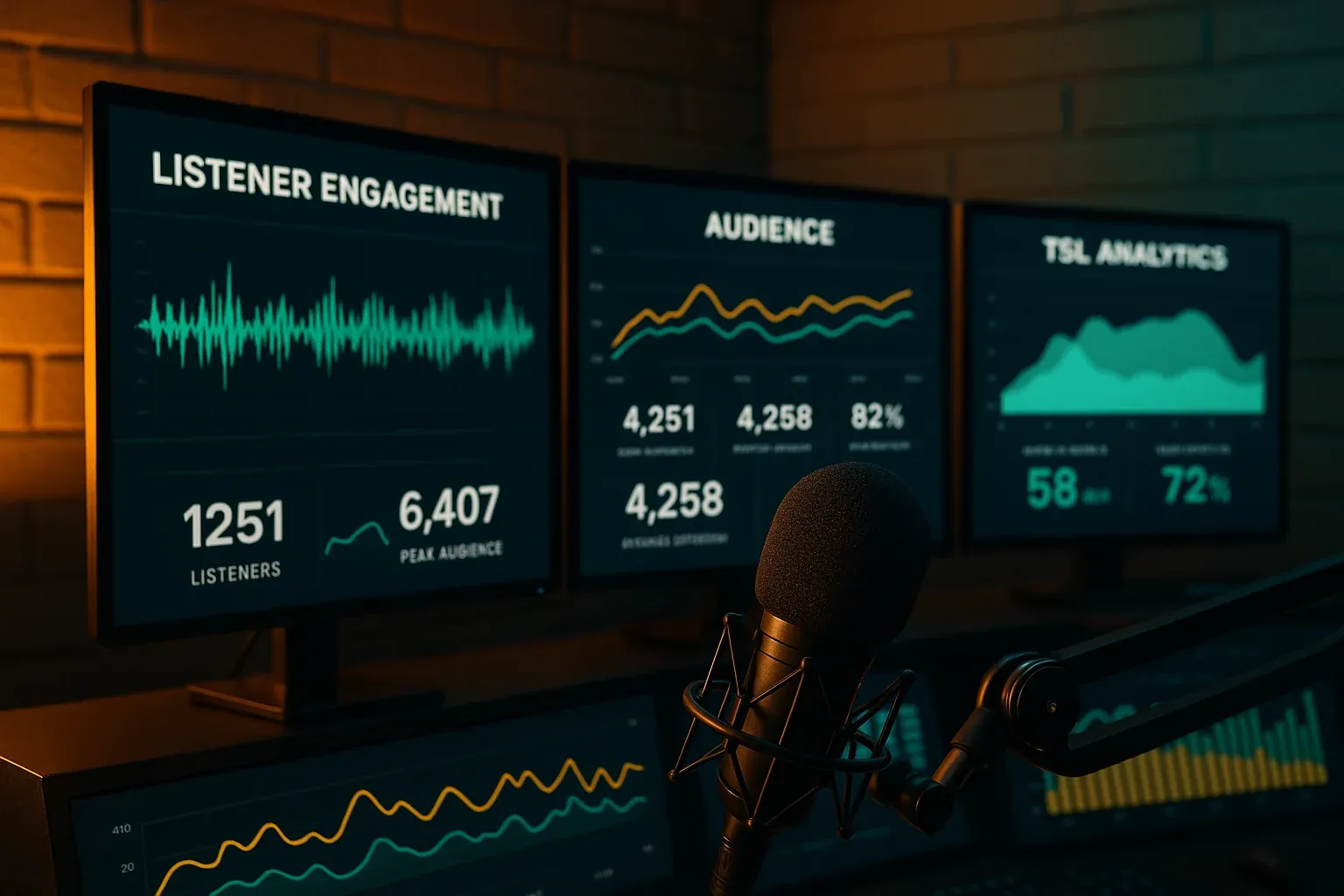

Radio has no shortage of numbers. AQH. Cume. TSL. Share. Reach. GRPs. P1 listeners. Digital streams. Social impressions. Podcast downloads. Smart speaker activations. The list keeps growing every year.
The problem isn't a lack of data. It's knowing which data actually tells you whether your show is working.
Most stations drown in metrics without ever connecting them to actionable programming decisions. The morning show gets a monthly report full of numbers. Half of them are vanity metrics. The other half require a statistics degree to interpret. And the PD is making decisions based on gut feel anyway because the data didn't arrive in time to matter.
Here's the truth: you don't need all the metrics. You need the right five or six. The ones that tell you whether listeners are finding your show, staying with your show, and caring enough about your show to come back tomorrow.
Let's cut through the noise.

The Two Categories That Matter
Every radio metric falls into one of two buckets: acquisition (are people finding you?) and retention (are they staying?).
Acquisition metrics tell you whether your marketing, signal, positioning, and brand awareness are working. Retention metrics tell you whether your content is working. As a programmer or on-air talent, retention is where you live. You can't control the billboard budget. You can control what happens between the songs.
The mistake most stations make is optimizing for acquisition while ignoring retention. A massive cume with terrible TSL means listeners are sampling your station and leaving. You're spending money to bring people to a party they don't want to stay at.
Flip that. Start with retention. Fix the content. Then the acquisition metrics take care of themselves — because listeners who stay also come back, and listeners who come back tell other people.
The Core Programming Metrics
1. Average Quarter-Hour Persons (AQH)
AQH is the foundational currency of radio. It measures the average number of people listening to your station during any 15-minute window within a measured daypart. It's what advertisers buy. It's what your sales team sells. And it's the single number that most directly reflects your show's performance.
Why it matters: AQH combines both acquisition and retention into one number. To grow AQH, you either need more people tuning in or the same people staying longer. Ideally both.
How to use it: Track AQH by daypart, not just overall. A morning show with strong AQH but a midday collapse tells a specific story — your morning content is working but you're not building bridges to the rest of the day. Compare AQH across quarter-hours within your show to find exactly when listeners drop off. That 9:15 AM dip? That's when your content gets soft. Fix that quarter-hour specifically.
What good looks like: This depends entirely on your market size and format. Don't compare your AQH to a station three markets up. Compare it to your own previous books and to your direct format competitors in-market.
2. Time Spent Listening (TSL)
If AQH is what you sell, TSL is what you control. Time Spent Listening measures how long your average listener stays tuned during a single listening occasion. It's the most direct measure of content quality in radio.
Why it matters: TSL improvements compound. Adding just one additional minute per listening occasion can produce outsized ratings gains because of how the math works. Nielsen measures in quarter-hours — so a listener who stays 14 minutes counts the same as one who stays 1 minute. But a listener who stays 16 minutes picks up an additional quarter-hour credit. Those borderline minutes are where ratings are won and lost.
How to use it: Monitor TSL trends over time, not individual books. A single ratings period can be noisy. Three consecutive books trending the same direction? That's signal. And look at TSL relative to your competition — if everyone in the market dropped, that's a market condition. If only you dropped, that's a programming problem.
What good looks like: Average radio TSL in 2026 is roughly 10 minutes per occasion. If your show consistently holds listeners for 12-15 minutes, you're outperforming. If you're below 8 minutes, you have a retention emergency.
3. Cume (Cumulative Audience)
Cume is your total unique audience — the number of different people who listen to your station for at least five minutes during a measured period. Think of it as your station's addressable audience.
Why it matters: Cume tells you how many people are willing to give you a chance. It's your top-of-funnel metric. High cume with low TSL means people are trying your station and bouncing. Low cume with high TSL means you have a loyal core but you're invisible to new listeners.
How to use it: The ratio of AQH to Cume (called your "recycling rate" or "turnover ratio") is one of the most diagnostic numbers in radio. A high turnover ratio means you're churning through listeners fast — lots of sampling, little sticking. A lower ratio means your audience is deep and loyal. Neither is inherently "better" — it depends on your format and strategy — but the trend matters enormously.
4. P1 Listener Share
P1 listeners are the people who spend more time with your station than any other. They're your core audience. Your evangelists. The ones who set you as a preset and default to your frequency every time they get in the car.
Why it matters: P1 listeners are disproportionately valuable. In most markets, your P1 audience generates 60-70% of your total listening. Losing even a small number of P1 listeners produces outsized ratings damage. Gaining P1s — converting casual listeners into loyalists — is the highest-leverage programming move you can make.
How to use it: Track the size of your P1 base across books. Is it growing, shrinking, or flat? If your P1 count is declining while your overall cume holds steady, you're losing depth — listeners are becoming less committed. That's an early warning sign that shows up in P1 data before it shows up in AQH.
The Modern Metrics Most Stations Ignore
Traditional metrics still matter. But in 2026, they only tell half the story. Your audience doesn't just listen on a terrestrial radio anymore. They stream. They podcast. They interact on social media. They talk to smart speakers. If you're only measuring over-the-air performance, you're blind to half of what your audience is doing.
5. Digital Streaming Sessions
If your station has an online stream (and it should), your streaming data is a goldmine that most programmers never touch. Unlike Nielsen, which samples and estimates, streaming data is exact. You know precisely how many people listened, when they started, when they stopped, and often where they are.
Why it matters: Streaming audiences skew younger and more mobile — the demographic traditional radio is fighting hardest to retain. A show that performs modestly in PPM but has a strong streaming audience is more valuable than the ratings suggest.
How to use it: Look at streaming session duration alongside traditional TSL. If your streaming TSL is significantly shorter than your over-the-air TSL, your content may have a tune-out problem that PPM is too blunt to catch. Streaming data gives you quarter-hour-level precision. Use it.
6. Social Engagement Rate
Social media followers are a vanity metric. Engagement rate is not.
Engagement rate measures how many of your followers actually interact with your content — likes, comments, shares, saves. A show with 5,000 followers and 8% engagement is building a stronger relationship with its audience than a show with 50,000 followers and 0.3% engagement.
Why it matters: Social engagement is a leading indicator. Listeners who engage with your show on social media between listening occasions are more likely to tune in tomorrow. Social engagement creates habitual connection outside the radio — it keeps your show top-of-mind when the listener isn't in the car.
How to use it: Track engagement rate (not follower count) weekly. Tie spikes in social engagement back to specific on-air content. When a particular bit generates unusual social activity, that's data telling you what resonated. Do more of that. Content that generates conversation is content that drives both social metrics and on-air performance.
Ready to simplify your show prep?
Try RCP free for 7 days. $0 until day 8
The Metric That Ties It All Together: Content-to-Performance Ratio
Here's the metric nobody talks about but everyone should: how efficiently does your content preparation translate into listener retention?
Think about it. You spend X hours prepping your show every day. That prep produces Y segments. Those segments produce Z minutes of TSL. The ratio of prep time to listener retention is your content efficiency score — and it's the single best measure of whether your prep process is working.
Most hosts have no idea what this ratio looks like because they've never tracked it. They prep the same way they always have, hope for the best, and check ratings every few months.
A better approach:
- Track your prep time honestly (including research, writing, and producer meetings)
- Log your segment performance — which bits landed and which fell flat
- Correlate your best-performing segments with how they were prepped
- Identify patterns in what prep methods produce the strongest content
You'll almost certainly discover that your best segments come from a specific type of preparation. Maybe it's the stories you find through real-time monitoring rather than overnight email blasts. Maybe it's the topics you prep as bullet points rather than scripts. Maybe it's the content your producer flagged versus what you found yourself.
This is where tools start to matter. A show that spends 30 minutes on curated, format-specific prep and performs well is more efficient than a show that spends three hours on generic research and performs the same. The goal isn't to prep more. It's to prep better.
How to Build Your Metrics Dashboard
You don't need a seven-figure analytics platform. You need a simple tracking system you'll actually use. Here's a framework:
Weekly (takes 10 minutes):
- Social engagement rate across platforms
- Streaming session count and average duration
- Qualitative content log — what worked, what didn't
Monthly (takes 30 minutes):
- AQH trend by daypart (from your ratings service)
- TSL trend (compare to previous month and previous year)
- P1 listener trend
- Cume trend and turnover ratio
Quarterly (takes 1 hour):
- Full competitive analysis — your metrics vs. format competitors
- Content-to-performance ratio audit
- Identify the three biggest opportunities for the next quarter
The key is consistency. A basic dashboard you check weekly beats a sophisticated analytics suite you look at twice a year. The stations that improve are the ones that measure, adjust, and measure again in a tight feedback loop.
What the Metrics Are Telling You (A Quick Diagnostic)
Use this cheat sheet when something feels off:
High cume, low TSL: People are finding you but leaving fast. Your content isn't sticky enough. Focus on retention tactics — forward promotion, appointment features, and eliminating tune-out triggers.
Low cume, high TSL: Your core loves you but nobody new is discovering you. This is a marketing and positioning problem, not a programming one. Your show is good — you just need more people to hear it.
Declining P1 with stable AQH: Your loyalists are getting less loyal. Something has changed — maybe a format tweak, a personnel change, or content drift. Investigate what shifted in the last 2-3 books.
Strong ratings, weak digital: Your over-the-air audience isn't following you to digital platforms. You're leaving engagement on the table. Build digital bridges — promote your stream, create social-specific content, give listeners a reason to connect outside the radio.
Weak ratings, strong digital: Your audience may be shifting platforms. This is actually good news — you're maintaining the relationship even if the listening method is changing. Make sure your digital metrics are part of your sales story.

Stop Measuring Everything. Start Measuring What Matters.
The stations that win in 2026 aren't the ones with the most data. They're the ones who know which six metrics predict their success — and check them relentlessly.
Ratings books come out every few months. But your show happens every day. You need leading indicators that tell you today whether tomorrow's show is trending in the right direction. Social engagement. Streaming data. Content performance logs. These are the real-time signals that let you course-correct before the next book drops.
Get specific about what you're tracking. Build a simple dashboard. Review it weekly. Adjust your content strategy based on what the numbers say, not what your gut assumes. And remember: the goal isn't to chase metrics. It's to use metrics to make better creative decisions.
Because at the end of the day, every number on your dashboard traces back to the same question: did the listener care enough to stay?
That's the only metric that truly matters. Everything else is just a way of measuring it.
Ready to simplify your show prep?
Try RCP free for 7 days. $0 until day 8
Frequently Asked Questions
How do you measure radio show success?
Radio show success is measured through a combination of traditional and digital metrics. The core metrics are Average Quarter-Hour Persons (AQH), Time Spent Listening (TSL), Cumulative Audience (Cume), and P1 Listener Share. In 2026, these should be supplemented with digital streaming data and social engagement rates for a complete picture of show performance.
What is AQH in radio?
Average Quarter-Hour Persons (AQH) is the average number of listeners tuned to a radio station during any 15-minute period within a measured daypart. It's the primary currency that advertisers buy and the most direct measure of a show's audience size. AQH combines both audience acquisition and retention into a single metric.
What is a good TSL for a radio station?
Average radio Time Spent Listening in 2026 is approximately 10 minutes per listening occasion. Shows that consistently hold listeners for 12-15 minutes are outperforming the norm. TSL below 8 minutes signals a retention problem that needs immediate attention. However, "good" TSL varies by format — talk stations typically see higher TSL than music-intensive formats.
What's the difference between cume and AQH?
Cume (cumulative audience) measures the total number of unique listeners who tune in for at least five minutes during a period — it's your total reach. AQH measures the average number listening at any given moment. A station can have high cume but low AQH if listeners are sampling and leaving quickly. The ratio between the two (turnover ratio) reveals how loyal your audience is.
How often should radio stations review their metrics?
Stations should track social engagement and streaming data weekly (10 minutes), review AQH, TSL, and cume trends monthly (30 minutes), and conduct a full competitive analysis quarterly (1 hour). The key is consistency — a simple weekly check produces better results than a deep annual review because it allows for real-time programming adjustments.