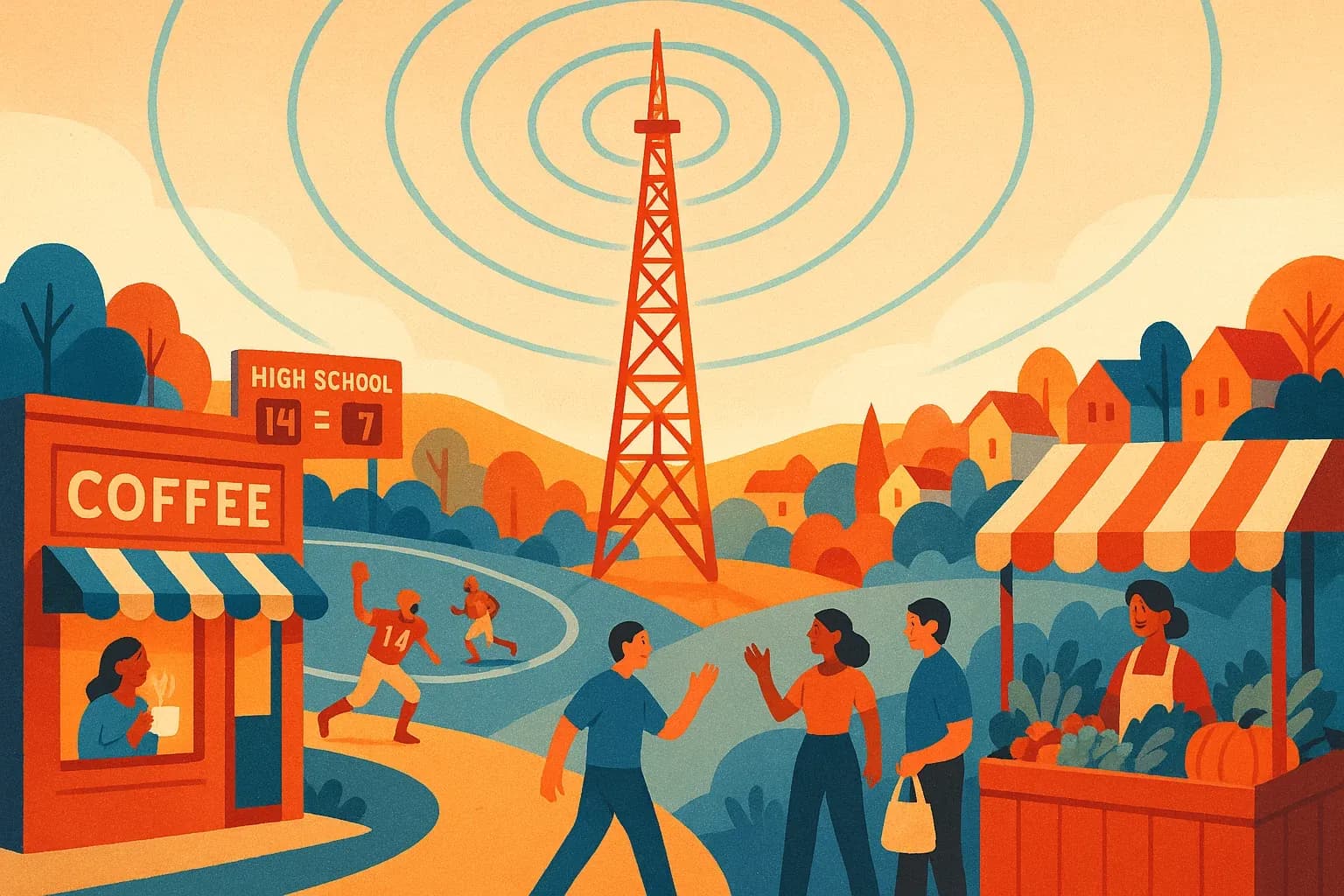

Spotify has 100 million tracks. Apple Music's algorithm is eerily accurate. TuneIn streams stations from 60 countries. And yet — none of them can tell your listeners that the high school football team won in overtime last Friday.
That's your edge. Local content is the one thing streaming can never replicate.
But here's the problem: most stations treat local content like an afterthought. A quick weather update. A recycled press release about a road closure. Maybe a half-hearted "community calendar" buried three clicks deep on the website.
That's not a local content strategy. That's a checkbox.
Stations that go all-in on local — the ones that treat community storytelling as a core competency, not an obligation — are seeing stronger listener loyalty, higher website traffic, and advertisers lining up to be part of the conversation.
This guide lays out a 5-pillar framework for building a local content strategy that actually works. Whether you're running a 3-person operation or a full-staff cluster, there's a version of this that fits your station — and it slots into the broader radio station content strategy framework as the local layer that streaming can't touch.
Why Local Content Is Radio's Biggest Competitive Advantage
Radio still reaches 88% of Americans weekly. That number holds up because of something no algorithm can manufacture: a real human voice from your town, talking about your town.
Streaming services can replicate your playlist. They can't replicate the DJ who called out your neighborhood by name during morning drive. They can't recap the city council meeting that affects your commute. They can't make you feel like you're part of something happening right here, right now.
And it's not just about on-air moments. Stations that publish local content on their websites — school news, city council recaps, high school sports scores, business spotlights, even obituaries — see higher repeat visits and longer time on site. People search for that stuff. They search for it by name, by neighborhood, by school district. If your station isn't the one providing it, someone else will.
The trend in 2026 is clear: relationships matter more than reach. Stations that build genuine emotional connections with their communities don't just survive — they thrive. And a radio station digital content strategy built around local storytelling is the fastest way to get there.
The 5 Pillars of a Local Content Strategy
A real local content strategy isn't just one thing. It's a system — five interconnected pillars that feed each other and compound over time.
1. Community News and Events
This is the foundation. Your station should be the first place people check for what's happening locally.
That means covering:
- City government: Council meetings, zoning decisions, road projects
- Schools: District news, school board decisions, graduation ceremonies
- Events: Festivals, charity runs, farmers markets, grand openings
- Community initiatives: Fundraisers, volunteer drives, neighborhood cleanups
You don't need a newsroom to do this. Build a simple sourcing system: subscribe to your city's press releases, follow school district social accounts, and check your local paper's calendar weekly. Better yet, train your on-air team to spot stories during their normal lives. The best local content often starts with "I was at the grocery store and..."
The key is consistency. A station that covers local events every single day — even briefly — becomes the go-to source. A station that does it once a month gets forgotten.
2. Local Business Spotlights
Every town has a restaurant owner with a great story. A barber who's been cutting hair since 1987. A new coffee shop trying to make it work.
Feature them. On air, on your website, on your socials. A 3-minute interview segment. A quick "shop local" social post. A 400-word blog feature.
This does three things at once:
- Creates genuine community content that listeners actually care about
- Builds goodwill with businesses that become evangelists for your station
- Opens a natural sponsorship pipeline — businesses you feature are far more likely to advertise
Don't make it a sales pitch. Make it a real story. "Tell us about this place" lands better than "Come buy an ad." The revenue follows the relationship.
3. Hyperlocal Social Media
Generic radio social posts ("Happy Friday!") get ignored. Hyperlocal social posts ("The line at Sal's Pizza on Oak Street is already out the door — who else is grabbing a slice before the homecoming game?") get shared.
The difference is specificity. Name the streets. Name the restaurants. Name the high school. Talk about things only someone who lives there would know.
Practical tips:
- Instagram Reels: Short clips from local events your team attends
- Facebook: Community group engagement — don't just post, comment on local discussions
- X/Twitter: Real-time local event coverage and listener interaction
- Nextdoor: If your station isn't on Nextdoor, you're missing the most hyperlocal platform that exists
One person with a smartphone at a local event creates more engaging content than a week of scheduled corporate posts.
4. On-Air + Digital Integration
Here's where most stations drop the ball. The morning show covers a local story. The website doesn't mention it. The social accounts post something completely different. The newsletter ignores it entirely.
That's four missed opportunities from one story.
The fix is simple: one story, five platforms. When you cover something locally, push it everywhere:
- On-air: The original segment or mention
- Website: A short blog post or recap with keywords
- Social media: Clips, photos, quotes from the segment
- Newsletter: Featured in your next email
- Podcast/replay: Clip it as a shareable audio piece
This isn't extra work. It's getting full value from work you already did. One local interview becomes five pieces of content. One community event becomes a week of posts.
5. Listener-Generated Local Content
Your listeners are your best reporters. They see things you don't. They know their neighborhoods. They have stories that make great radio.
Build systems to capture it:
- "Everyday heroes" segments: Spotlight listeners who volunteer, mentor, or make a difference
- Listener-submitted stories: "What's happening in your neighborhood?" callouts
- Community callouts: "Send us your best local restaurant recommendation" — simple, shareable, and it drives engagement
- UGC on social: Repost listener photos from local events with credit
Interactive content gets phones ringing and social feeds buzzing. When a listener hears their name, their neighborhood, their story on your station — that's a bond no streaming app can touch.
How to Source Local Content When You're Short-Staffed
"That all sounds great, but we barely have enough people to keep the lights on."
Fair. That's the reality for most stations. But a local content strategy doesn't require a dedicated team. It requires a system.
Build your local tipster network:
- Follow your city's official social accounts and press release lists
- Connect with school district PR contacts (they want coverage)
- Monitor police/fire scanner apps for breaking local stories
- Join neighborhood Facebook groups and Nextdoor
- Build relationships with local business owners who'll tip you off to stories
Repurpose ruthlessly. One local story should never be "one and done." Extract every piece of content from it:
- On-air mention
- Social media post with photo
- Short website article (250-400 words)
- Newsletter feature
- Audio clip for podcast feed
That's five touchpoints from a single 10-minute effort.
Automate what you can. Tools like RCP Local can auto-curate market-specific news and rewrite it for radio — handling the sourcing and formatting so your team can focus on the stories that need a human touch. Automation handles volume; your team handles personality.
And here's the bottom line: you don't need to do all five pillars perfectly from day one. Start with one. Community news and events is the easiest. Add a second pillar next month. Build the habit, then build the system.
Measuring Your Local Content Strategy
If you can't measure it, you can't improve it. Here's what to track:
Website metrics:
- Traffic to local content pages vs. non-local
- Time on page for local articles (should be higher than average)
- Organic search traffic from local keywords ("your city + events," "your city + news")
Social engagement:
- Engagement rate on local posts vs. generic (expect 2-3x higher)
- Share rates (local content gets shared more — people tag friends)
- Comments mentioning specific places, people, or events
On-air signals:
- Call-in volume during local segments
- Listener mentions of local content in texts/calls
- Advertiser inquiries tied to local features or sponsorships
Revenue indicators:
- New local advertisers who discovered you through content
- Sponsorship renewals tied to specific local segments
- Event partnerships that started from on-air coverage
Track these monthly. Even rough numbers tell a story. If local posts consistently outperform generic content — and they will — that's your signal to double down.
For more on tracking your station's digital presence, see our guide on SEO for radio broadcasters.
Key Takeaways
- Local content is your superpower. Streaming can't replicate it. Period.
- Use the 5-pillar framework: Community news, business spotlights, hyperlocal social, on-air/digital integration, and listener-generated content.
- One story, five platforms. Stop treating each channel as separate. Repurpose everything.
- You don't need a big team. You need a system, a tipster network, and the discipline to be consistent.
- Measure what matters. Local content drives engagement, traffic, and advertiser interest — but only if you track it.
- Start with one pillar. Build the habit. The rest follows.
Radio stations that lean into their local advantage — that refuse to become "just another audio option" — don't just survive. They become essential.
Your community already trusts your voice. Give them a reason to keep listening.
FAQ
What is a local radio content strategy?
A local radio content strategy is the framework for producing content that reflects your specific market — local news, community stories, area events, local-business spotlights — across on-air, website, social, and email channels. It's what differentiates a community radio station from a national streaming service. The strategy defines your local content pillars, sourcing, publishing cadence, and the community relationships that sustain it.
How much local content should a radio station produce?
A minimum viable local content strategy produces one strong local piece per daypart, per weekday — so roughly 15–20 local content items per week. That covers morning show local hooks, midday community spotlights, afternoon drive local news, and a weekly community story. Stations producing less than 10 pieces of local content per week typically lose the "voice of the market" positioning to hyperlocal blogs and social media.
Can small market stations execute a strong local content strategy?
Yes — small markets often have a structural advantage. In a small market, every high school sport, community fundraiser, and local business is a content opportunity with clear listener relevance. The challenge for small markets isn't finding local content — it's producing it consistently without dedicated staff. Tools like RCP Local solve that workflow problem at the price point small markets can afford.
What's the biggest mistake stations make with local content?
Treating "local" as a feature instead of a positioning strategy. Stations that win local lean into it across every touchpoint — on-air breaks, website, email, social, and partnerships. Stations that fail at local drop in a local news break at the top of the hour and call it done. Local has to be the ANGLE, not a segment.
How does local content strategy drive radio revenue?
Local content is the highest-converting sponsor category. Local businesses advertise where they believe their customers spend attention, and consistent local content gives you the audience connection that wins local-business budgets over regional/national spot buys. Stations with strong local content typically command 15–25% rate premiums from local-business advertisers versus stations with weak local content.
Ready to simplify your show prep?
Try RCP free for 7 days. $0 until day 8