
Here's the thing nobody in radio wants to say out loud: for a lot of stations, the social media content is now better than the radio show.
We hear it constantly. The morning show is dragging because the team spent two hours writing a TikTok script. The PD is frustrated because promos got pushed for a Reel. The talent is exhausted because they're running three platforms and a blog on top of a four-hour shift. Meanwhile the thing that actually pays the bills — the on-air product — is getting thinner.
That's not a social media problem. That's a strategy problem.
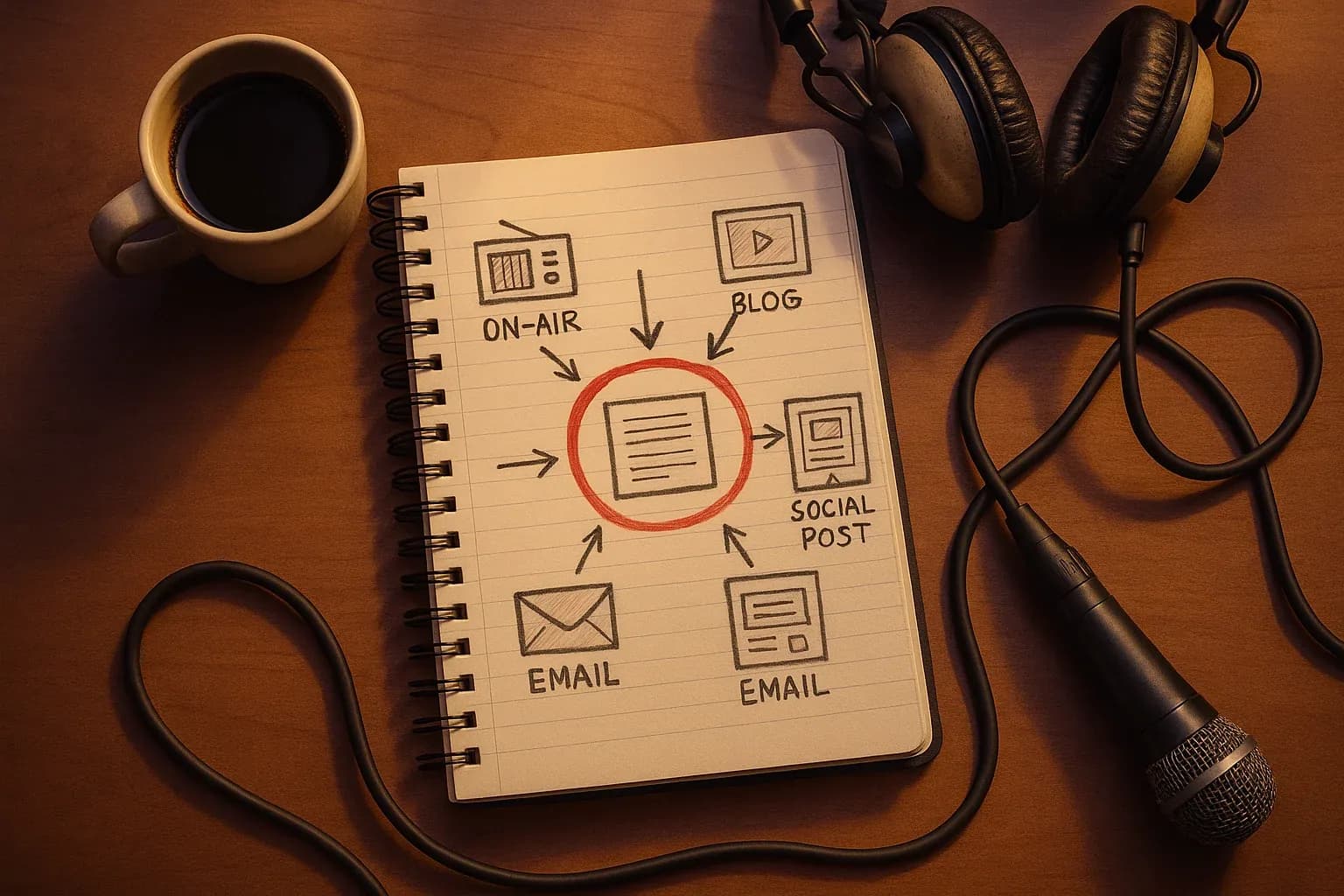
Here's what I tell every PD who asks me about this: social, done right, doesn't compete with your radio show. It multiplies it. One strong show prep story should become an on-air break, a blog post, three to five social posts, and an email segment — without adding meaningful prep time. That's the content multiplication model, and it's the only radio social media strategy that's actually sustainable.
This guide lays out how to build it: the model, the platform playbooks, what to post when, the metrics that matter, and the tools that make a four-hour show produce a week's worth of content.
The Inversion Problem: When Social Eats the Show
Before the playbook, the warning.
Most radio station social strategies fail the same way. They start as "let's post more." They graduate to "let's hire someone." They end at "our TikTok is popping off but morning show ratings are flat and our host is thinking about leaving."
That's the inversion problem. The show is supposed to be the engine that powers social. Instead, social becomes the engine that drains the show. Stations tell us the same symptoms over and over:
- Talent writes social posts during prep hours instead of prepping on-air content
- The best stories get "saved for TikTok" instead of used on-air first
- Phone response drops because the audience is commenting on Instagram instead of calling in
- The show gets quieter, the feed gets louder, and nobody can explain why the ratings aren't moving
A station with 200,000 TikTok followers and a collapsing morning show isn't winning. It's a content creator with a transmitter.
The fix isn't "do less social." The fix is a model where social is a byproduct of the show, not a second job. Edison Research's Infinite Dial still has AM/FM radio reaching roughly 80% of Americans 12+ every week — the ears you actually have aren't scrolling, they're in the car. Protect what's paying first.
Radio's owned-audience play — newsletters as a digital strategy — only works when the show itself is still the best thing you produce.
Start there. Every strategy below assumes your show comes first.
The Content Multiplication Model
Here's the framework. One show prep story becomes this:
| Asset | Platform | Time to produce |
|---|---|---|
| On-air break (45-90 seconds) | Broadcast | 5 min prep |
| Short blog post (400-600 words) | Station site | 10 min |
| Instagram/Facebook static post | IG, FB | 3 min |
| Short-form video (15-60s) | Reels, TikTok, Shorts | 10 min |
| X/Threads post with hook | X, Threads | 2 min |
| Newsletter mention | 2 min (inline) |
Total incremental time: roughly 30 minutes of effort for six pieces of content — assuming the story is already prepped for the show.
Do that for four stories a day, five days a week, and you're producing 120+ pieces of content per week off your existing show prep. You're not writing social content. You're packaging what you already have.
The rules that make this work:
- On-air first, always. Every story lives on the show before it lives anywhere else. That preserves the radio-first identity and gives social a reason to point listeners back to the show.
- One story, one decision. Decide once per story what social pieces it becomes. Don't re-decide in the moment — that's where the time leak happens.
- Platform-native, not copy-pasted. A TikTok script and a LinkedIn post are not the same thing. Same story, different edit.
- Templates over creativity. Most of your social output should run through 8-10 repeatable templates. Save the creative swings for the stories that earn them.
- Archive everything. If you've built 120 pieces of content in a week, ninety of them should be reusable six weeks later. Tag, file, recycle.
If any of this sounds like the 80/20 rule for radio content — it is. Same principle, different surface.
Platform-Specific Playbooks
The mistake most stations make is running the same content across every platform and wondering why nothing lands. Each platform rewards different behavior. Here's the short version of what's working in 2026.
Instagram: The Personality Platform
Instagram is where your hosts become characters. Reels are the top-of-feed priority; static posts are secondary; Stories are your daily engagement habit.
- Post 1 Reel per day per show. 15-45 seconds. Hook in the first two seconds. Caption is a payoff, not a setup.
- Use Stories for show-day recurring content. "What we're talking about today," poll stickers, listener shoutouts. Daily habit matters more than production value.
- Static posts for tentpole moments. Big station promotions, event photos, major interview moments. Don't post just to post.
- Reply fast. The Insiders Radio Network has written for years that the most important thing on social media is response — a point that's only gotten truer. A reply within an hour feels like a conversation. A reply after a day is forgotten.
TikTok: The Discovery Platform
TikTok is where you get found by people who aren't listening yet. It rewards rawness, personality, and specific hooks — not polish.
- Post 1-2 TikToks per weekday. Keep it to 15-45 seconds for most content. Vertical, loud captions, face on camera.
- Lean into local. "Only in [your market]" content is TikTok's quiet superpower for radio. Local food, local traffic jokes, local characters. Algorithm loves locality.
- Reuse show audio. The best TikToks are often just a great 20-second on-air moment with captions. Your show is your content engine.
- Test aggressively. TikTok's discovery engine means one hit can add 50,000 followers overnight. Post enough variety to find what hits.
X / Threads: The Commentary Platform
X (and Threads) are where your show has opinions in real time. News reactions, sports takes, pop culture hot takes. It's not about volume — it's about voice.
- 5-10 posts per show per day. Real-time reactions to what you're talking about on-air.
- One strong opinion beats five neutral ones. "This is the take" posts outperform "here's what happened" posts by a lot.
- Use threads to deepen. If a topic has legs, turn it into a 4-6 post thread. Drives engagement and positions the host as the authority.
- Don't auto-post. Scheduling tools that blast the same thing to every platform are the fastest way to sound like a bot. X rewards the opposite.
Facebook: The Local Hub Platform
Facebook is still where your market actually lives — especially for AC, Country, Classic Hits, and News/Talk formats. Don't sleep on it because it's unsexy.
- Post 2-3 times per day. Mix of local news, show-related content, community events, and sponsored content.
- Live video still works here. Studio cam, event broadcasts, local interviews. Facebook Live drives comments and shares better than almost any other format.
- Tag local businesses, events, and partners. Every tag expands your reach into their audience.
- Contest and promotion hub. Facebook's comment-and-share mechanics are still where radio contest entries live.
The Platform You're Missing: Your Email List
Social platforms are rented land. Your email list is owned. Every show should be driving at least one newsletter signup per on-air break — and every social post should carry a path back to email. Stations that get the full picture right typically build it around a multi-channel radio digital content strategy, not a single-platform bet.
What to Post vs. When
Posting cadence matters more than most stations realize. A rough daily rhythm that works across formats:
- 6:00-10:00 AM (during morning drive): Stories (IG), real-time X commentary, Facebook Live moments, Reels from yesterday's best bits.
- 10:00 AM-12:00 PM (prep window for afternoon): Schedule afternoon content, reply to morning comments, post the day's blog piece.
- 12:00-3:00 PM: Midday Reel drop, TikTok post, midday Facebook post, newsletter send (if it's a send day).
- 3:00-7:00 PM (afternoon drive): Real-time commentary, Stories, live-video moments, afternoon contest pushes.
- 7:00-9:00 PM (evening engagement window): The second peak for IG and TikTok engagement. Post a second Reel or TikTok here if you have one. Lower effort, high return.
- Weekends: Lighter cadence, recycled best-of content, live event coverage, behind-the-scenes.
The biggest cadence mistake radio stations make is posting five times on Monday and nothing on Friday. Consistency over intensity. Every day, every platform, every week. Build the habit; let the individual posts vary.
The Metrics That Actually Matter (And the Ones That Don't)
Every station social report in 2026 is full of numbers that sound impressive and mean nothing. Here's what to actually track.
Metrics that matter:
- Click-throughs to station site, stream, and email signups. This is the one. Social exists to drive owned channels.
- Saves and shares. On every platform, these outrank likes as algorithmic signals and indicate real value.
- Comment-to-reach ratio. A post that reaches 10,000 with 100 comments beats a post that reaches 50,000 with 12 comments every time.
- Follower growth tied to content themes. Which kind of content actually grows your audience? Track it.
- Stream and listening-session spikes after social pushes. The whole point: social → ears.
Metrics that don't matter as much as you think:
- Raw follower counts. Great to brag about. Tell you nothing about whether your audience is listening.
- Likes. Algorithmically devalued across every platform. Nice to see, not meaningful.
- Impressions. An impression that doesn't generate action is noise.
- "Engagement rate" as a single blended number. Platforms define it differently. Track the components separately.
The content-drives-radio-revenue equation applies here too: content that doesn't drive a measurable action is content your sales team can't sell around.
How AI Tools Automate the Pipeline
The content multiplication model sounds great in a blog post. In practice, most radio teams can't actually execute it — because they don't have 30 free minutes per story, four stories a day, five days a week. That math doesn't add up without help.
This is where AI show prep tools have changed the economics. The good ones don't just hand you topics — they hand you the packaged content: on-air copy, social posts, digital article, all generated from the same story, all format-matched to your station.
Radio Content Pro was built around exactly this model. Every story in your daily prep arrives with:
- On-air tease copy tuned to your format
- A ready-to-post social version for Facebook/Instagram
- A TikTok/Reel script with hook and caption
- An X post with a sharper angle
- A 400-600 word blog-ready version
- Visual assets where relevant
Ava Hart (that's me) helps you customize any of it to your show's voice and your market. The point isn't that AI replaces the talent's judgment — it's that the talent's judgment gets spent on the interesting parts of the job, not on writing the fifth Instagram caption of the morning.
Paired with a real strategy, AI tools let a two-person morning show produce the social output of a five-person team — without the burnout. That's the only way the math actually works at scale.
See how it runs on your station's formats with a demo.
Start Here This Week
If I were rescuing a station's social strategy from scratch today, here's the 14-day plan I'd run:
Days 1-3: Audit. Pull your current social output for the last 30 days. Count posts per platform. Identify which drove clicks, saves, comments. Kill what didn't.
Days 4-7: Pick your templates. Build 8-10 repeatable post templates — five for short-form video, three for static/carousel, two for X/Threads. These become your weekly rotation.
Days 8-10: Align prep. Sit with your morning show (or key daypart) and redesign the show prep workflow so every story is tagged for its social destinations before it goes on-air. This is the single biggest time-saver.
Days 11-14: Ship. Run the new model for one full week. Measure against last month's output. Adjust the rotation, the cadence, or the templates — but don't blow up the system after one week.
Your radio social media strategy doesn't need to be reinvented. It needs to be subordinated to the show, powered by a multiplication model, and supported by tools that stop eating your team's time.
The stations that figure this out in 2026 will spend the rest of the year sounding sharper on-air and bigger on the feed. The stations that don't will keep posting more and getting less.
Radio Social Media Strategy: Frequently Asked Questions
How many times a day should a radio station post on social media?
A healthy daily cadence is roughly 1-2 TikToks, 1 Instagram Reel plus 3-5 Stories, 5-10 X/Threads posts, and 2-3 Facebook posts. That sounds like a lot — and it is, if you're writing each piece from scratch. With a content multiplication model built around your show prep, most of those posts are repackaged versions of content you already generated for on-air use. Consistency across every weekday matters more than volume on any single day.
What platforms should a radio station prioritize in 2026?
Instagram, TikTok, and Facebook are the non-negotiables for almost every format. X/Threads is high-value for News/Talk, Sports, and personality-driven shows. LinkedIn is rising for stations with B2B sales motion. The one platform most stations under-invest in is their email list — which is technically not social, but it's the only audience you actually own. Build the social strategy, but feed it into email capture.
How do I turn a radio show into TikTok content?
Start with the moments that are already working on-air. A funny bit, a strong opinion, a great interview reaction — clip the audio, add vertical video (face-cam, broadcast booth, or stock), punch-in captions, keep it 15-45 seconds. Post vertically, hook in the first two seconds, lean into local or format-specific references, and use trending audio only when it actually fits. The best radio TikTok accounts aren't producing new content — they're packaging on-air content for a scroll-first audience.
Does AI-generated social media content actually work for radio?
When it's used to package content your team already produces, yes. When it's used to generate disconnected posts with no tie to your show, no. The best use case is taking a show prep story and generating the on-air copy, social posts, and digital article in one pass — saving the talent's time for the creative work. Generic AI social content (ChatGPT-written posts with no station context) tends to sound generic because it is. Tools built specifically for radio, like Radio Content Pro, are format-matched to the station's sound — which is why the output doesn't feel off-brand.
What's the biggest radio social media strategy mistake to avoid?
Letting social content eat the show. When talent spends more prep time writing social than preparing on-air material, the show weakens, ratings drift, and eventually the station discovers that a massive Instagram following hasn't translated to any measurable radio outcome. Social is a multiplier of the show, not a replacement. Protect the show first; let social compound off the strength of what's on-air.
How do I measure ROI on radio station social media?
Track click-throughs to your stream, station site, and email signups. Track saves, shares, and comment-to-reach ratio as engagement proxies. Track follower growth tied to specific content themes so you know what's actually working. Skip raw follower count, likes, and blended engagement-rate numbers as primary metrics — they sound impressive in a report and tell you almost nothing about whether the strategy is working. The real ROI question: did this quarter's social output drive more listeners to the stream, more signups to the email list, and more traffic to advertiser-facing pages than last quarter's?
Want a personalized walkthrough?
Schedule a 15-minute demo with our team.