
Eighty percent of your show prep is probably wasting your time.
Not because it's unnecessary — it is necessary. But here's what I've noticed after years of working with radio professionals: most of the hours you burn on prep don't actually require you. Your talent, your voice, your knowledge of the market? That's only needed for a fraction of the work. The rest is grunt work that anyone — or anything — could handle.
That's the core idea behind radio content productivity through the 80/20 rule, also known as the Pareto Principle. And once you see it, you can't unsee it.
 The split is real: most of your prep time goes to tasks that don't need your personality.
What the 80/20 Rule Actually Means for Radio
The Pareto Principle is simple: roughly 80% of results come from 20% of effort. Italian economist Vilfredo Pareto noticed the pattern in 1896 when he realized 80% of Italy's land was owned by 20% of the population. The ratio shows up everywhere — business, fitness, relationships. And radio.
Applied to radio content: 80% of your best on-air moments come from about 20% of your prep work. The local story you turned into a phone topic. The personal take that got people texting. The bit you spent ten minutes developing that carried the whole hour.
Now flip it. The other 80% of your prep time — the scanning, the aggregating, the formatting — produces maybe 20% of what listeners actually notice. It's essential infrastructure, sure. But it's not where the magic happens.
Think about your last really great show. The segment that lit up the phones, the bit that had your co-host laughing, the topic that people were still texting about at noon. How long did you actually spend prepping that moment? Probably not long. Maybe ten minutes of creative thinking. Maybe a quick conversation with your producer. The raw material came from hours of scanning — but the magic came from a few minutes of your actual talent.
I talked to a morning show host last month who tracked her prep for a week. She spent 14 hours total. Eleven of those hours were research and organization. Three hours were creative work — developing angles, writing bits, planning phone topics. Guess which three hours her PD praised?
If you want the full picture of what show prep involves, our complete guide to radio show prep covers every step. But today we're focused on one question about radio content productivity: which steps actually need you?
The 80%: Tasks That Consume Your Time but Not Your Talent
Let's break down where those hours actually go. Industry research puts the average at 15+ hours per week for most radio personalities. Here's the typical split:
News aggregation and content scanning — 3-4 hours a week scrolling through a dozen sites before sunrise. You're not really reading. You're hunting. Scanning headlines, opening tabs, closing tabs, opening more tabs. By the time you find something usable, you've forgotten what you were looking for.
Formatting and organizing prep documents — 1-2 hours of copy-paste tedium. Grab this link, format that quote, move these talking points into your doc. It's digital filing, and it's mind-numbing.
Monitoring trending topics and social feeds — 2 hours bouncing between Twitter/X, Reddit, Instagram, and TikTok. Some of it's research. Most of it's a scroll trap dressed up as productivity.
Entertainment and pop culture tracking — 2 hours keeping up with celebrity news, music charts, and viral moments. This varies by format — CHR and Hot AC shows feel it the hardest — but every format has some version of it.
These tasks feel productive. They are productive. But they don't require your personality, your local connections, or the thing that makes listeners tune in to your show specifically. If you want to improve your radio content productivity, this is where to start — because anyone, or any tool, could do them just as well.
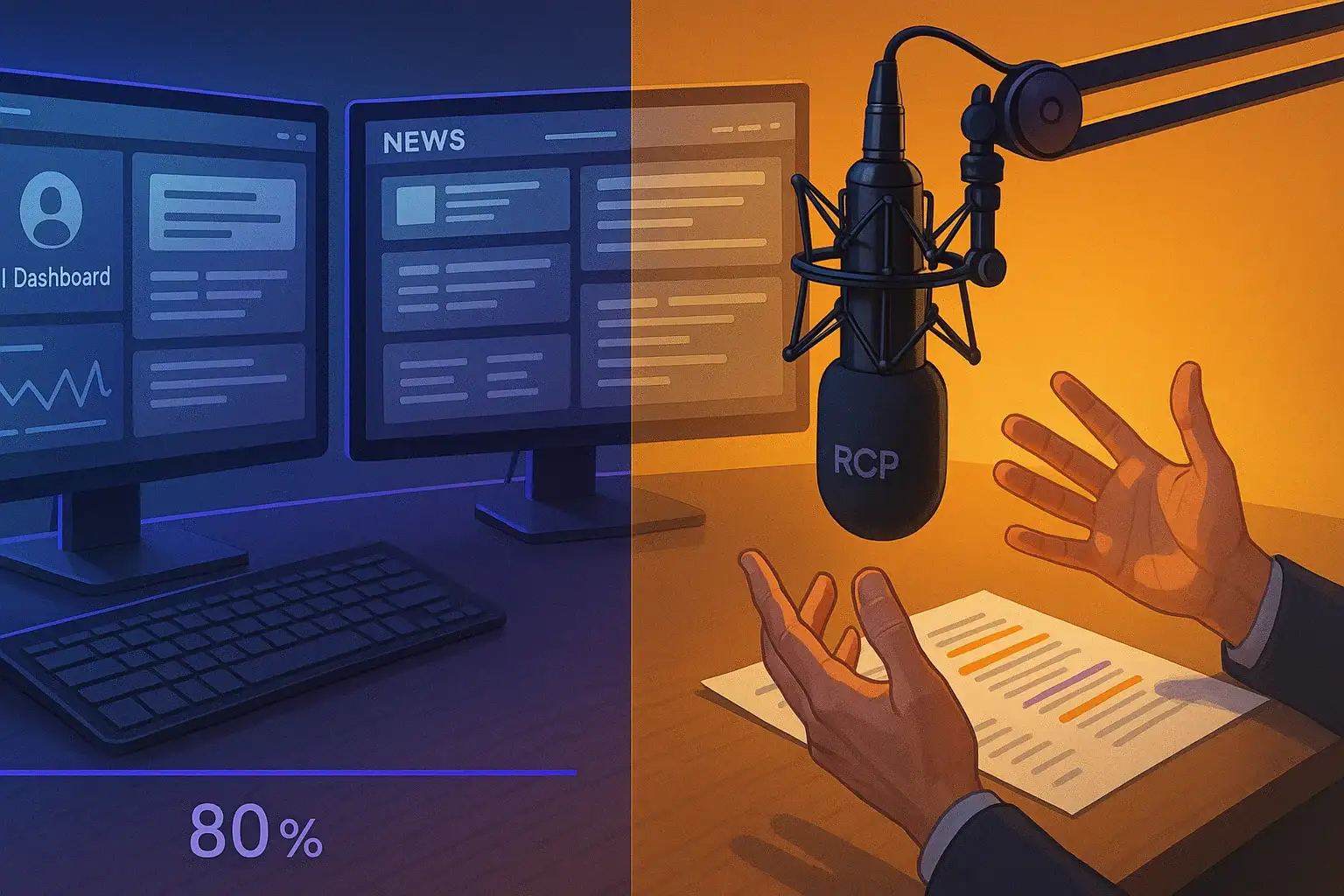
That's where AI-powered automation saves radio pros 10+ hours weekly. Not by replacing the creative work, but by handling everything around it.
 Same broadcaster, different workflow. The right side is what happens when you automate the 80%.
The 20% That Actually Moves the Needle
This is where radio gets good. The tasks only you can do — and honestly, the tasks that probably got you into this business in the first place.
Local angles and community connections. Your knowledge of what's happening in your city, the school closings everyone's panicking about, the local drama nobody else is covering. No algorithm knows your market like you do. This is your competitive edge over Spotify, podcasts, and every other audio option your listeners have.
Personal storytelling and opinion. The story about your kid this morning. Your take on last night's game. That observation from the grocery store that somehow became a 15-minute phone segment. That's not content — that's connection. And you can't automate connection.
Audience interaction. The phone topics that hit. The text messages that spark debate. The social media thread that bleeds into on-air gold. This requires instinct, timing, and the kind of read-the-room skill that only comes from doing the work.
Segment creativity and bit development. The "what if we..." moments. The creative spark that turns a news story into theater of the mind. This is the 20% that builds listening habits, drives PPM, and makes PDs want to keep you.
Here's the real kicker: these tasks aren't just the most valuable — they're also the most fun. When you're not drained from the 80%, the 20% doesn't feel like work at all.
The biggest show prep mistake I see? Spending all your energy on the 80% and rushing through the 20%. Getting the ratio backward.
How to Boost Your Radio Content Productivity with the 80/20 Rule
This isn't theory. Here's how to actually do it.
Step 1: Audit your current prep time. Track how you spend every hour of prep for one week. Be brutally honest. Write it down — don't estimate from memory. Use a simple spreadsheet or even a notepad by your keyboard. Log every task switch: "8:15 — scanning Reddit. 8:40 — found a story, writing talking points. 9:00 — back to scrolling." Most people are shocked by where the time actually goes.
Step 2: Categorize every task. Label each one: "80%" (could be automated or delegated) or "20%" (requires my personality, knowledge, or creativity). If someone else could do it just as well, it's an 80% task.
Step 3: Automate the 80%. This is where tools come in. Radio Content Pro handles content aggregation, trending topic monitoring, format-specific curation, and prep organization — exactly the tasks that eat your 80%. The content arrives structured and ready. You just add the personality.
Step 4: Invest the reclaimed time into the 20%. This is the step people skip. Don't just save time — reinvest it. Use those freed-up hours for developing bits, researching local angles, actually engaging with listeners on social. Call a local source. Brainstorm with your producer. Write that recurring segment you've been putting off for months. Even reclaiming five hours a week transforms a show.
The stations I've seen get the most out of this approach treat the time savings like found money. They don't pocket it and leave early (though some sleep a little later). They spend it on the creative work that drives ratings. That's real radio content productivity — not doing more, but doing what matters.
Want to see what this looks like in practice? Here's a walkthrough of setting up your first week with Radio Content Pro.
FAQ
What is the 80/20 rule for radio content?
The 80/20 rule — also called the Pareto Principle — applied to radio content means that roughly 80% of your show's best moments come from 20% of your prep effort. That 20% is the creative, personal work: storytelling, local angles, bit development, and audience interaction. The other 80% of your time goes to routine tasks like news scanning, content aggregation, and document formatting that could be automated.
How can I save time on show prep?
Start by tracking how you spend your prep time for one week. Categorize tasks as routine (aggregation, scanning, formatting) or creative (storytelling, local angles, bits). Automate the routine tasks with tools like Radio Content Pro, then reinvest that time into the creative work that listeners actually notice.
What radio show prep tasks should I automate?
News aggregation, trending topic monitoring, entertainment updates, social media scanning, and content formatting are all strong candidates. These tasks are important, but they don't require your personality or local expertise — they just need to get done.
 This is what the 20% looks like: confident, creative, and actually enjoying the work.
Key Takeaways
The 80/20 rule isn't complicated. It's just honest.
- Most of your prep time isn't creative work — news scanning, aggregation, formatting, and monitoring eat the bulk of your hours
- Your best on-air moments come from a small fraction of effort — local angles, storytelling, and audience connection are where radio magic happens
- Automating the 80% doesn't weaken your show — it frees you to do more of what makes your show worth listening to
- Start with a one-week audit — tracking your time reveals the imbalance you've been feeling
- Tools handle the routine so you can focus on the craft — that's not laziness, that's strategy
The best shows aren't built by doing more. They're built by doing the right things.
Ready to simplify your show prep?
Try RCP free for 7 days. $0 until day 8