How do you increase radio ratings when the budget for new promotions is flat and the music research says you're already playing the right songs? You focus on the lever most stations ignore: content quality.
The ratings formula comes down to two things — cume (how many people listen) and TSL (how long they stay). Most programming conversations focus on cume: bigger contests, more marketing, flashier imaging. But TSL is the cheaper, more controllable lever. And content is what drives it.
Here are 10 strategies that connect what happens in the studio to what shows up in the ratings book.
The Content-Ratings Connection Most Stations Miss
Radio ratings math is simpler than most programmers make it. There are only three ways to grow your share:
- Get more listeners (cume) — This costs money. Billboards, TV spots, digital ads, street teams.
- Get listeners to tune in more often (occasions) — This requires habit-building. Consistent features, reliable appointment content.
- Get listeners to stay longer (TSL) — This requires content that holds attention.
Of these three, TSL is the most underinvested lever in radio. Stations will spend six figures on a promotion to add cume, then serve those new listeners a show that was prepped in 15 minutes. The content doesn't hold them, and they're gone before the next ratings sweep.
Here's a principle that experienced programmers know intuitively: the time you spend on show prep directly correlates with time spent listening. Cut corners on prep, and it shows up in the book. Every time. If you're making show prep mistakes that hurt your ratings, the content side is where you'll find the fix.
The 10 strategies below all target that content-to-ratings pipeline. Some boost TSL directly. Some build occasions. A few help with cume. All of them start with what you create and say on the air.
Strategy #1: Open Every Break Like It's the First One
Your listeners don't hear your whole show. Even your most loyal P1 fans miss roughly 94% of what you do on any given day. They tune in at random — during a commute, on a lunch break, while running errands.
That means every break opener is a first impression for someone.
The stations that win in ratings treat every break like it needs to earn the next five minutes. They lead with a story hook, a provocative question, or a cold open with a sound element that grabs attention before the listener's thumb reaches for the skip button.
Strong opens come in a few reliable formats. Story hooks work well ("A listener called me yesterday with a question I couldn't answer..."). So do provocative questions ("Would you let your teenager do what this town just approved?"). Cold opens with ambient sound or a clip — news audio, a voicemail, a song lyric — create instant curiosity before the listener even knows the topic.
What to do tomorrow: Pick your three best breaks this week. Write a sharper open for each. Not a tease — the actual first 10 seconds of the break. Make it land even if the listener just tuned in 30 seconds ago.
Strategy #2: Invest More Time in Show Prep
This one sounds obvious. It's not — because most hosts think they already prep enough.
The difference between a 15-minute prep scan and a 45-minute deep prep session isn't just more headlines. It's better selection, sharper angles, and personalized takes that sound like you actually care about the topic. Listeners can tell the difference between a host who scanned Twitter for five minutes and one who dug into a story.
Better prep doesn't mean more topics. It means fewer topics, prepared more thoroughly. A show that covers three stories well will always outperform one that skims ten.
If you don't have a daily show prep checklist, start there. Structure your prep time so the most important work — topic selection and angle development — gets the most minutes.
Strategy #3: Master the Art of the Forward Tease
Teasing is the single most effective TSL tool in radio. A well-crafted tease gives listeners a specific reason to stay through the next song set, commercial break, or segment.
Three types that work:
- Specific teases: "Coming up — the one thing happening at the school board meeting tonight that every parent needs to hear."
- Mystery teases: "After the break — what a listener texted us this morning that stopped the entire show."
- Time-anchored teases: "At 7:45, we're giving away the tickets. But first..."
The common mistake? Teasing too far ahead or being too vague. "Coming up later, some cool stuff" is not a tease. It's air filler.
Good teases are promises. Keep them, and listeners learn to stick around. For more on this, check out our guide to TSL-building teases.
Strategy #4: Build Appointment Listening With Consistent Features
Listeners form habits slowly. A new feature needs to run at the same time, in the same slot, with the same name for weeks before your audience even registers it exists. Programmers worry too much about burnout and not enough about burn-in.
Appointment features drive both occasions (people tune in specifically for that segment) and TSL (they stay through it). Think:
- Daily countdowns or rankings
- Recurring call-in segments ("War of the Roses," "Second Date Update")
- Signature bits tied to a day of the week
- News commentary at a fixed time
The key is consistency. Your audience can't form a habit around something that runs at 7:15 on Monday, 8:40 on Wednesday, and not at all on Friday.
This principle applies to music scheduling too. Research shows that tighter music rotations — playing the most popular songs more often — can increase TSL because listeners are more likely to hear a song they love in any given quarter hour. The same logic applies to content features: familiarity breeds preference, and preference drives listening occasions.
Strategy #5: Turn Passive Listeners Into Active Participants
There's a massive ratings difference between someone who has your station on in the background and someone who texts in, calls in, or posts about your show on social media. Active listeners are your P1s — and P1 listeners contribute roughly five times the quarter hours of casual listeners.
That math changes everything. Converting even a small percentage of passive listeners into active participants has an outsized impact on your share.
Ways to drive interactivity:
- Text-to-vote polls on topics you're already discussing
- Social media callouts that pull listener stories into the show
- Callback bits where you reference what listeners said earlier
- Contests that require listening (not just online entry)
The goal isn't to fill the phones. It's to make listeners feel like they have a stake in the show. When they feel ownership, they tune in more often and stay longer. Need ideas? Here are topics that get your phones ringing.
Strategy #6: Recycle Your Best Content (More Than You Think)
If 94% of your show goes unheard by any given listener, why are you treating every break like it needs to be brand new?
The best radio programmers recycle relentlessly. They identify which segments got the strongest reaction — calls lit up, social media blew up, the whole show clicked — and they bring those segments back. Not the exact same content, but the same framework, the same topic angle, the same energy.
One programming approach that's proven effective: concentration of force. Instead of spreading your resources across 20 topics at surface level, go deep on 5. Do them better. Repeat the winners. A station that applied this principle grew its share by 70% over time.
Less content, done better, repeated strategically. That's the formula.
Strategy #7: Localize Everything
Local content is the one thing your station can do that Spotify, Apple Music, and every podcast in the world cannot. It's your competitive moat.
Every national story has a local angle. Every trending topic connects to something happening in your market. The stations that consistently win ratings are the ones that take what everyone is talking about and make it about the community they serve.
This means:
- Connecting national news to local impact
- Featuring local business owners, coaches, teachers, and personalities
- Covering community events that matter to your listeners
- Partnering with local organizations for content (not just sponsorships)
If your content sounds like it could air on any station in any city, it's not local enough. The most effective local content doesn't just mention the city name — it reflects the community's identity. Reference the rivalry between the two high schools. Name the restaurant that just opened on Main Street. Talk about the weather event everyone's posting about. Specificity is what makes local content irreplaceable.
Build a local content strategy and make it a non-negotiable part of daily prep.
Strategy #8: Use Social Media to Extend On-Air Content
Social media isn't a separate silo. It's a TSL multiplier.
When you clip the best 60 seconds of your show and post it on Instagram or TikTok, you're not just building a social following. You're reminding people to tune in tomorrow. When you tease tomorrow's segment on your story, you're creating an occasion — a reason to listen at a specific time.
The stations that treat social as an extension of on-air content see measurable impact on tune-in. The ones that post generic memes and stock photos don't.
Social strategies that drive ratings:
- Clip the best breaks and post them within an hour of airing
- Behind-the-scenes content that humanizes the show
- Listener UGC (reposting what listeners share about your station)
- Tease tomorrow's content on your evening story
For a complete approach, read our content strategy framework.
Strategy #9: Personalize Content to Your Format and Market
Generic show prep sounds generic on the air. Listeners can tell when a host is reading from a sheet that could've been written for any station in the country.
Format-specific prep matters. A Country morning show talks about topics differently than an Urban AC drive show. The stories overlap, but the angle, the language, the cultural references — those need to match your audience.
Market-specific prep matters even more. Your listeners care about what's happening at the high school, the city council, the new restaurant downtown. National content is table stakes. Local + format-specific content is what sounds authentic.
This is where AI-powered content tools are changing the game. Instead of one-size-fits-all prep sheets, tools like Radio Content Pro deliver content already tuned to your format and market — so personalization doesn't add hours to your prep time.
Strategy #10: Measure Content Performance, Not Just Ratings
Ratings books come out every few months (or quarterly in smaller markets). If you wait for the book to tell you whether your content strategy is working, you're flying blind for weeks at a time. The programmers who pull ahead make mid-book content adjustments on weekly signals instead of waiting for the next book to land.
Track leading indicators instead:
- Call and text volume per segment
- Social media engagement on show-related posts
- Website traffic to show pages and blogs
- Podcast/stream downloads of on-demand content
- Contest entry volume for on-air promotions
These metrics tell you what's resonating right now — not what resonated eight weeks ago. Adjust your content based on what the data shows, not on gut feel alone.
For a full breakdown of what to track, check out our guide to show performance metrics.
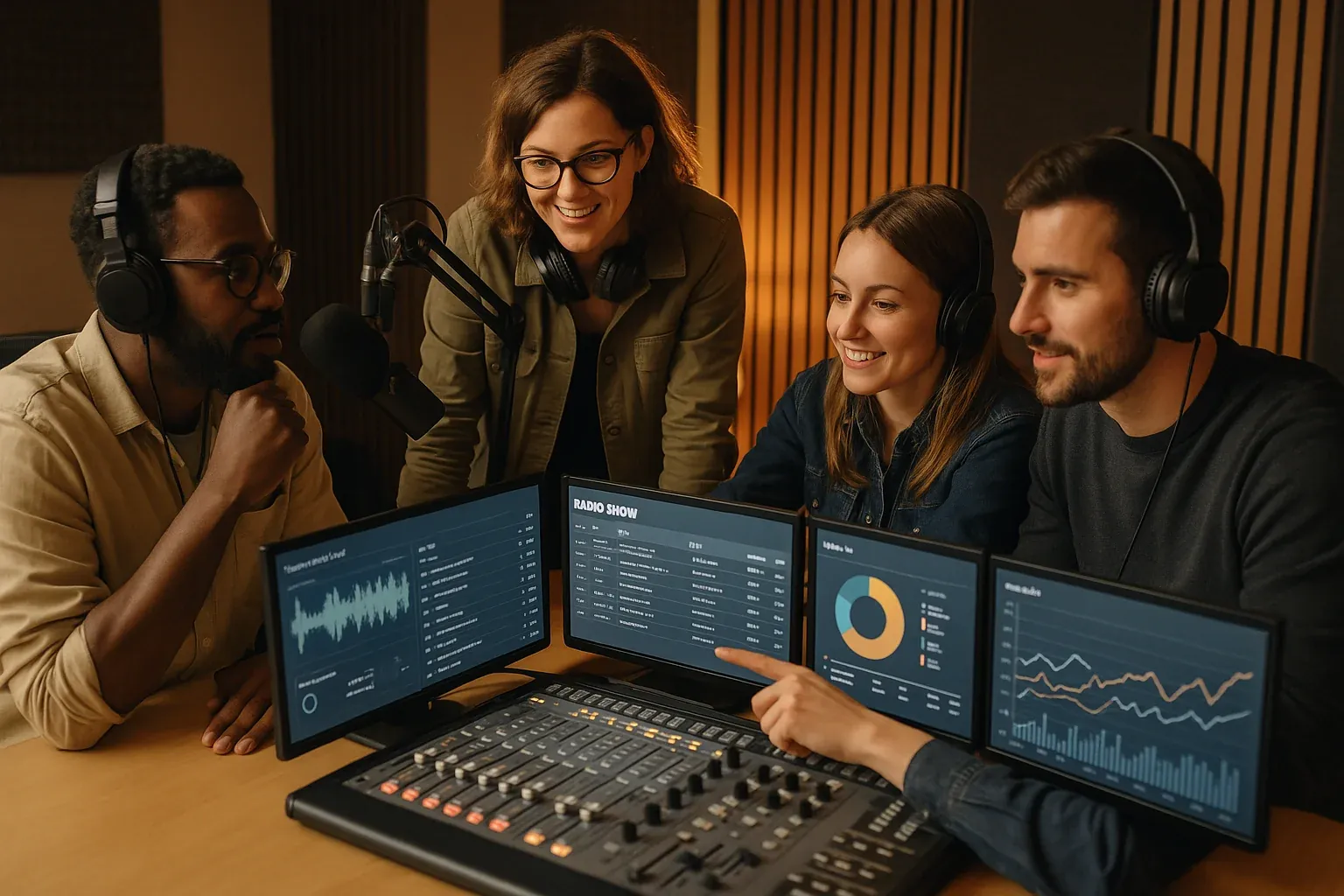
Your Content-Driven Ratings Playbook
Increasing your radio ratings doesn't require a bigger promotion budget or a new morning show. It requires better content — prepared more thoroughly, delivered more strategically, and measured more intentionally.
Here's the quick-reference checklist:
- Open strong — Every break is someone's first impression
- Prep deeper — Fewer topics, covered better
- Tease forward — Give listeners a reason to stay
- Build appointments — Consistent features create habits
- Drive interactivity — Active listeners are worth 5x passive ones
- Recycle winners — Your audience missed it the first time
- Go local — It's your only unbeatable advantage
- Extend to social — Use digital to drive on-air tune-in
- Personalize by format — Generic prep sounds generic on air
- Measure weekly — Don't wait for the book to know what's working
Content is the most underinvested lever in radio programming. The stations that figure this out first will be the ones pulling ahead in the next ratings book.
FAQ
What are the most effective ways to increase radio ratings?
The highest-leverage moves are all content-driven: deeper show prep (fewer topics covered better), stronger breaks (open every segment with something that earns the next 90 seconds), appointment programming (features that listeners schedule into their week), and forward-teasing (give listeners a reason to stay through the stop-set). None of these require a bigger budget — they require more intention. The radio show prep guide walks through how to structure prep so those moves actually happen day to day.
How long does it take to see radio ratings improvements?
Content improvements typically show in the book within one ratings cycle — 3–4 months for PPM markets, 6 months for diary markets. But weekly signals like TSL per session, time-spent in drive, and P1 listener retention start moving in 2–4 weeks if your content changes are genuine, not cosmetic. Don't wait for the book to diagnose; pull weekly cume and TSL data and look for small early signals.
What's the difference between cume and TSL, and which should I focus on?
Cume is unique listeners; TSL is time spent listening per session. Cume grows with marketing and reach; TSL grows with content quality. Most stations over-focus on cume because it's the bigger number, but TSL is where content strategy actually wins. A station with average cume and excellent TSL often out-rates a station with great cume and mediocre TSL, because rating = cume × TSL in the Nielsen methodology.
Can a small-market station improve ratings through content alone?
Yes — and small-market stations often have the advantage. A local team knows its community better than a large-market station knows theirs, and hyper-local content, personal listener relationships, and consistent features move the needle without a promotion budget. According to Nielsen's radio audience data, radio still reaches over 82% of American adults weekly — the audience is there. The question is whether your content gives them a reason to stay.
What radio content should we cut to improve ratings?
Cut anything that doesn't earn its break. Three specific targets: generic weather checks that add no station personality, topics that weren't prepped enough to actually have a take on, and features that used to work but haven't been reviewed in 18+ months. Audit the last two weeks of airchecks honestly — if a segment wouldn't earn the next 90 seconds from a new listener, replace it. Stations tell us most of their ratings drag traces back to a handful of show prep mistakes that compound week over week.
Want a personalized walkthrough?
Schedule a 15-minute demo with our team.