
Three weeks into a ratings book, every programmer faces the same quiet decision: the numbers look soft, and you can either blow up the show or wait it out. There's a third option. This guide covers how to read mid-book radio ratings signals, what content you can adjust now and actually see pay off, what to leave alone until the next book, and the one rule that keeps a mid-book change from teaching you nothing.
It's a Tuesday in week three of the book. A program director pulls up the latest numbers, and the morning show is down — not off-a-cliff down, just soft. Enough to notice. Enough to feel it in the hallway. There's still real runway left in the quarter, and the question sitting on the desk is the one every PD knows by heart: do something now, or hold the line?
That moment — mid-book, numbers in hand, clock still running — is one of the most decision-heavy points in a programmer's quarter. It's also where the most expensive mistakes get made. Move too hard and you scramble a book you could have salvaged. Freeze, and you hand the quarter away while telling yourself you're being patient.
Reading radio ratings mid-book well is a skill, and it's a learnable one — the in-quarter companion to the year-round work of growing your ratings through better content. Here's the framework.
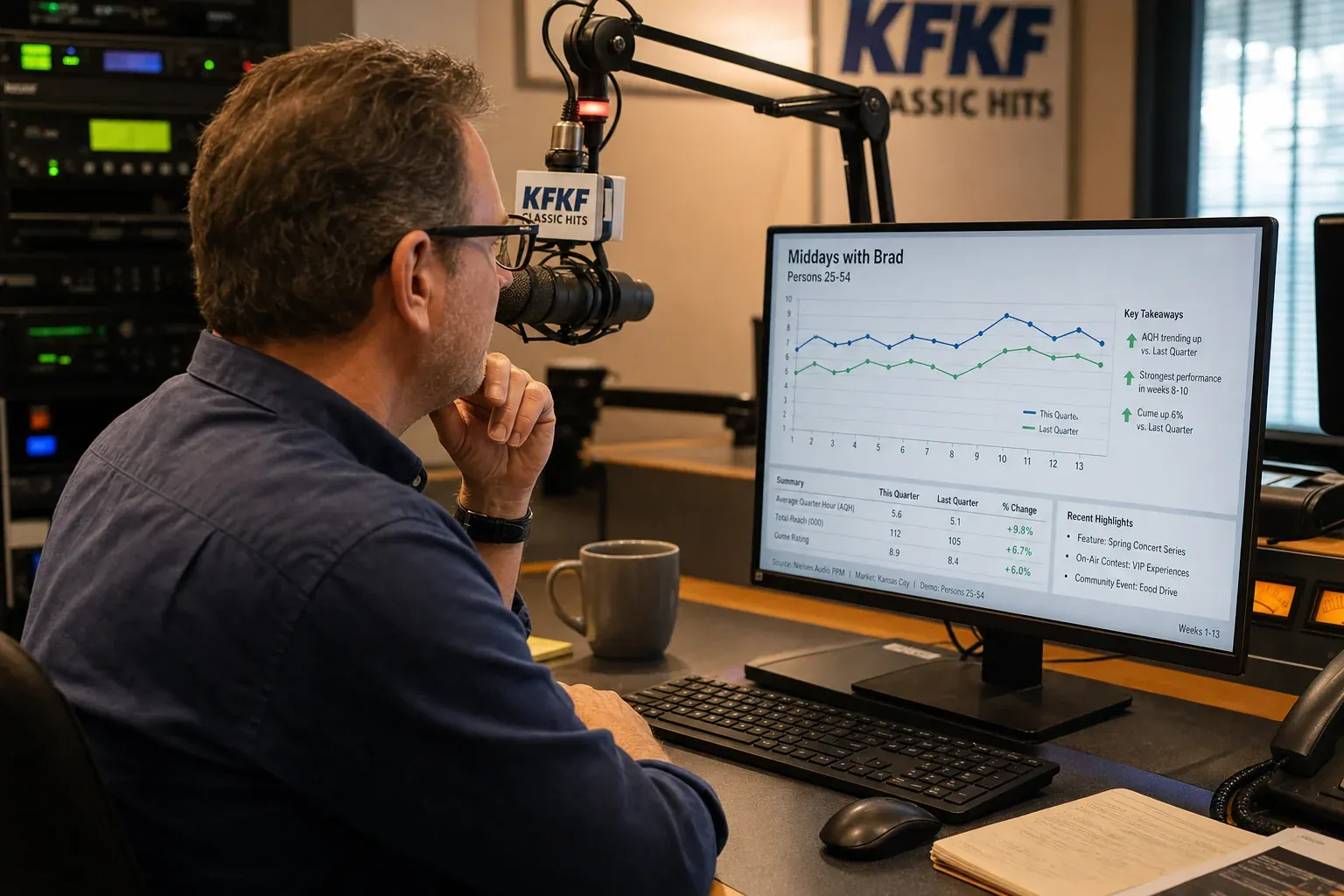
What "Mid-Book" Actually Means — And Why It's a Decision Point
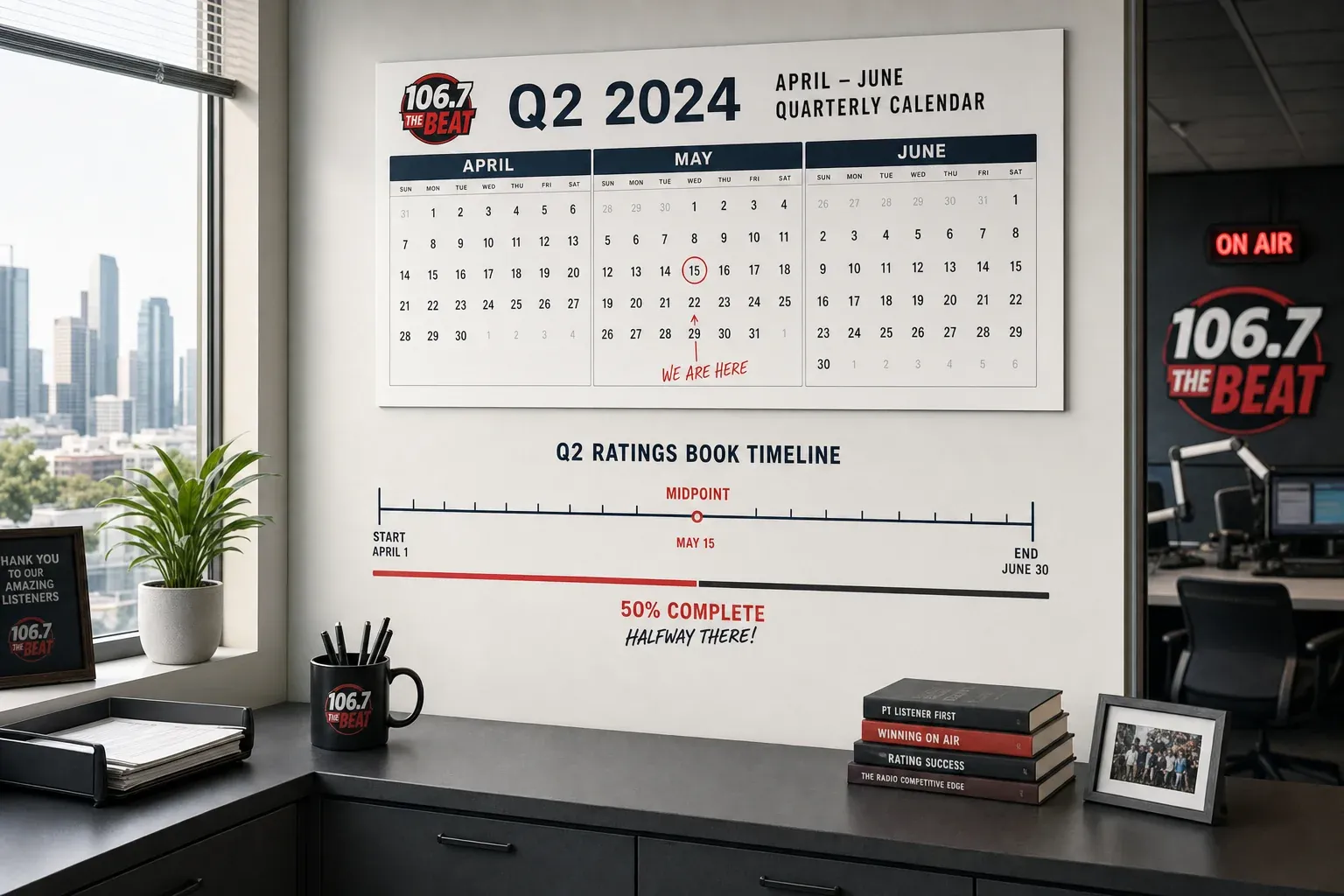
A ratings book is a calendar. A sweep, a PPM month, a quarter — each one has a beginning, a middle, and an end. Mid-book is exactly what it sounds like: the stretch where you have enough data to see a trend, and enough runway left to do something about it.
That combination is the whole reason it matters. Early in the book, almost anything looks like noise — too few data points to trust. Late in the book, the trend is real but the runway is gone, and there's nothing left to move. The middle is the only window where reading the data and acting on it both make sense at the same time.
Most programmers handle that window in one of two ways, and both are traps.
- Panic. The number is soft, so the show gets torn apart — new features, new clocks, new everything, all at once. It feels decisive. It usually just rattles the staff and scrambles the data.
- Paralysis. "Let's not overreact. We'll see what the book says." Then the book says the same soft number, the quarter's over, and nothing was learned.
There's a third path, and it's the one disciplined programmers take: read the signals, change one thing on purpose, and protect the back half of the book. Everything below is how to do that. Before you touch anything, it helps to know exactly which show performance metrics are worth watching in the first place.
Know How You're Measured Before You Change Anything
Before any of this, one fact has to drive the rest: the right mid-book move depends entirely on how your market is measured. PPM and diary markets reward different behavior, and a tactic that wins in one can do nothing in the other.
Diary markets run on memory. Listeners reconstruct their week from recall, which means the currency is memorability. A big, distinct, talked-about moment gets written down. A pleasant but forgettable hour does not — even if it was perfectly good radio. Mid-book in a diary market, the question to ask is blunt: is the show giving listeners something worth remembering and recording? Impact beats precision here.
PPM and meter markets capture listening minute by minute through a device — Nielsen's Portable People Meter methodology logs exposure automatically rather than asking listeners to remember it. Nothing depends on memory — which means precision is suddenly the game. Tune-out is measured. Pacing, break placement, and whether listeners stay through a stopset all show up in the data. Small structural choices that a diary would never catch can move quarter-hours in a meter market.
The mistake to avoid is applying one market's playbook to the other — chasing minute-by-minute retention tweaks in a diary market, or assuming one memorable bit a day will carry you in a metered one. Know your measurement first. It tells you which of the adjustments below are even worth your time.
Read the Leading Signals — Don't Wait for the Book
The ratings book is a lagging indicator. By the time it lands, the quarter it describes is already over. If the book is the only thing you watch, you're always driving by the rearview mirror.
The fix is to read leading signals — the things you can see week to week that tend to move before the ratings do:
- Call and text volume. Are listeners reaching back? Engagement is an early pulse.
- Social shares and comments. Not vanity likes — shares and real replies, the signals that a segment traveled.
- Streaming and app sessions. Session counts and length on your own platforms, available in near real time.
- On-demand and podcast pickup. What listeners choose to hear again tells you what landed.
- Website traffic on show content. Are the bits and topics pulling people to your site?
Read those signals by daypart, not as one blended number. A soft morning and a strong afternoon drive are two different problems with two different fixes, and a station-wide average hides both. And give a trend room to be a trend — one slow week is noise. Look for direction sustained across three or four weeks before you call it real.
If the leading signals point at content, two places to look first: the time listeners spend with you and the prep gaps that quietly show up in the numbers.
The One-Variable Rule
This is the single most important discipline of the entire mid-book stretch, so it gets its own section: change one thing at a time.
When the numbers are soft, the temptation is to fix everything at once — new music, tighter breaks, a fresh feature, a promo push, all in the same week. Resist it. If you change five things and the number moves, you've learned nothing about which one did the work. And if the number drops, you can't tell which change to undo. You've spent a book and come out the other side no smarter.
Pick one variable. The best candidate is usually the change with the biggest gap to close, the most control on your side, and the fastest read. Then give it real runway — a meaningful change needs weeks to register, not days. One deliberate adjustment you can actually measure beats five you can't.
What You Can Adjust Mid-Flight
Some changes pay off inside the current book. The common thread is that they're tweaks to execution, not identity — which is exactly why they're safe to make now.
- Opens. Sharpen how every break starts. It's the highest-leverage, fastest-reading change you can make, because the open is where listeners decide whether to stay.
- Teases. Build forward momentum so listeners have a reason to ride through the next break — a meter-market staple, and never wasted in a diary market either.
- Segment pacing. Tighten what's running long. A bit that sags is a bit listeners leave.
- Break and stopset placement. Small structural moves relative to the quarter-hour, and giving listeners a genuine reason to stay through the spots, can move metered credit.
- Content focus. Concentrate prep on fewer, better segments instead of spreading thin across everything.
Notice that none of these change who the show is. They change how well it executes — and execution is fair game mid-book.
This is also where having the content side handled stops being a luxury. Radio Content Pro keeps format-specific prep, teases, and digital content flowing automatically, so when you decide to sharpen opens or tighten focus, your team has the raw material to do it well instead of scrambling. RCP does 90% of the work; your personality adds the 10% that makes it yours. When you make a mid-book change, that's the 10% you want your talent spending their energy on — like the topics that actually get the phones ringing.

What to Leave Alone Until the Next Book
Just as important as knowing what to change: knowing what to keep your hands off.
Mid-book is the wrong time for identity-level change. Leave these alone:
- Format positioning — what the station fundamentally is.
- The show's core identity — its premise, its hosts' roles, its reason to exist.
- Major recurring features mid-life — pulling a tentpole feature mid-book disorients loyal listeners.
- Talent and lineup.
- The music base.
Two reasons. First, psychological consistency is an asset. Listeners reward familiarity — a station they can predict is a station they keep on. Burning that consistency on a panic move is expensive, and you rarely get it back at the price you paid. Second, a change that big can't be read cleanly mid-book anyway. It'll smear across the rest of this book and pollute the next one, so you still won't know whether it worked.
If a real identity question is nagging at you, it's legitimate — it just belongs in a between-books planning session, not a Tuesday in week three. Write it down and schedule it.
When in Doubt, Cut
When you're genuinely unsure whether something is working, the safer mid-book move is almost always to cut it, not to prop it up.
You don't get hurt by what you don't run. A borderline segment, a bit that's gone tired, a break that's bloated by a minute — trimming it is lower-risk than adding more around it to compensate. A tight show reads better to listeners than a full but flabby one, in any market. And cutting is itself a clean one-variable test: remove the thing, hold everything else steady, and watch. Subtraction is underrated. Mid-book, it's often your sharpest tool.
A Daypart-by-Daypart Mid-Book Check
Run this quick read across the schedule — one daypart at a time, because each one fails and wins differently:
- Mornings: Cume and appointment moments. Is the show giving listeners specific reasons to come back tomorrow, or just filling time well?
- Middays: Time spent listening and at-work listening. Is it background-safe but still rewarding enough to hold the quarter-hour?
- Afternoon drive: The most underserved daypart in radio. Is it getting real prep and real attention, or quietly coasting on autopilot? It's worth treating afternoon drive show prep with the same seriousness as mornings.
- Evenings and overnights: Often automated, but check that transitions and imaging still feel intentional.

Your Mid-Book Playbook
Mid-book isn't a fire drill. It's a discipline — and a repeatable one. Every book, the moment comes back around, and the programmers who handle it well do the same five things:
- Read the leading signals, by daypart, instead of waiting for the book.
- Know how your market is measured — PPM precision or diary memorability — before choosing a move.
- Change one variable, deliberately, and give it weeks to register.
- Leave the identity alone — adjust execution, not who the show is.
- Cut what's not working rather than piling on more.
Do that, and the soft Tuesday in week three stops being a crisis. It becomes what it should be: a checkpoint, with a clear next move.
FAQ
How long does a mid-book content change take to show up in the ratings?
Expect weeks, not days. A content change has to reach listeners, change their behavior, and then accumulate enough measured listening to register — which is why mid-book timing matters so much. Make the change with enough runway left in the book for it to land, and resist judging it after a few days. In a PPM market you may see leading signals shift within a week or two; a diary market is slower still. If you change something with only days left in the book, you've made a change for the next book, not this one.
Should I make changes mid-book or wait for the next book?
It depends on the size of the change. Execution-level adjustments — opens, teases, pacing, break placement, content focus — are fair game mid-book and can pay off inside the current quarter. Identity-level changes — format positioning, core show concept, talent, major features — should wait for a between-books planning window, because they can't be made or measured cleanly mid-flight. The rule of thumb: adjust how the show runs now; reconsider what the show is later.
What's the one thing most programmers get wrong mid-book?
Changing too much at once. When the numbers are soft, the instinct is to fix everything immediately — but that scrambles the data so thoroughly that the book teaches you nothing, win or lose. The disciplined move is the harder one: pick the single highest-leverage change, make only that, give it real runway, and read the result. One change you can measure beats five you can't.
Ready to simplify your show prep?
Try RCP free for 7 days. $0 until day 8