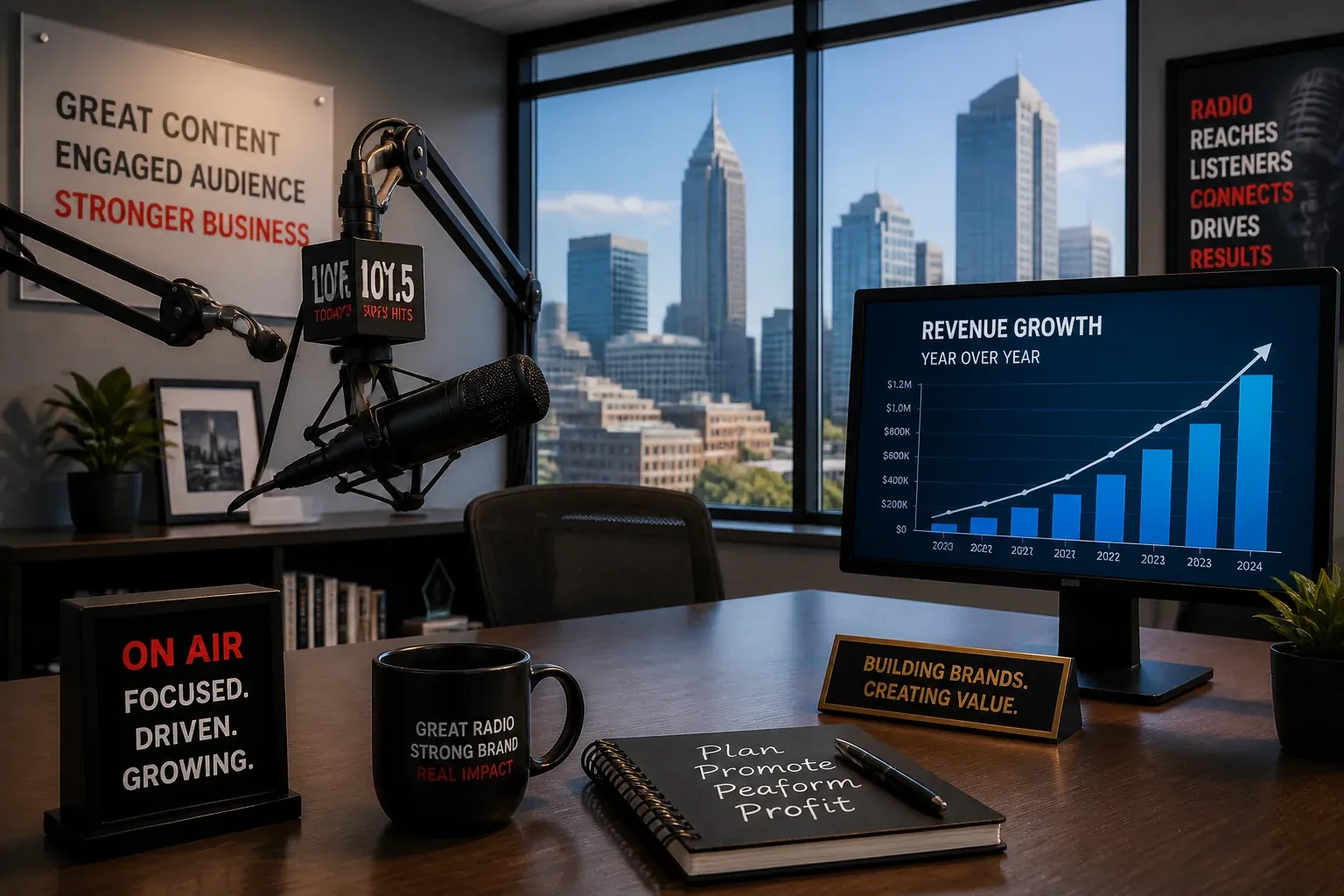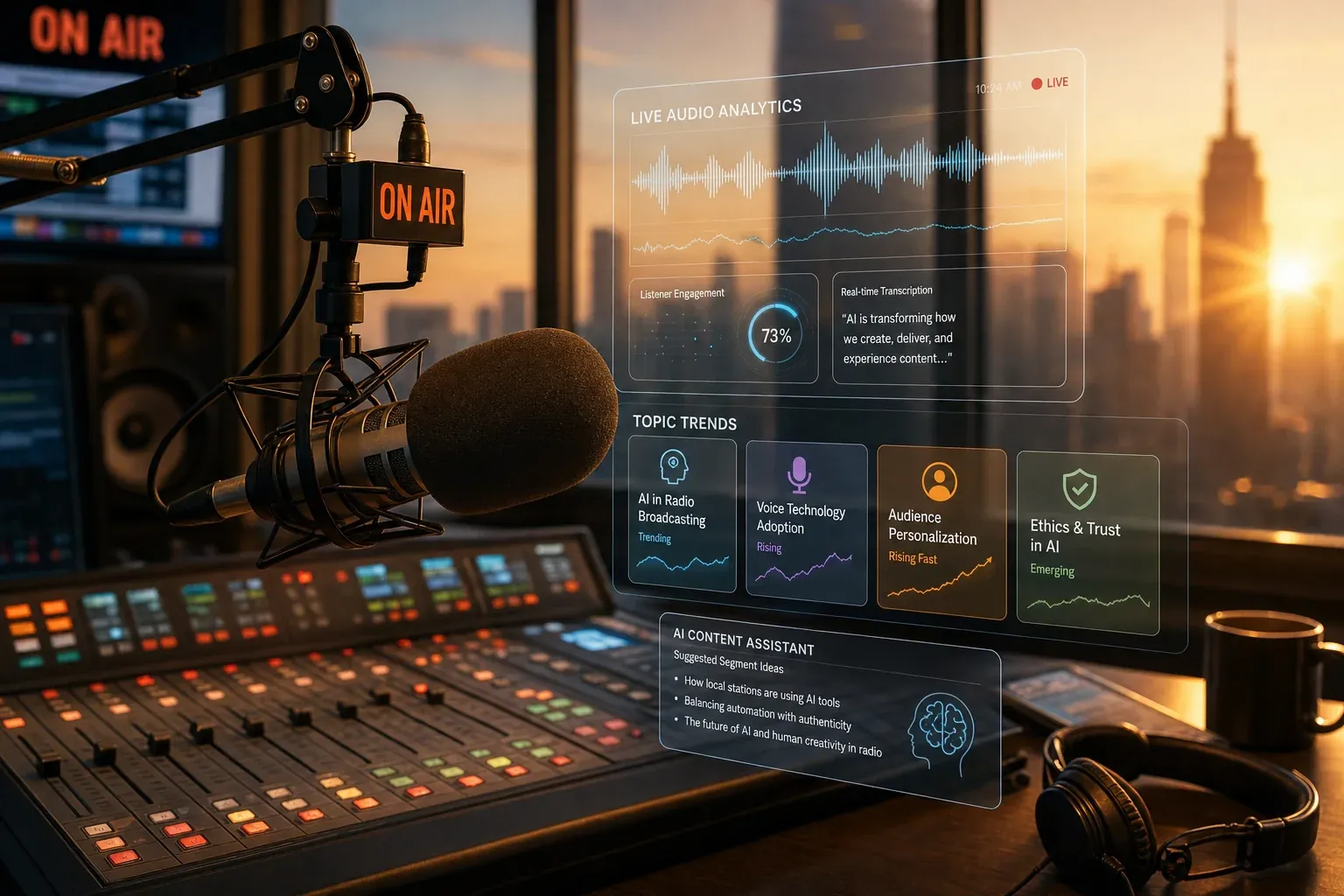

Digital revenue is no longer radio's side hustle. It's the main event.
The RAB/Borrell Digital Benchmarking Report landed in February with a number that should reframe every programming and sales conversation happening at radio stations right now: $2.3 billion in digital revenue for 2025, representing 24.4% of total industry revenue. That's not a projection. That's what happened.
And the trajectory? Digital revenue is growing at a compound annual rate of 8.3% while core broadcast advertising declines 2.2% per year. The forecast for 2026: $2.5 billion, a 9.5% jump. As Borrell Associates CEO Gordon Borrell put it, digital has moved "from add-on to primary growth engine."
But here's what the topline number hides: the gap between stations that get this right and stations that don't is enormous. The top 5% of radio clusters generate three to four times more digital revenue than the average. Three to four times — from stations serving similar markets with similar signals.
The difference isn't technology budgets or sales staff size. It's content. The stations winning the digital revenue race are the ones that figured out how to turn their content engine into a revenue engine. Here's exactly how they're doing it.
The $2.3 billion breakdown: where digital revenue actually comes from
Before we get into strategy, let's look at where this money lives.
The average radio station generated $511,873 in digital revenue in 2025. The average market cluster pulled $2.3 million. Those numbers include everything from display advertising on station websites to social media sponsorships, email advertising, podcast monetization, and streaming audio ads.
Streaming audio is the fastest-growing segment — up 9.2% year-over-year, outpacing OTT video and every other individual ad format. But the real story isn't any single channel. It's the bundling. Stations that sell digital packages alongside traditional spots consistently outperform those selling either in isolation.
RAB President Mike Hulvey noted that "advertisers recognize digital services within radio's toolbox." That recognition is translating into dollars. But — and this is critical — three-fourths of radio buyers aren't yet utilizing stations' digital products. That's not a problem. That's a $1.7 billion opportunity sitting on the table, waiting for stations with the content to fill those digital channels.
The stations capturing this opportunity share a common trait: they treat content as the fuel for every digital revenue channel, not as an afterthought produced between spot breaks. It's the heart of a station-wide content strategy — one documented plan, every channel, fed by the same engine.
Strategy 1: Auto-publishing turns on-air content into website revenue
The simplest digital revenue play is also the most overlooked: turning what you already create on-air into content that lives on your website.
Every morning show produces hours of discussion about local topics, trending stories, and community events. At most stations, that content evaporates the moment it airs. The show ends, the content is gone, and the station's website sits unchanged with the same contest page from last month.
The stations driving digital revenue have flipped this. They auto-publish show content — recaps, topic summaries, interview highlights, local story roundups — to their websites daily. This does three things simultaneously:
It creates advertising inventory. Every blog post and show recap page carries display ads, sponsored content slots, and affiliate opportunities. One post per day across a five-show station is 25 new ad-carrying pages per week — over 1,300 per year.
It drives organic search traffic. Google rewards fresh, locally relevant content. A station that publishes daily about local topics becomes the default search result for "[city name] + [topic]" queries. That search traffic has advertising value whether you're selling display ads, sponsored content, or lead generation for local businesses.
It builds the case for digital bundles. When a sales rep can show an advertiser, "Our website gets 47,000 monthly visits, here's the content your ad would appear alongside," that's a fundamentally different conversation than "we have spots available in afternoon drive."
Here's the reality that most station managers already know: air talent didn't get into radio to write blog posts. The industry trend pushing personalities to become bloggers has met understandable resistance — many are simply bored with the task, and management asking already-stretched talent to add "content director" to their title rarely works.
That's exactly why automation has changed the equation. AI-powered auto-publishing tools can take on-air content and transform it into website-ready posts without requiring talent to type a single word. What used to require a full-time digital producer now takes minutes of automated processing. The on-air content already exists. The question is whether you're capturing its digital value or letting it vanish.
Strategy 2: Newsletters as the owned-audience revenue channel
If auto-publishing is the most overlooked strategy, newsletters are the most underestimated.
Newsletters give radio stations something rare in 2026: a direct line to an engaged audience that no algorithm can throttle. No Facebook reach decay. No Google algorithm update. No platform risk. You own the list, you control the relationship.
The stations treating newsletters seriously are building subscriber lists of 10,000 to 50,000+ local contacts — and monetizing them in ways that go far beyond traditional radio advertising.
Sponsored newsletter sections let local businesses reach a hyper-targeted, opted-in audience. A breakfast restaurant sponsoring the "What's Happening This Weekend" section of a Friday newsletter is buying attention that's worth multiples of a generic display ad.
Event promotion drives ticket sales and live event revenue. A station with a 25,000-person email list can fill a listener appreciation event, concert, or community fundraiser without spending a dollar on paid promotion.
Cross-selling digital packages becomes natural. When an advertiser sees their newsletter sponsorship driving foot traffic, the conversation about adding website ads, social sponsorships, and podcast pre-rolls gets much easier.
The content that powers effective radio newsletters isn't complicated. It's curated local stories, show highlights, community event listings, and personality-driven commentary. It's the same content that makes good radio — reformatted for the inbox.
One thing that trips up stations early: treating the entire subscriber list as one audience. Studies show that 60% of recipients delete irrelevant emails, and 27% eventually unsubscribe. The stations doing this well segment their lists — morning show fans get different content than afternoon drive listeners, sports fans get different content than community-events subscribers. Segmentation keeps engagement high, which keeps advertiser value high.
The deeper insight: newsletters leverage radio's existing relationship with the local community. Radio stations technically "own" the audience through their signal, but that ownership is passive — listeners come and go, and you can't reach them directly. A subscriber list converts passive listeners into an addressable audience. No digital-native competitor can replicate the trust and familiarity that a morning show host carries. That trust translates directly into newsletter open rates that dwarf industry averages — and into advertising premiums that reflect that engagement.
Strategy 3: Social content that sells (not just entertains)
Social media at most radio stations is a cost center. Someone posts contest graphics, maybe clips an occasional funny moment, and the analytics sit in a dashboard nobody checks.
The stations turning social into a revenue channel approach it differently. They create platform-native content designed for sponsorship from day one.
Here's what that looks like in practice:
Recurring branded segments on social. A "Traffic Hack Tuesday" series on TikTok sponsored by a local auto dealership. A "Friday Food Find" Instagram reel series sponsored by a restaurant group. These aren't one-off posts — they're content franchises with built-in sponsorship value.
Behind-the-scenes content that advertisers can't get elsewhere. Concert prep, remote broadcast setup, studio tours, talent rides-along — this content performs because it's authentic and exclusive. And it's content that advertisers genuinely want to be associated with, because it makes them part of the station's story rather than an interruption.
Local reaction content. When a major local story breaks, the station that posts the first on-the-ground reaction video on social media captures attention that advertisers can ride alongside. Speed matters. AI tools that can generate social-ready clips and commentary from breaking stories give stations a structural speed advantage.
The revenue model for social isn't CPM-based display advertising. It's sponsorship and branded content — which commands far higher rates and builds deeper advertiser relationships. The content investment required is modest: three to five intentionally created pieces per week, designed for specific platforms and sponsorship integration.
Strategy 4: Podcast extensions monetize your best content twice
You already create audio content. Podcasting is simply capturing its long-tail value.
The numbers are clear: enhanced podcasts with show segments, interviews, and exclusive content create incremental ad inventory beyond broadcast. Pre-roll and mid-roll podcast ads sell at CPMs of $15-25, compared to $2-5 for traditional radio spots. Even modest download numbers — 500 to 2,000 per episode — generate meaningful incremental revenue when you're producing five shows per week.
But the real value of podcasting for radio stations isn't the ad revenue alone. It's the audience data.
Podcast analytics give you something broadcast radio can't: listener-level data on consumption patterns, completion rates, and content preferences. That data makes your entire advertising package smarter. You can tell an advertiser not just that 50,000 people listen to your morning show, but that 3,200 of them are so engaged they seek out your content on-demand — and here are the topics they care most about.
The stations doing this well aren't producing separate podcasts. They're repurposing their best on-air content — clipping interviews, packaging themed segment compilations, adding exclusive commentary. The math is compelling: a single 30-minute live show segment can become three 60-second TikToks or Reels, one 5-minute YouTube highlight clip, and a full podcast episode. That's six pieces of monetizable digital content from one block of on-air work that was already happening. The content already exists. AI-powered clipping and formatting tools have reduced the production overhead from hours to minutes.
For a deeper look at how content powers the full revenue picture, our analysis of how content drives radio revenue covers the programming-sales flywheel in detail.
Strategy 5: Digital bundle selling powered by content proof
All four strategies above converge into the most powerful revenue play: the digital bundle.
Instead of selling radio spots and hoping the advertiser also buys some digital, leading stations now sell integrated content packages. Here's what a typical bundle looks like:
| Component | Deliverable | Value Driver |
|---|---|---|
| On-air | :30 spots in morning and afternoon drive | Reach and frequency |
| Website | Sponsored content placement on 4 show recap pages/week | SEO traffic + local relevance |
| Newsletter | Logo + sponsored section in weekly email to 25,000 subscribers | Owned audience, high open rates |
| Social | Branded segment on 2 platforms, 4 posts/week | Platform-native engagement |
| Podcast | Pre-roll on 3 show podcasts/week | On-demand, high-intent listeners |
This bundle doesn't just add up to more revenue than spots alone. It's a fundamentally different product. The advertiser isn't buying frequency — they're buying integration into the station's content ecosystem. And that integration is only possible when the station actually produces content across all these channels.
The stations selling digital bundles have grown digital's share of total revenue to that 24.4% benchmark — and the best are pushing past 30%. Those selling spots alone are watching their core revenue decline at 2.2% annually with nothing to replace it.
Half of all radio stations now conduct digital sales training at least weekly. The ones that do report stronger performance across the board — not just in digital revenue, but in total revenue. Digital becomes the conversation starter that keeps the entire advertising relationship healthy.
For the full framework on building a digital content strategy from scratch, our guide on radio station digital content strategy for 2026 walks through the five pillars step by step.

What separates the top 5% from everyone else
The RAB data reveals something important about distribution: the top 5% of radio clusters generate three to four times more digital revenue than average clusters of similar size. That's not incremental improvement. That's a different business model.
After watching what these stations do differently, the pattern is clear:
They treat content as a revenue asset, not a cost center. Every piece of content — on-air, digital, social, email — has a line-of-sight to monetization. Content investment decisions are evaluated against revenue impact, not just ratings impact.
They require digital in every sales pitch. High-performing stations don't make digital optional. Every advertiser proposal includes digital components. This isn't aggressive upselling — it's a recognition that advertisers need multi-channel reach, and the station that provides it wins the budget.
They invest in tools that close the content gap. The content creation bottleneck — not enough staff to produce content for five digital channels — is the single biggest barrier to digital revenue growth. The stations in the top 5% have solved it, most often with AI-assisted content production that turns on-air content into multi-platform digital assets automatically.
They measure and report digital performance to advertisers. When an advertiser can see that their sponsored newsletter section drove 340 clicks to their website last month, the renewal conversation is easy. Transparency in digital performance builds long-term advertiser relationships that spot buys alone can't match.
RAB's research found that local businesses now employ three times more in-house marketing professionals than a decade ago. These marketers think in terms of impressions, click-through rates, and attribution. The stations that speak their language — with content-driven digital products and transparent reporting — win their budgets.
The content-to-revenue roadmap
If your station isn't in that top 5% yet, here's the practical path forward:
Month 1: Start auto-publishing. Pick your highest-profile show and begin publishing daily content recaps to your website. One post per day, 300-500 words, covering the topics discussed on-air. AI tools make this near-automatic. This immediately creates new digital advertising inventory.
Month 2: Launch or revive your newsletter. Weekly frequency, curated local content plus show highlights. Start building the subscriber list from your existing listener database, on-air promotion, and website opt-ins. Target 5,000 subscribers by month six.
Month 3: Create one recurring branded social series. Partner with a single advertiser on a weekly social content franchise. Film it, post it, measure it. Use the results to sell the next one.
Month 4: Package your first digital bundle. Combine on-air spots with website, newsletter, and social placements. Price it as a premium product, not an add-on. Present it to your top three advertisers.
Month 5: Add podcast repurposing. Clip your best daily content into podcast episodes. Start with one show, measure downloads, and layer in pre-roll advertising once you hit consistent production.
Month 6: Measure, report, optimize. Pull together your first quarterly digital performance report. Show advertisers the full picture: impressions, clicks, opens, downloads. Use the data to refine your content strategy and pricing.
This isn't a massive technology investment. It's a content strategy shift powered by tools that already exist. The average station leaving $50,000 to $100,000 per year on the table isn't doing so because of budget constraints. It's because the content pipeline — from creation to distribution to monetization — hasn't been built yet.
What this means for 2026 and beyond
The $2.3 billion digital revenue figure from 2025 is just the beginning. At 9.5% projected growth, digital will represent over a quarter of total radio revenue by the end of 2026. Within three years, it could approach a third.
The stations that build their content-to-revenue pipeline now will compound that advantage every month. More content creates more digital inventory. More inventory generates more revenue. More revenue funds better content and tools. The flywheel accelerates.
The stations that wait will find the gap harder to close with each passing quarter. Local digital ad budgets don't wait for radio stations to catch up — they flow to whoever can deliver multi-channel content packages today.
Digital revenue has moved from add-on to primary growth engine. Content is what powers that engine. The question isn't whether your station will make this shift. It's whether you'll be leading it or chasing it.
Frequently asked questions
How much digital revenue should a radio station expect?
The national average is $511,873 per station annually, according to RAB/Borrell data from 2025. However, top-performing clusters generate three to four times that amount. Factors include market size, digital product mix, sales training investment, and — critically — the volume and quality of content produced across digital channels. Stations just starting a digital content strategy should target $50,000 to $100,000 in incremental digital revenue within the first year.
What is the fastest way to grow radio digital revenue?
Start with auto-publishing on-air content to your station website and launching a weekly newsletter. These two strategies create immediate advertising inventory (website) and an owned audience channel (email) with minimal staff overhead, especially when AI content tools handle the production. Half of all radio stations now conduct digital sales training weekly — pair content production with sales enablement for fastest results.
How does content drive digital revenue for radio stations?
Content is the fuel for every digital revenue channel. Website content creates pages that carry display ads and attract search traffic. Newsletter content builds an owned audience that sponsors pay to reach. Social content creates branded partnership opportunities. Podcast content generates premium pre-roll inventory. Without a consistent content engine, digital channels have nothing to monetize — which is why three-fourths of radio buyers still aren't utilizing stations' digital products.
Want a personalized walkthrough?
Schedule a 15-minute demo with our team.