

Since 2005, more than 2,900 US newspapers have shut down. Whole communities lost their primary source of local news overnight. And guess what filled the gap in a lot of those markets?
Radio.
Listeners still want to know what happened at the city council meeting. They want the high school football scores. They want to hear about the new bakery that opened on Third Street. Streaming services can't give them that. Your station can.
But here's the honest truth: most radio stations don't have the staff to run a newsroom. You're already juggling air shifts, social posts, and a website that probably hasn't been updated since last Thursday.
That's exactly why every full Radio Content Pro plan includes local stories from your market, with nothing extra to add. This guide walks you through what they do, how they work, and how to use them to own your market.
If you haven't read it yet, check out our guide to building a local content strategy first — it lays out the "why." This article is the "how."
Let Ava build tomorrow’s show
Stories picked for your format, ready by your time, written in your voice.
What Is Hyperlocal Content (and Why Should You Care?)
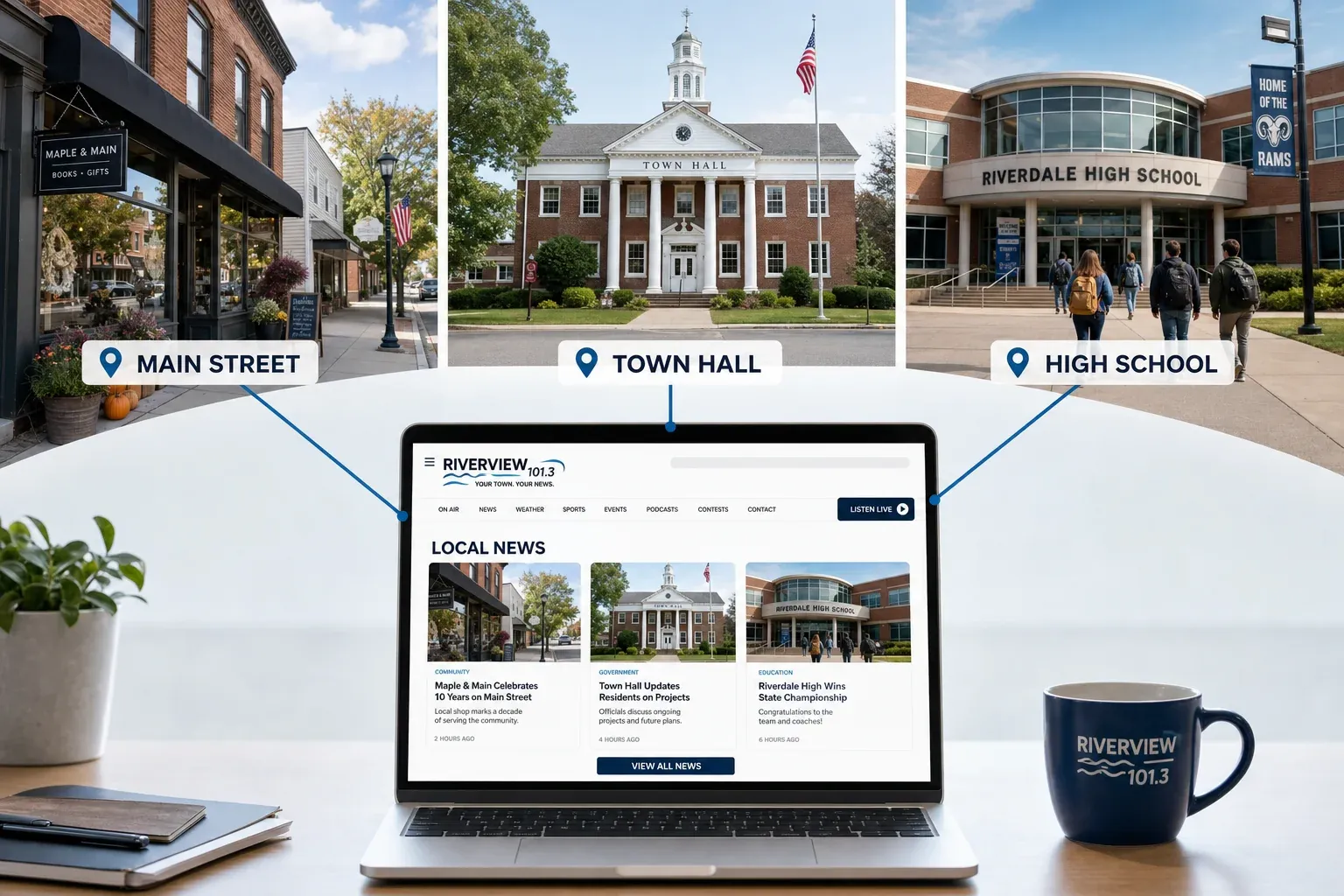
Hyperlocal content is news and information specific to a particular community, neighborhood, or ZIP code. Not "national news with a local angle." Actual local stuff. The road construction on Elm Street. The school board vote about redistricting. The charity 5K your morning show host ran last Saturday.
Why does it matter? Three reasons.
Listeners crave it. The trend in 2026 is clear: relationships matter more than reach. People don't just want music — they want connection. A DJ who mentions your kid's school by name creates a bond that Spotify's algorithm never will.
Advertisers pay for it. Local businesses want to reach local audiences. A station that publishes hyperlocal content on its website — and can prove traffic to those pages — has a compelling pitch that goes way beyond "we have X thousand listeners." You're offering targeted, measurable, community-level reach.
It's your competitive moat. iHeart can syndicate a morning show across 50 markets. They can't cover your city council meeting. That specificity is what makes local radio irreplaceable — but only if you actually do the local part. A lot of stations talk about being "local" without actually publishing local content. That's a gap your competitors will fill if you don't.
What Local Stories Actually Do
Local stories are part of every full Radio Content Pro plan, with no add-on and no setup fee. (The Daily Prep-only plan doesn't include them.) Here's the short version: you set your market, and I pick stories from there for your show, right alongside the rest of your prep. Every one is ready for on-air, and the pieces for your website, social and newsletters are a tap away.
Think of it as a local news desk that's already done the digging before you sit down.
What you get:
- Market-specific stories. Set your market and local stories come from there: city government, schools, business, sports, events.
- Radio-ready writing. Press «In my voice» on any story and I write it the way you talk. No press release language. No wire copy.
- Pieces for every platform. Each story's «Content» tab has teases, scripts, phone topics, a blog post and social posts, each with «Generate» and «Copy».
- Ava Hart personalization. Need to tweak a story for your afternoon show? Want a punchier tease? I'm on every page — ask "Make it more local." or "Make it funnier." and I'll rewrite it for your voice, your audience, your format.
Here's what local stories are not: a replacement for your on-air talent's personality. We handle the sourcing and the first draft. Your team adds the commentary, the humor, the "I drove past that this morning and couldn't believe it" moments. RCP does 90% of the work; your personality adds the final 10%. That's what makes this work.
How Local Stories Work: Setup to First Story
Getting started takes less time than your average staff meeting. Here's the process:
Step 1: Set your market. Open «Profile» from the menu. On the «On air» card, press «Edit on-air details», change «Market» to your city, and press «Save on-air details». Local stories come from there.
Step 2: I pick your stories. Every morning, For You fills with the stories I pick for your show, local ones included, each with a ready-to-air tease or a line on why it's for you. Set a show schedule in Show Builder and I'll have your show built, in running order, by your «Ready by» time.
Step 3: Tune it. Getting too much national news? Press «Not for me» on a story and pick «Too national / not local». I'll find you another and use that to tune For You.
Step 4: Personalize with Ava. Open any story and I'm right there. Need a version that's edgier for your rock station? A family-friendly take for your AC format? A quick social caption? Just ask. I know the story, I know your format, and I'll customize in seconds.
That's it. No IT department required. No CMS training. No "let me set up a meeting with our web developer." Set your market and you're live.
5 Ways to Put Local Stories to Work
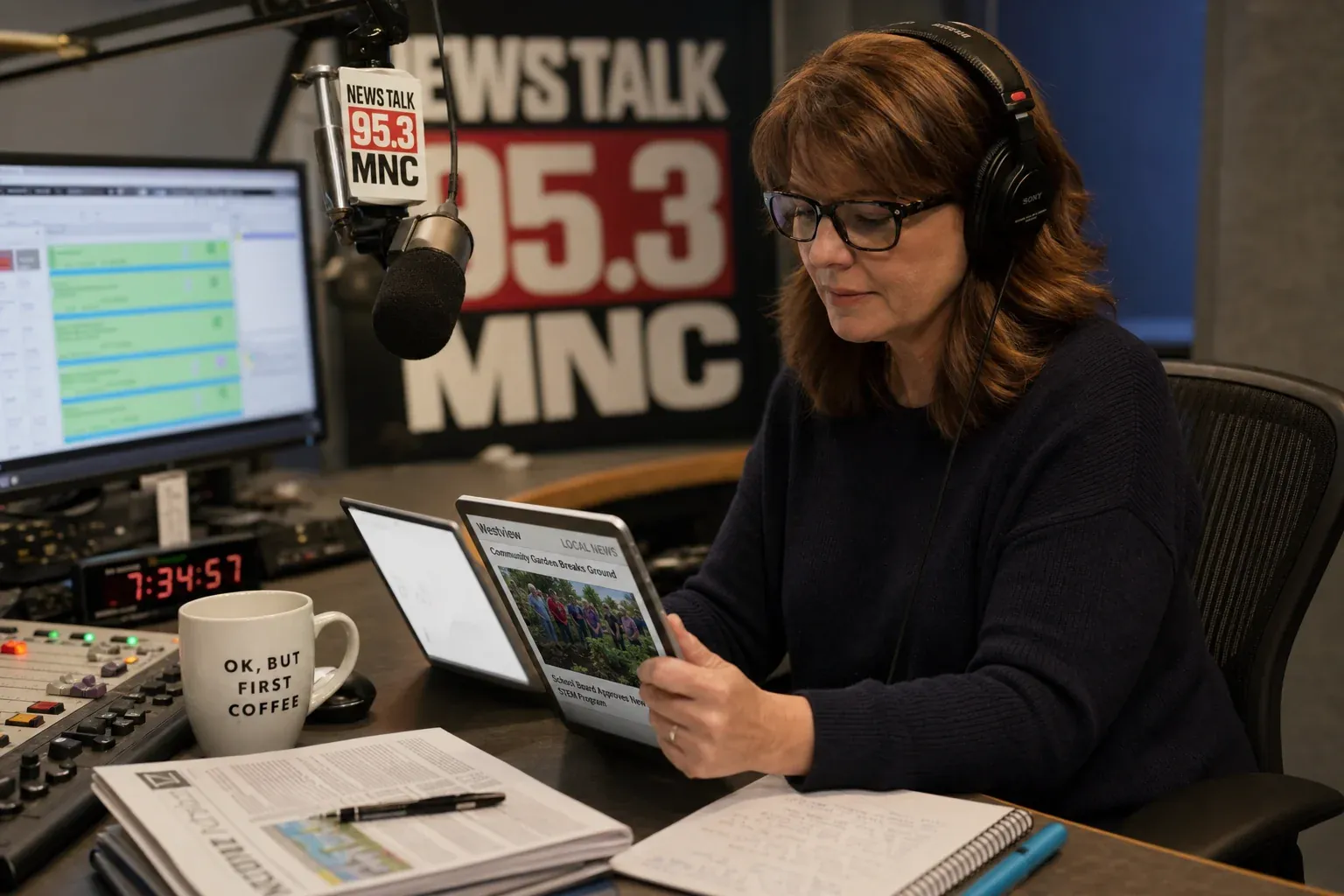
Local stories aren't a one-trick tool. Here's how to put them to work across your entire operation:
1. Morning Show Prep That Actually Feels Local
Your morning host opens For You at 4 AM. Instead of scrolling through national wire stories trying to find something relevant, they've got local stories waiting. The high school basketball team's buzzer-beater last night. A new restaurant opening downtown. The weather emergency that had everyone talking yesterday.
That's morning show gold — and it took zero research time. Your host spends their prep making those stories theirs instead of hunting for them. Add a personal take. Riff on the restaurant opening because they actually ate there last week. Turn the buzzer-beater into a phone topic.
That's the difference between great show prep and just getting by. Your talent isn't Googling — they're creating.
2. Website Traffic That Compounds Over Time
Here's something most PDs don't think about: people Google local stuff all the time. "Springfield city council meeting results." "Highway 65 construction update." "Central High School football score."
If your station's website has those stories, you show up in those searches. If it doesn't, someone else does — probably the local TV station or a community Facebook group.
When you publish local stories consistently, every day, you start ranking for local search queries. Every story's «Content» tab has a blog post ready to copy to your site. One story might only get a handful of visits. But a steady stream of them? That's visitors who now associate your station with local news. It compounds. Every month, your library of indexed local pages grows and keeps working for you around the clock.
You can tie this into a broader digital content strategy that turns those website visitors into loyal listeners.
3. Social Media Content That People Actually Share
Generic radio social posts ("Happy Monday!") get 12 likes from your aunt and two bots. A post about the local farmer's market opening this weekend gets shared 200 times.
Local stories give you a steady stream of community stories to post on social, with social posts ready on each story's «Content» tab. These aren't fluff — they're stories people care about because they live there. Pair them with the hyperlocal social strategy in our content ideas guide and you'll see engagement numbers you haven't hit in years.
4. Newsletter Fuel
Running a station newsletter? (If you're not, you should be.) Local stories are perfect newsletter content. A weekly "Top 5 Local Stories" digest gives subscribers a reason to open every single time.
You barely have to write anything. Pick five local stories, copy the pieces, drop them in your template, done.
5. Advertiser Magnet
This is the one that gets GMs excited. When your website is publishing local content daily — content that gets real traffic from real people in your market — you've got something concrete to sell.
"We reach 50,000 local listeners" is good. "We publish 30 local news articles a week that generate 15,000 monthly website visits from your ZIP code" is better. That's a pitch no one else in your market can make.
The revenue opportunities stack up fast: sponsored content packages where local businesses get featured alongside community news. Display ads on your most-trafficked local pages. Newsletter sponsorships that put a brand next to the stories people actually open emails to read. Even geotargeted pre-roll on audio clips pulled from local stories.
Every local article you publish is another ad impression, another SEO landing page, another reason for a local business to write you a check instead of giving it to Google Ads.
Local Stories in RCP vs. DIY: The Honest Comparison
Could you do all of this manually? Sure. Some stations do. But let's be real about what that looks like:
| DIY Local Content | Local stories in RCP | |
|---|---|---|
| Time investment | Hours of sourcing and writing, every day | Picked for you before your show |
| Consistency | Drops when staff is sick, on vacation, or busy | Fresh picks in For You every morning |
| Writing | Depends on who's writing | «In my voice», with «Key facts» and «Article source» a tap away |
| Multi-platform | Requires manual repurposing | Teases, scripts, blog post and social posts on every story |
| Cost | Staff time (your most expensive resource) | Included in every full Radio Content Pro plan |
The math is pretty simple. If a part-time content person costs you $15/hour and spends 10 hours a week sourcing local content, that's $600/month — just for the local part.
With Radio Content Pro, local stories come with the plan: $199/month or $1,999/year, with Ava's Daily Prep and everything else included.
I'm not saying fire your content person. I'm saying free them up to do the stuff that requires a human — the interviews, the live event coverage, the personality-driven content that builds genuine listener loyalty. Let me handle the digging.
One honest caveat: local stories work best in markets with accessible local news sources. If you're in a very small, rural market where there aren't many digital news outlets to source from, coverage might be thinner. Try it free for 7 days and see what your market looks like.
Getting Started
You don't need IT approval. You don't need a committee meeting. Here's what you actually need:
- A Radio Content Pro account (start your 7-day free trial, no card needed)
- Your market (set «Market» on your Profile's «On air» card)
Pricing:
- Local stories are included in every full Radio Content Pro plan. Radio Content Pro is $199/month or $1,999/year.
- Existing members keep their current rate.
No long-term contract. No complicated onboarding. No "Phase 1 discovery sessions." Set your market and local stories start showing up in For You.
Key Takeaways
- Hyperlocal content is radio's biggest competitive advantage — it's the one thing streaming can't replicate
- Local stories in RCP handle the hardest part — sourcing and first drafts of market-specific content
- It works across every platform — morning prep, website, social, newsletters, and advertiser packages
- Setup is one field: «Market» on your Profile
- It's included in every full Radio Content Pro plan — no add-on, no setup fee
Your listeners already expect you to be the voice of their community. Local stories in RCP help make sure you actually are.
FAQ
What are local stories in Radio Content Pro?
Stories from your market, included in every full Radio Content Pro plan. Set your market and I pick local stories for your show alongside everything else, so your station can credibly claim to be "the voice of [your market]" without a full local editorial team.
Are local stories a separate product?
No. Radio Content Pro picks stories for your show based on your format, your audience and your market. Set «Market» on your Profile and local stories come from there.
What do local stories cost?
Nothing extra. Local stories are included in every full Radio Content Pro plan ($199/month or $1,999/year). The Daily Prep-only plan ($59/month) doesn't include them. There's no add-on and no setup fee. Existing members keep their current rate.
How do I set up local stories?
Change «Market» on your Profile's «On air» card and press «Save on-air details». Local stories come from there.
Do local stories work for small market stations?
Yes — small markets are where local stories deliver the most leverage. Small market stations often can't afford a dedicated local news writer, but their listeners expect strong local content. Coverage depends on how many local news sources your market has; try it free for 7 days and see.
Let Ava build tomorrow’s show
Stories picked for your format, ready by your time, written in your voice.