
Holiday weeks compress three weeks of work into four days, demand a tonal pivot most teams don't rehearse, and almost always land during a ratings book. This guide gives you a repeatable system — three weeks out to airshift Tuesday — using Memorial Day as the worked example. Same system runs for July 4, Labor Day, Thanksgiving, and every week that breaks routine.
Forget "getting ahead" for the holiday week. The real frame is that holiday weeks aren't days off — they're three regular weeks of work compressed into four. The stations that handle them well stop trying to outwork the squeeze and start engineering around it. Show prep that survives a holiday week isn't about more hustle. It's about a system you can run on tired.
I'll be direct about what this guide is and isn't. It isn't pep talk. It's the actual cycle the program directors we work with use to keep tone, content, and sponsor reads aligned across a week where any one of those three can quietly fall apart. The Memorial Day case study at the bottom is the concrete walkthrough — but the system underneath it is reusable for every holiday on the calendar.
If you want the broader month it lives inside, the May 2026 radio content calendar maps the surrounding 31 days. The Memorial Day radio content guide goes deeper on the day itself. This post is the workflow that connects them.
Why Holiday Weeks Break Normal Show Prep
Stations tell us the same thing every spring and fall: the weeks they get the most listener feedback on are the holiday weeks, and the weeks they're the least prepared for are the holiday weeks. The mismatch isn't accidental. Holiday weeks introduce four pressures normal weeks don't:
- A tonal pivot most teams don't rehearse. A regular Monday morning runs on weekend energy. A Memorial Day Monday needs restraint. A July 4 Monday needs celebration. A day-after-Thanksgiving Friday needs slow-cooked warmth. Defaulting to weekend energy on the wrong holiday is the most common single mistake we hear discussed in air checks.
- A content double-load. The holiday produces theme-specific content. The other dayparts still need their normal prep. You're not adding 20% more — you're often running both calendars at once.
- A sponsor minefield. Holiday-adjacent advertisers want their reads to land near the holiday content. Tone-deaf placement (a doorbuster spot inside a Memorial Day tribute block) damages trust faster than any music decision will.
- A team that's also taking time off. Producers, news, and on-air swap PTO around holiday weeks. The plan has to survive someone being out.
The instinct on a tough week is to try harder. The system below is built so you don't have to.
The Holiday Week Prep System (Day-by-Day)
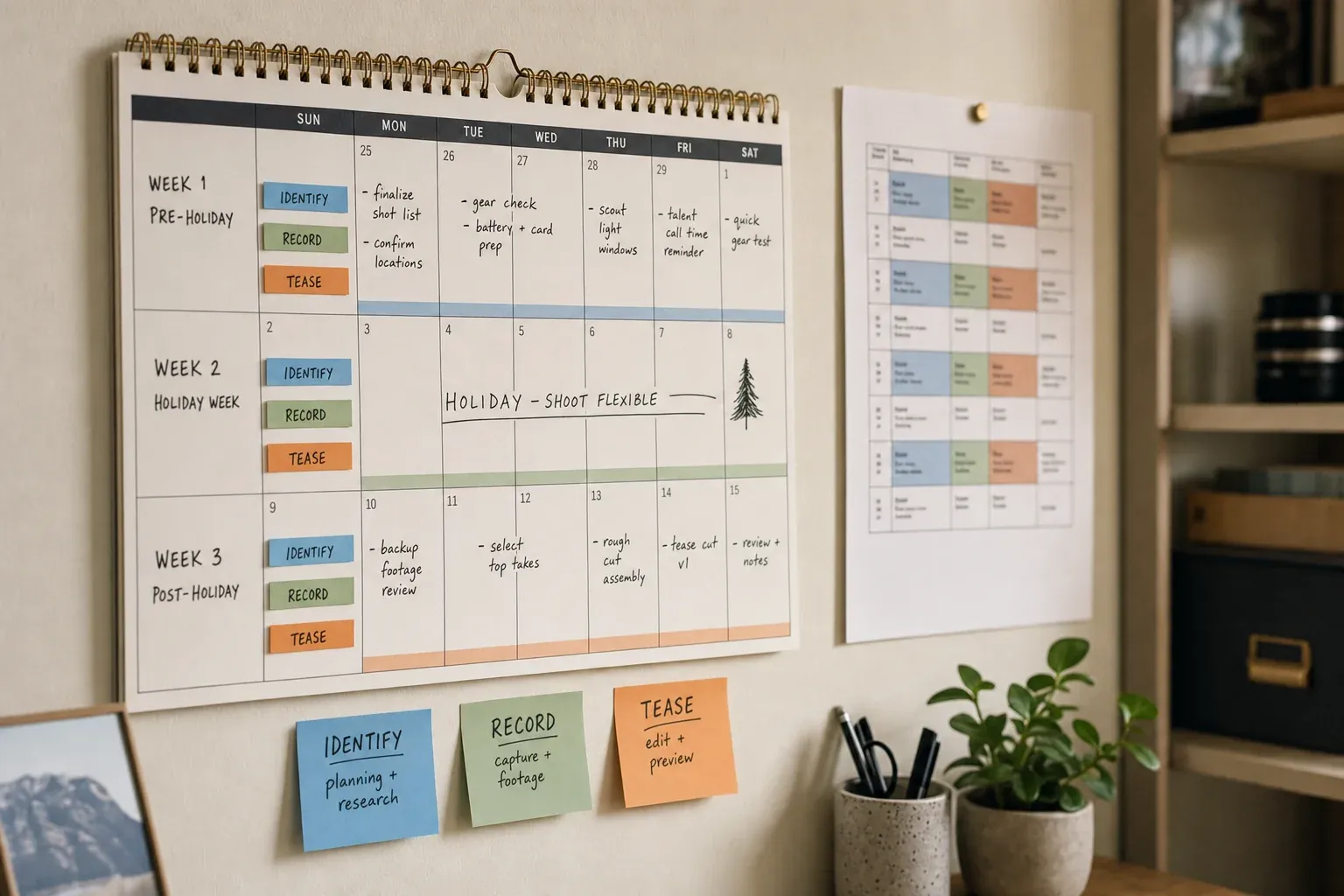
The cycle below runs on a three-week lead. Stations that consistently nail holiday weeks treat the system as standing, not improvised — same checklist for every major holiday, with the holiday-specific content slotted in.
3 Weeks Out: Identify and Lock
This is the only week with breathing room. Use it.
- Lock the holiday angle for each daypart. Morning show: tribute spine, three signature segments, a call-in hook. Midday: lighter touch, one anchor segment per day. Afternoon drive: see the afternoon drive show prep guide — the workout-to-commute pivot still applies; you're just adding holiday content to the rotation.
- Identify local voices. Three to five real people you'll book for tribute, celebration, or community segments. For Memorial Day, that's Gold Star families, VFW or American Legion contacts, and the county VSO. For July 4, it shifts to community organizers, fire chiefs, and parade leads. Same workflow, different list.
- Brief sales on tone. A 15-minute meeting that prevents a week of cleanup. Tell the sales team which ad categories work near holiday content blocks and which need to live elsewhere in the day.
2 Weeks Out: Record, Don't Improvise
Holiday weeks should be 70% pre-produced, 30% live. Reverse the ratio on a normal week if you want, but never on a holiday week.
- Record tribute or celebration segments. Edit while your team has time and creative bandwidth. The version of you on holiday-week Monday is not the version you want producing emotional content for the first time.
- Schedule social. Stack Instagram, Facebook, and TikTok content for the full holiday weekend now. Same day, post-it scheduled, done.
- Draft sponsor reads with acknowledgment-first framing. "[Sponsor] joins us in remembering…" sits cleanly inside a Memorial Day block. "[Sponsor] doorbuster blowout" doesn't.
1 Week Out: Tease and Confirm
The week before is when teases start running on-air, not when production begins.
- On-air promotion of holiday programming. Three teases per daypart leading into the weekend.
- Final approvals. Sponsor read tone, music logs, news coordination for any ceremony coverage.
- Producer/host walkthrough. The morning team should hear the run-of-show on Thursday or Friday — never read it cold on the holiday morning.
Holiday Week: Run the Plan, Not the Panic
If the first three weeks are right, the holiday week itself is mostly execution.
- Pre-show check-in (15 minutes). Daily. The whole on-air team plus the producer. What's locked, what's live, what's the tone of the next four hours. The PDs we work with describe this as the single most valuable habit they keep on holiday weeks.
- Tone-set, not rebuild. If something breaks, you swap a segment. You don't rewrite the day.
- Aircheck the same day. Holiday-week air goes by fast and gets forgotten. Twenty-minute air check while it's fresh — what landed, what to lift for next year, what to retire.
The Content Double-Dip: One Source → Three Platforms
The biggest time saver on a holiday week isn't more content. It's pulling more from each piece of content you already produced.
A single recorded interview with a Gold Star family, parade lead, or veteran-owned business should ship as:
- On-air segment — the full piece, edited for the morning show or afternoon drive.
- Social audio/video. A 30- to 60-second vertical clip pulled from the same interview. Same source file, different export. Schedule it across Instagram Reels, TikTok, and Facebook.
- Digital article. A 350-word write-up on the station site with the embedded audio. This is the piece most stations skip — and it's the piece that earns Google traffic on the holiday name for years.
Three deliverables, one production session. Apply the same logic to every signature holiday segment and you've effectively cut your content workload by two-thirds without cutting reach.
The full discipline behind this — making one source produce multiple, format-appropriate outputs — is why stations move from manual prep to a service that ships content in all three formats by default. We covered the tradeoffs in detail in RCP vs. traditional show prep.
Case Study: Memorial Day Week, Run the System
Memorial Day 2026 is Monday, May 25. The system above maps cleanly onto the four weeks leading in.
- 3 weeks out (May 4): Lock the tribute spine. Identify three local Gold Star families or VFW contacts. Brief sales on tone — auto, insurance, and home services categories work; party retail and food doorbusters don't. Reach out to the right Memorial Day sponsors — the breakdown is in the dedicated guide.
- 2 weeks out (May 11–17): Record three tribute segments. Edit to length. Schedule social for May 23 through May 25. Draft Monday morning sponsor reads with acknowledgment-first framing.
- 1 week out (May 18–24): Tease tribute content on-air starting Monday May 18. Final sponsor read approvals. Confirm Monday-morning logistics with news for any community ceremony coverage.
- Memorial Day weekend (May 23–25): Saturday and Sunday carry weekend warmth with tribute segments stitched throughout the dayparts. Monday morning runs solemn — restrained register, tribute programming as the spine, sponsor reads with acknowledgment-first framing. Pre-show check-in at 5:15 AM each weekend morning. Aircheck Monday's morning show by Tuesday at noon.
A station running this system spends roughly eight focused hours over three weeks instead of forty rushed hours in five days — and the on-air product sounds prepared instead of patched.
The Mistakes That Kill Holiday-Week Show Prep
The full breakdown of which prep mistakes cost stations the most ratings is in Show Prep Mistakes Killing Ratings. The three that show up the most on holiday weeks specifically:
- Improvising the tone. "We'll feel it out Monday" is not a plan. It's how morning shows accidentally play weekend energy on Memorial Day.
- One-and-done content. Recording a great segment that runs once and never gets repurposed for digital or social. Wasted work, every time.
- Letting sales near the segment-block calendar last. Sponsor reads inside tribute blocks need to be planned in week one, not approved Sunday night.
FAQ
What's the hardest holiday week for radio show prep?
The PDs we work with consistently name three: Memorial Day (tonal pivot, last Monday in May), the week of July 4 (Independence Day, schedule-disrupting), and the week of Thanksgiving (PTO-heavy across the team). The week of Christmas is intense but most stations have run all-Christmas formats long enough that the playbook is muscle memory. Memorial Day is the one most stations underestimate because it falls during a ratings book and the tone is the opposite of a normal Monday morning.
How far in advance should radio stations prep for a holiday week?
Three weeks is the right window for any major holiday — Memorial Day, July 4, Labor Day, Thanksgiving, Christmas. Two weeks is workable but rushed. One week is improvisation, and listeners can hear the difference. The three-week lead allows time to book local voices, record and edit segments, schedule social across the holiday weekend, and brief sales on tone-of-day expectations.
What's the difference between holiday-week show prep and a normal week?
A normal week runs roughly 70% live, 30% pre-produced. A holiday week should reverse that ratio. The reasons: tone needs to be locked in advance, signature segments are emotional and benefit from editing time, and the team is more likely to be short-staffed because of PTO. Pre-production is what makes holiday weeks survivable.
What's the best system for managing show prep across multiple holidays in a year?
Use the same three-week cycle for every major holiday — identify and lock at three weeks out, record at two, tease at one, execute holiday week. Standardize the checklist, swap in the holiday-specific content. Tools that ship format-specific content across on-air, digital, and social by default eliminate the double-dip step entirely. We covered automated workflows in the AI tools for radio stations guide.
How do you brief a sales team on holiday-week tone without losing revenue?
A 15-minute meeting at three weeks out, framed as "categories that work" instead of "categories we're rejecting." Auto, insurance, and home services almost always work near holiday content. Party retail, doorbuster framing, and "blowout" copy almost never do — at least not adjacent to tribute or community blocks. Move those reads to other dayparts. Revenue stays intact; tone stays intact.
Key Takeaways
- Holiday weeks are a compression problem, not a content problem. Engineer the workflow before you produce more material.
- Three weeks out, two weeks out, one week out, holiday week. Same cycle for every major holiday — only the content swaps in.
- 70% pre-produced, 30% live. Reverse the normal-week ratio. Pre-production is what makes the week survivable.
- One source, three platforms. Every holiday segment ships as on-air, social, and digital. Cuts content workload by two-thirds without cutting reach.
- A 15-minute pre-show check-in is the single most valuable habit on a holiday week. Tone, content, and sponsor reads stay aligned.
If holiday-week prep is the part of the calendar your team consistently dreads, work with Ava — Radio Content Pro delivers format-specific holiday segments, social-ready clips, and digital articles from the same source content, so your morning team runs the system instead of rebuilding it every spring. Start a free trial and have your Memorial Day plan in hand by tomorrow morning.
Ready to simplify your show prep?
Try RCP free for 7 days. $0 until day 8